
The best time to send a press release is between 9 AM and 12 PM Eastern on Tuesday, Wednesday, or Thursday, when journalists are most actively scanning their inboxes for new stories. Sending outside this window doesn't just reduce your chances slightly. It can cut media pickup rates by half or more because newsroom workflows follow rigid daily and weekly cycles that determine which pitches get read and which get buried.
Most PR professionals learn timing through expensive trial and error, burning through announcements that deserved coverage but landed at the wrong moment. The gap between a well-timed release and a poorly timed one often comes down to understanding journalist routines, editorial calendar resets, and how wire services like PR Newswire and Business Wire process volume at specific timestamps.
Timing strategy shifts depending on whether you're targeting print magazines with month-long lead times, broadcast producers who need 48 hours to schedule crews, or digital outlets that can publish within hours. The right approach also changes by season, with January and September offering significantly stronger pickup than mid-summer or late December. Every factor, from time zone alignment to day-of-week selection to seasonal editorial cycles, plays a measurable role in whether your news reaches its audience.
Best Time of Day to Send a Press Release
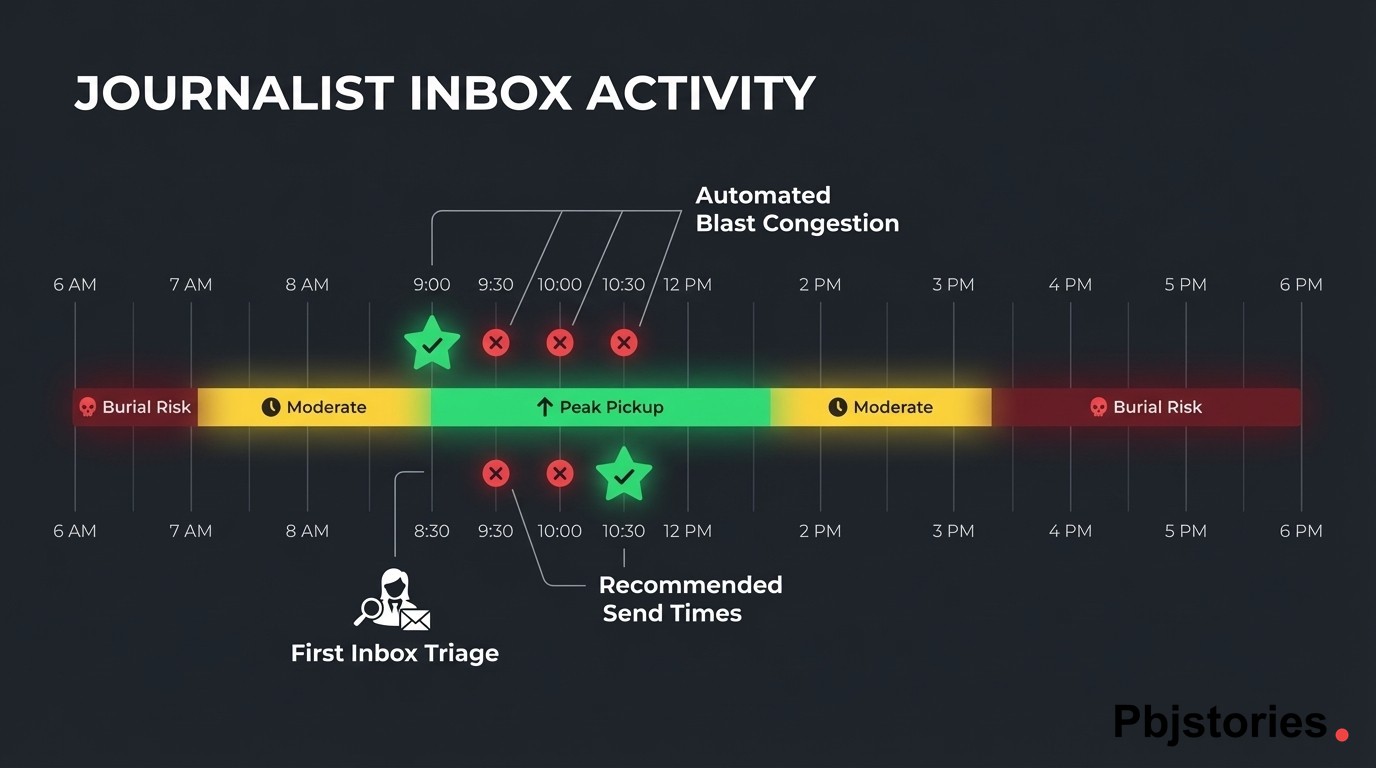
Journalist workflow patterns and distribution data from major wire services point to a clear window: between 9 AM and 12 PM on Tuesday through Thursday. This range consistently produces the highest open rates and media pickup.
Most journalists begin triaging their inboxes between 8:30 AM and 9:30 AM. Releases arriving during that first-pass window get attention before the day fills with editorial meetings, interviews, and filing deadlines. By early afternoon, reporters shift from sourcing stories to writing them.
Sending before 7 AM risks burial under overnight emails that pile up from international senders and automated systems. Sending after 3 PM is equally problematic because newsroom staff are focused on closing stories, not evaluating new pitches.
One small but effective tactic: avoid sending at exactly :00 or :30 minute marks. Thousands of automated wire service blasts and scheduled emails fire at those timestamps, creating inbox congestion. Sending at off-times like 9:07 AM or 10:22 AM places your release slightly outside that cluster, improving the chance a journalist actually sees the subject line.
Time Zone Adjustments for National and International Distribution
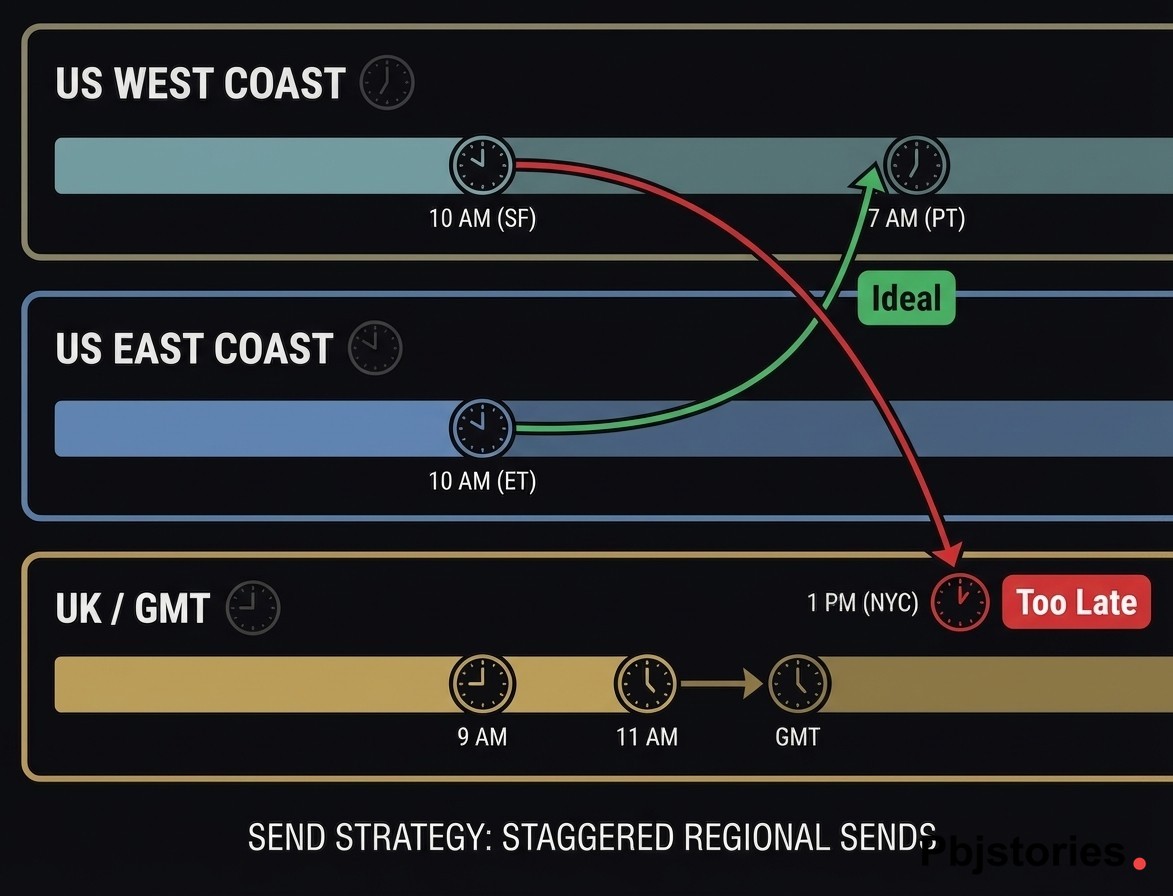
Timing should always be based on the recipient's time zone, not the sender's location. A 10 AM send from a San Francisco office hits New York journalists at 1 PM, well past peak inbox hours.
For US national distribution, 10 AM Eastern Time is the standard benchmark. It reaches East Coast media during prime hours and lands in West Coast inboxes at 7 AM as reporters start their day. UK-based media operates on a different cycle entirely, with the optimal window falling between 9 AM and 11 AM GMT.
Campaigns targeting multiple regions benefit from staggered sends rather than a single global blast. Platforms like PBJ Stories distribute to 500+ outlets across time zones, making regional scheduling far more manageable than manual sends.
Best Day of the Week to Send a Press Release
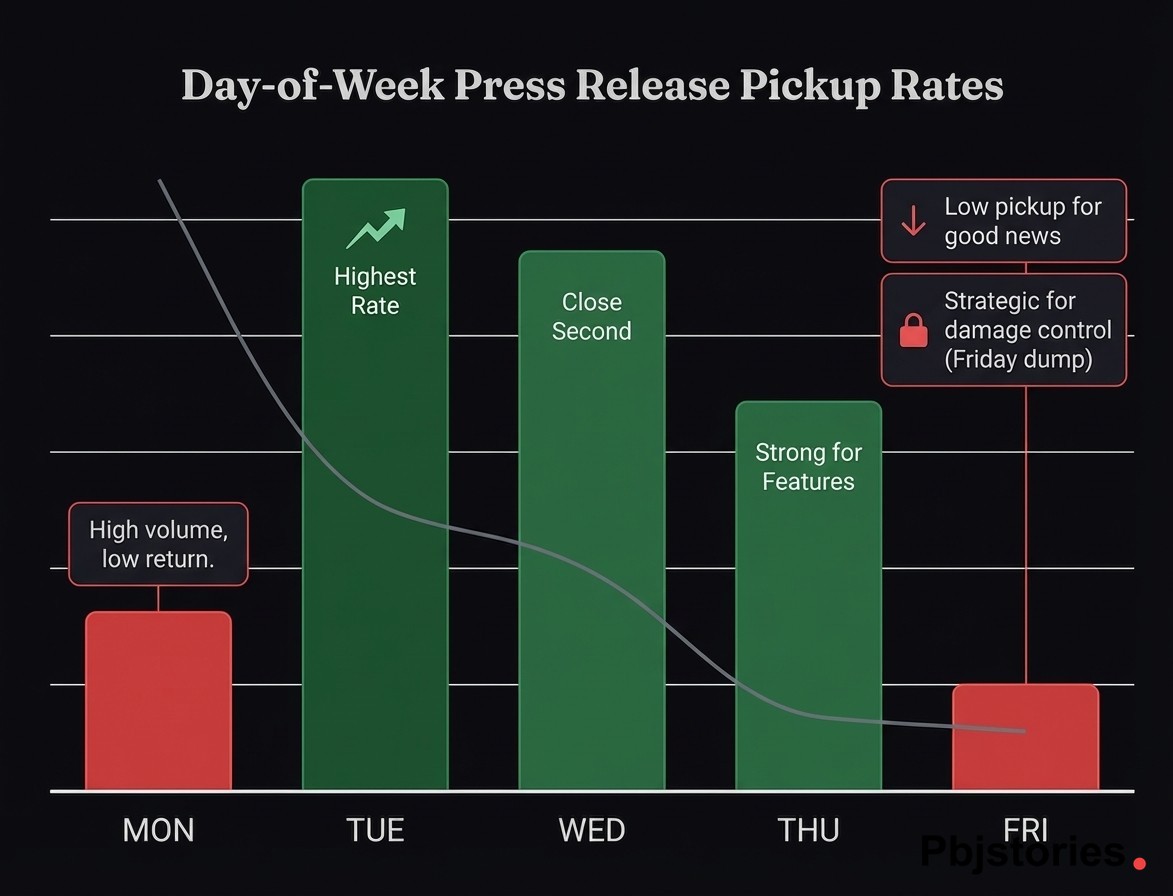
Tuesday, Wednesday, and Thursday deliver the strongest results. Tuesday consistently ranks as the single best day to send a press release because journalists have cleared their Monday backlog and are actively seeking stories to develop throughout the week.
Distribution data from major wire services reveals a counterintuitive pattern: Monday and Friday see the highest volume of press releases but produce the lowest pickup rates per release. Competition is fiercer on those days, and journalists are either catching up from the weekend or winding down toward it.
Thursday holds particular strength for feature stories and weekend-edition coverage, as editors finalize Friday and Saturday plans mid-week. The gap between Tuesday and Wednesday performance is marginal, though. A compelling, newsworthy story sent on Wednesday will outperform a weak announcement sent on Tuesday every time.
Why Monday and Friday Press Releases Get Buried
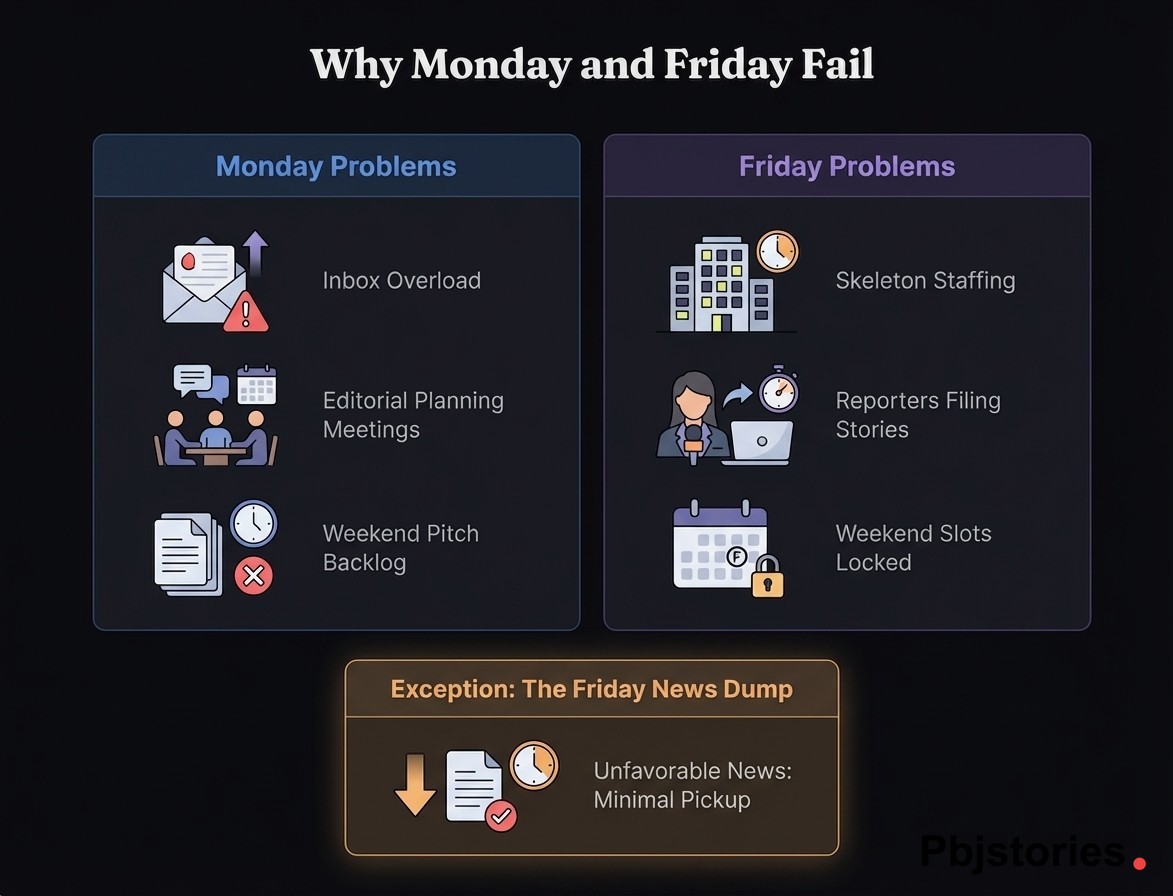
Monday inboxes overflow with weekend pitches, internal newsletters, and automated alerts. Assignment editors spend Monday mornings in editorial planning meetings, mapping the week's coverage rather than sourcing new stories. Your release sits buried beneath dozens of competing messages before anyone triages it.
Friday presents the opposite problem. Newsrooms shift to skeleton staffing by early afternoon, and reporters focus on filing final stories rather than picking up new leads. Weekend coverage slots are typically locked in by Thursday.
One deliberate exception exists: the "Friday news dump." Organizations in political and corporate communications sometimes release unfavorable news on Friday afternoons specifically to minimize pickup. Reduced staffing and lower audience attention make this tactic effective for damage control.
Using Slow News Days Strategically
Slow news periods like weekends, holiday weeks, and late August create less competition for journalist attention. Editors still need to fill coverage slots, so they actively search for stories during quiet cycles rather than waiting for pitches to arrive.
This approach works best for feature-style or evergreen announcements. A community initiative, human-interest angle, or trend piece gains traction when breaking news isn't dominating the cycle. Hard news or time-sensitive releases, however, lose urgency if held for a slow period.
How Far in Advance to Send a Press Release Before an Event
The ideal lead time depends entirely on media type and announcement category:
- Print outlets require 3–4 weeks advance notice for editorial calendars and production cycles
- Digital and online publications work well with 1–2 weeks
- Broadcast and radio typically need 1–2 weeks, along with audio assets or confirmed interview availability
For product launches, send embargoed pitches to tier-one journalists 2–3 weeks before the announcement, followed by a public release on launch day. For events specifically, distribute the release 2–3 weeks out, then send a follow-up reminder 3–5 days before the date so producers can lock in crew scheduling.
The embargo strategy ties all of this together. Sending under embargo gives journalists preparation time while ensuring coverage publishes simultaneously on announcement day. This coordinated timing turns a single announcement into a concentrated wave of coverage rather than a slow trickle.
Seasonal and Monthly Timing for Press Release Coverage
January and September are the strongest months for press release pickup in 2025 and beyond. Journalists return from holiday and summer breaks actively seeking fresh stories, and editorial calendars reset across most publications.
Late November through December is generally weak because holiday coverage dominates newsrooms and staffing drops. Mid-summer, particularly July and early August, is similarly quiet. However, that reduced competition creates opportunity for feature-style stories that would otherwise get buried during heavier news cycles.
Beginning-of-month sends tend to outperform end-of-month sends. Editors plan content calendars in the first two weeks and have more flexibility before coverage slots fill up.
Industry-specific patterns matter too. Retail PR peaks in September and October to secure holiday product coverage. Tech PR aligns around CES in January and major product cycle announcements. Healthcare PR ties to national awareness months like Heart Health in February or Breast Cancer Awareness in October.
Wire Distribution vs. Direct Journalist Pitching: How Timing Differs
Wire services like PR Newswire and Business Wire syndicate releases broadly and instantly, while direct pitching targets specific reporters with personalized emails. These two approaches demand different timing strategies.
Wire distribution offers less scheduling flexibility because your release publishes the moment it goes live, competing with every other release sent that minute. This makes the off-rounded-time tactic and the Tuesday-through-Thursday window even more critical.
Direct pitches allow far greater nuance. You can email a specific reporter at 8 AM knowing their beat schedule, then follow up two to three days later with additional assets. A personal email to the right journalist at the right time consistently outperforms a wire blast to hundreds of generic contacts.
Most PR professionals use both methods together. Wire distribution provides broad syndication to outlets including Google News and Yahoo Finance, generating search visibility that lasts beyond the initial news cycle. Direct pitches to key reporters then drive deeper, more detailed coverage. For a full comparison of wire services and their pricing, see our best press release distribution services guide.
Common Press Release Timing Mistakes to Avoid
Even strong announcements fail when basic scheduling errors undermine distribution. The most frequent mistakes include:
- Sending at :00 or :30 timestamps, when automated blasts create peak inbox congestion
- Defaulting to your own time zone instead of the recipient's
- Launching on the same day as a major event like CES or SXSW
- Skipping follow-up entirely, which means your release is forgotten within hours
- Treating every announcement identically, when a funding round, community fundraiser, and product recall each demand different lead times
Follow up 2–3 business days later with a brief, personalized note offering additional assets: quotes, data, or interview access. Following up the same day risks irritating reporters. And would you send a product recall the same way you send a fundraiser announcement? Different stories require different distribution strategies.
Press Release Timing Quick-Reference Table
| Factor | Best | Acceptable | Avoid |
|---|---|---|---|
| Time of day | 9 AM–11 AM | 8 AM–2 PM | Before 7 AM, after 3 PM |
| Day of week | Tuesday–Wednesday | Thursday | Friday afternoon, Monday morning |
| Season | January, September, early Q1/Q3 | Most months | Late December, mid-July |
| Lead time for events | 2–4 weeks | 1 week | Same day |
These benchmarks improve your odds, but they never override fundamentals. A well-written release sent to the right journalist on a Thursday will outperform a weak pitch timed perfectly on Tuesday. Strong content and genuine reporter relationships consistently matter more than any scheduling tactic.
Press Release Timing FAQ
Is Friday a Good Day to Send a Press Release?
Friday is generally the worst day for positive news. Journalists are finalizing weekly coverage, and newsroom staffing drops significantly by afternoon, so fewer reporters are available to pick up new stories. The deliberate exception is the "Friday news dump," where organizations release unfavorable news on Friday afternoon specifically to minimize media attention.
Should I Send a Press Release Before or After an Event?
Send before the event, typically 1–4 weeks in advance depending on media type. Pre-event releases give journalists time to plan coverage, schedule interviews, and assign camera crews. A post-event follow-up release featuring results, quotes, and photos can then generate a second wave of coverage. See our event press release guide for a full walkthrough.
What Time Zone Should I Use When Sending a Press Release?
Always use the recipient's time zone, not the sender's. For US national distribution, 10 AM Eastern Time is the standard benchmark. It catches East Coast journalists at peak hours while reaching West Coast media at 7 AM. For international campaigns, stagger sends by region or prioritize the time zone of your primary target audience.
Does Sending at a Non-Rounded Time Actually Help?
Yes, but the effect is marginal. Wire services and email automation tools default to :00 and :30 timestamps, so dozens of releases hit journalist inboxes simultaneously. Sending at off-times like 9:12 AM or 10:23 AM places your release outside that cluster, improving visibility. Strong content and targeted distribution still matter far more.
What Is the Worst Time to Send a Press Release?
The clearest dead zones are Friday after 2 PM, holiday weekends, before 7 AM on any day, and during major breaking news events. Competing with massive industry conferences like CES or SXSW, or earnings season for public companies, will drown out smaller announcements. Plan around these windows rather than hoping your story cuts through the noise.
Timing your press release correctly is only half the equation. The other half is making sure your announcement actually reaches the right outlets and ranks for the keywords your audience is searching. PBJ Stories combines AI-powered writing with SERP-driven keyword targeting and distribution to 500+ high-authority news sites, including Google News and Yahoo Finance, so your release lands in journalist inboxes at the right moment and keeps working long after the send.
Whether you're a startup founder skipping the agency retainer or an SEO team building contextual backlinks at scale, PBJ Stories handles the full workflow: write, optimize, distribute. Put your timing strategy into action and get your press release distributed where it matters most.
Get PR tips delivered weekly
Join 3,200+ PR professionals getting actionable tips on press release writing, distribution, and media outreach.
No spam. Unsubscribe anytime.