
A press release is a formal written announcement sent to journalists and media outlets to communicate newsworthy information about an organization. Despite being one of the oldest tools in public relations, it remains the standard format that newsrooms worldwide expect when receiving corporate news, product updates, or event announcements. Yet most releases fail to earn coverage because they ignore the structural conventions and editorial expectations journalists rely on.
The gap between sending a press release and actually getting published often comes down to format, newsworthiness, and distribution strategy. Many organizations, from startups to nonprofits, treat press releases as marketing copy rather than news documents. That disconnect leads to immediate rejection from editors who scan hundreds of pitches daily.
Understanding the anatomy of a press release, the different types suited to specific announcements, and the distribution channels that actually reach newsrooms separates a release that generates coverage from one that gets deleted. The sections below break down the standard format element by element, walk through a fully annotated example, and cover practical guidance on writing, distributing, and choosing the right PR communication format.
What Is a Press Release and Why Does It Matter?
A press release is an official statement issued by an organization to news media, announcing something newsworthy for public distribution. It serves four core purposes: informing journalists, building public awareness, creating an official record of the announcement, and establishing organizational credibility.
The range of organizations that rely on press releases is broad. Startups, Fortune 500 corporations, government agencies, nonprofits, independent artists, and event organizers all use them to reach the public through media channels. Public companies face an additional obligation because SEC disclosure rules require them to issue press releases for material events such as quarterly earnings reports and merger agreements.
You may also see the term media release used interchangeably. Both refer to the same document. "Media release" is simply the preferred term in Australia and several European markets.
Journalists generally treat press releases as "organizations reporting on themselves." The release functions as a jumping-off point for coverage, not a finished story. Reporters verify claims, seek additional sources, and reshape the narrative for their audience.
And that distinction matters. A well-structured press release does not guarantee publication. It earns a journalist's attention long enough to spark genuine coverage.
Standard Press Release Format: Key Elements Explained
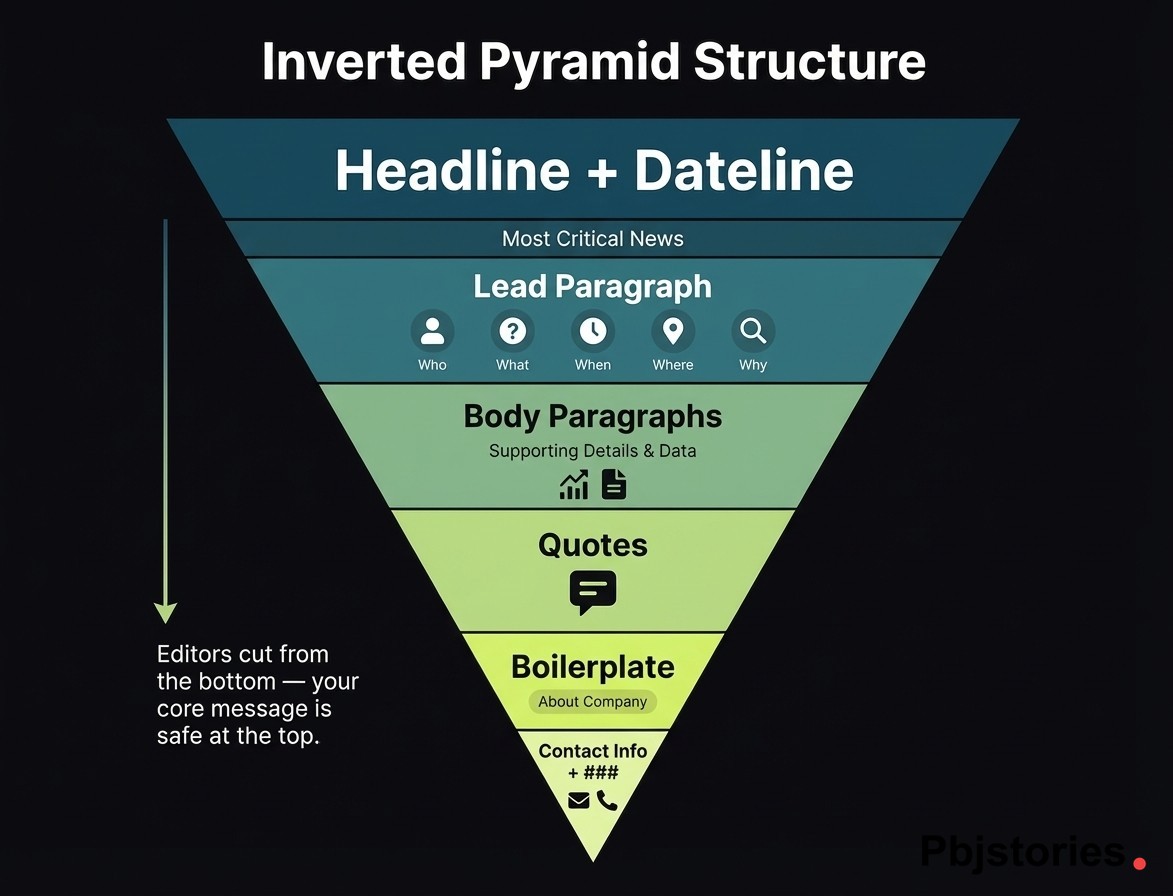
The standard press release format follows the inverted pyramid structure borrowed from journalism, placing the most critical news at the top and arranging supporting details in descending order of importance. Editors often cut from the bottom, so this structure ensures the core message survives editing.
AP style governs press release writing conventions across the United States.
Headline, Dateline, and Lead Paragraph
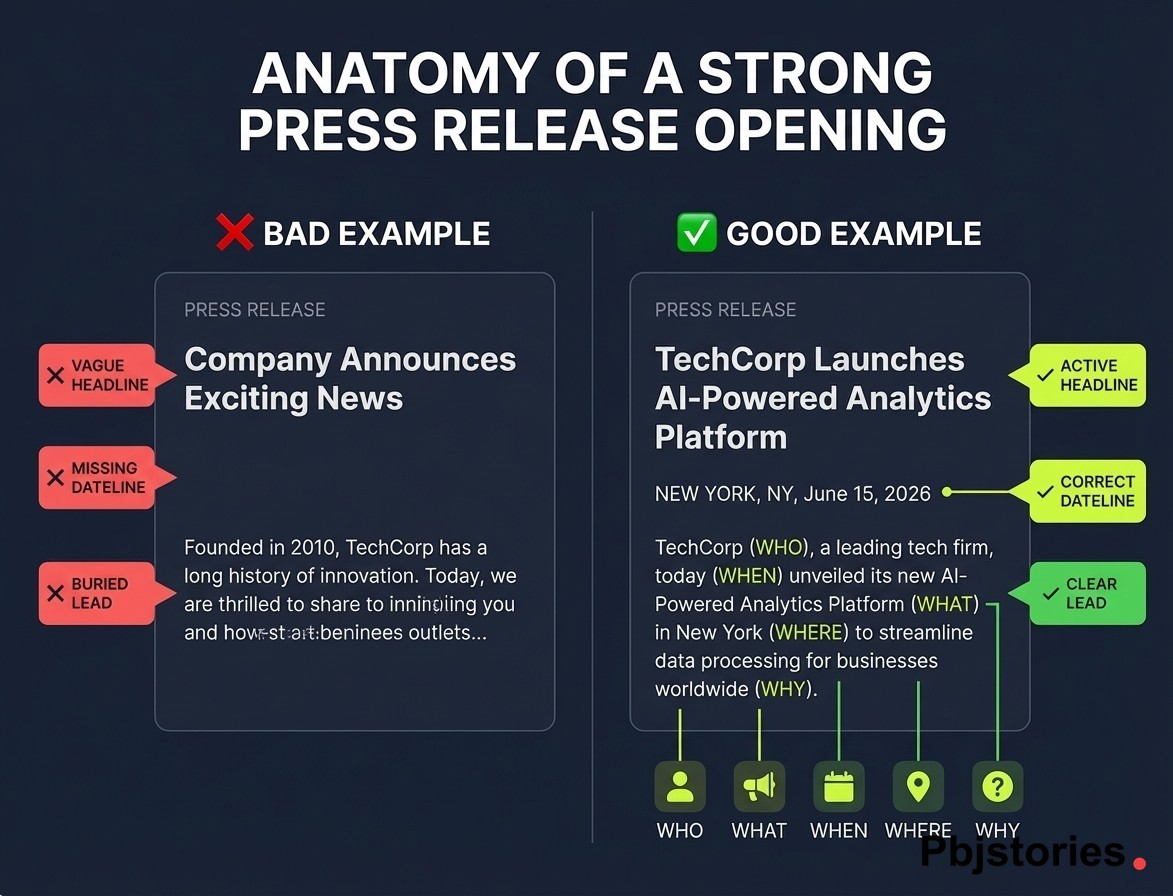
The headline summarizes the news in a clear, factual statement using active voice, typically under 10 words. Avoid clickbait or promotional language because journalists expect straightforward titles they can adapt for their own stories.
The dateline appears at the start of the first paragraph and signals where the news originates and when it was issued. It follows a standard format: city and state abbreviation, then the release date (e.g., NEW YORK, NY, June 15, 2026). Wire services and newsrooms rely on the dateline to confirm timeliness and geographic relevance.
The lead paragraph answers who, what, when, where, and why in two to three sentences. This is the paragraph journalists scan first to decide whether to continue reading or move on. A weak lead that buries the actual news will get the entire release deleted. For a visual breakdown of how these elements fit together, see our press release template.
Body, Quotes, Boilerplate, and Contact Information
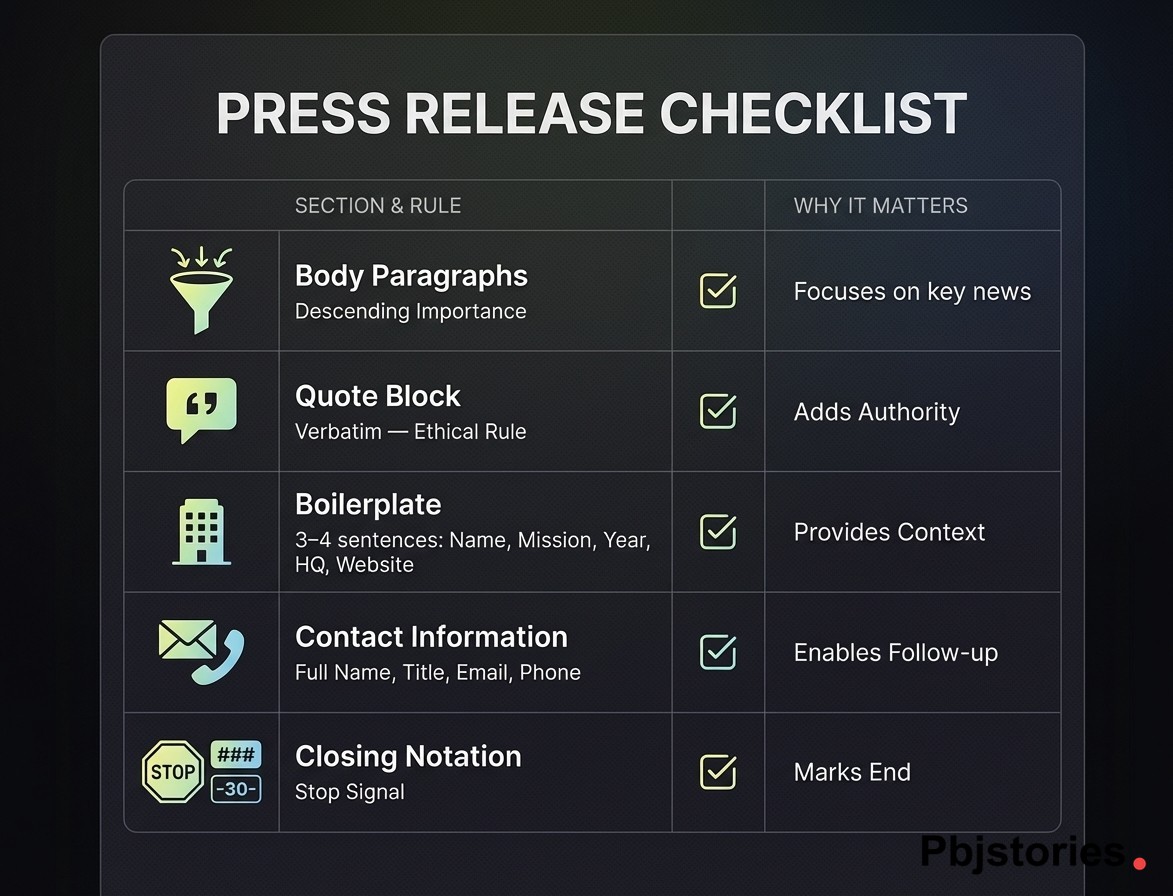
The body paragraphs expand on the lead with supporting details, context, and data points. Arrange information in descending order of importance so the core message stays intact even after editorial cuts.
Quotes, typically one or two, come from a company executive or spokesperson. They add a human voice and opinion that journalists cannot ethically rewrite, making them one of the few elements carried into coverage verbatim.
What is a boilerplate in a press release? It is the standard "About [Company]" paragraph placed at the end. A boilerplate includes the company name, mission, founding year, headquarters location, and website. Keep it to 3-4 sentences and reuse it consistently across every release.
Contact information follows the boilerplate: full name, title, email, and phone number of the designated media contact.
Finally, the closing notation, either the ### symbol or -30-, signals the document's end. This convention dates back to telegraph-era journalism, when operators needed a clear stop signal.
Types of Press Releases for Business, Music, Events, and More
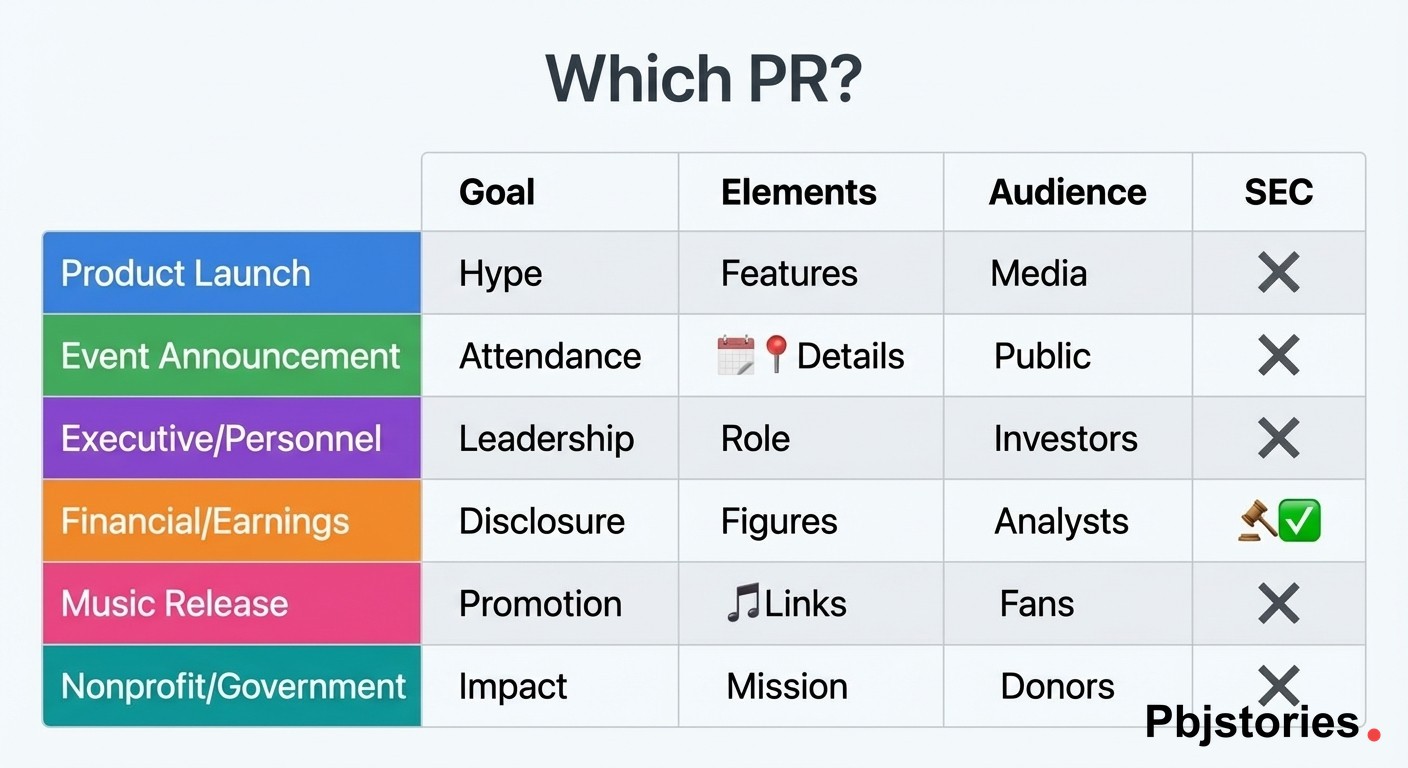
Organizations use several distinct types of press releases, though the standard format remains consistent across all of them. Only the subject matter changes.
Product or service launch: Announces new offerings to generate media coverage and consumer interest.
Event press release: Promotes conferences, fundraisers, grand openings, or community gatherings, always including date, time, and location details.
Executive and personnel announcement: Introduces new C-suite hires, board members, or key departures that signal strategic direction.
Financial and earnings release: Publicly traded companies report quarterly or annual results, required by SEC disclosure regulations.
Crisis or response release: Addresses negative events like recalls, data breaches, or public controversies with an official organizational stance.
Partnership and merger announcement: Joint releases issued by two or more organizations to announce collaborations or acquisitions.
Music press release: Independent artists announce album drops, book launches, gallery openings, or festival appearances. Traditional newsrooms rarely cover indie releases, so these typically target music blogs, playlist curators, and niche publications.
Each type follows the same inverted pyramid structure. A press release template works for any category with minor adjustments to the subject matter and target audience.
Annotated Press Release Example
Below is a fictional but realistic press release with each structural element labeled inline.
[HEADLINE] Greenline Energy Opens 50-MW Solar Farm in Austin
[DATELINE] AUSTIN, TX, June 15, 2026
[LEAD PARAGRAPH] Greenline Energy today announced the completion of a 50-megawatt solar farm in East Austin, expected to power 12,000 homes annually. The facility begins commercial operation on July 1, 2026, following two years of construction and $85 million in investment.
[BODY] The project uses bifacial solar panel technology to increase energy yield by 15% compared to conventional single-sided modules. Travis County approved the development in 2024 as part of its renewable infrastructure initiative.
[QUOTE] "This farm moves Austin closer to its 2030 clean energy goals while creating 200 permanent jobs in the region," said Maria Chen, CEO of Greenline Energy.
[BOILERPLATE] About Greenline Energy: Founded in 2018 and headquartered in Austin, TX, Greenline Energy develops utility-scale solar projects across the American Southwest. Learn more at greenline-energy.com.
[CONTACT INFO] Media Contact: James Okoro, PR Director, james@greenline-energy.com, (512) 555-0199
[CLOSING] ###
This example works because the lead answers who, what, when, where, and why in two sentences. The quote adds perspective a journalist cannot rewrite, and the boilerplate establishes credibility with founding year, location, and scope.
How to Write and Distribute a Press Release
Writing a strong release and getting it in front of the right journalists are two separate skills. Both must work together, since even a perfectly formatted announcement fails if distribution misses the mark.
Writing Tips: Newsworthiness, Conciseness, and Common Mistakes
Before drafting, apply a simple filter: if the announcement would not interest someone outside the organization, it probably should not be a press release. Journalists receive hundreds of pitches daily, so only genuinely newsworthy content survives the first scan.
Keep the release to 400-600 words, roughly one page. Write in third person using past or present tense, and follow AP style conventions for dates, numbers, and abbreviations. For detailed guidance on length, see how long a press release should be.
Several common mistakes get releases deleted immediately:
- Burying the actual news below three paragraphs of company history
- Using excessive superlatives like "revolutionary" or "industry-leading"
- Sending to journalists who cover an unrelated beat
- Attaching a PDF instead of pasting the full text in the email body
Targeting the right press release keywords in the headline and lead paragraph improves discoverability across search engines and news aggregators. AI writing tools can accelerate early drafts, but human editing remains essential. Tone, factual accuracy, and journalist expectations require judgment that automated systems frequently miss.
Distribution Channels: Wire Services, Direct Outreach, and Digital Platforms
Wire services like Business Wire, PR Newswire, and Cision syndicate releases to hundreds of outlets simultaneously. This broad reach suits publicly traded companies that must meet SEC disclosure requirements, but costs typically range from $400 to $1,500+ per release.
Direct journalist outreach delivers stronger earned media results because personalized emails build real relationships with beat reporters. The tradeoff is time: researching the right contacts and tailoring each pitch demands significant effort.
AI-powered distribution platforms offer a middle ground, publishing to 250-500+ outlets including Google News and Yahoo Finance at lower cost than traditional wire services. PBJ Stories operates in this category, combining keyword optimization with broad syndication.
Sharing the release on LinkedIn, X (formerly Twitter), and your company newsroom extends visibility beyond traditional media channels.
One critical distinction often missed: "guaranteed placement" services that publish to low-quality content farms are not earned media. Syndication means paid distribution. Organic pickup, where a journalist independently covers your story, carries far more credibility and SEO value.
Press Release vs. Media Advisory vs. Pitch
These three PR communication formats serve different purposes, and using the wrong one wastes both your time and the journalist's.
A press release is a complete written story ready for publication, typically 400-600 words, delivering the full news with quotes, context, and a boilerplate. Use it for announcements: product launches, executive hires, earnings reports.
A media advisory is a short, bullet-point invitation alerting reporters to an upcoming event. It covers who, what, when, and where in under 200 words, with no narrative. Use it to drive attendance, not tell a story.
A media pitch is a personalized email to a specific journalist proposing an exclusive story angle. It focuses on persuasion rather than information, so it is never intended for publication. Use it when you want tailored coverage from a particular outlet. For more on crafting effective outreach, see these press release tips.
Frequently Asked Questions About Press Releases
What Is the Purpose of a Press Release?
A press release informs news media about newsworthy events so journalists can develop coverage for their audiences. Beyond media outreach, it builds public awareness, establishes organizational credibility, and creates an official record of the announcement. Common use cases include product launches, executive hires, quarterly financial results, crisis communication, and community initiatives.
How Long Should a Press Release Be?
The industry standard is 400-600 words, roughly one page. Journalists prefer concise releases and skip lengthy ones. Place the most critical information in the first paragraph, following the inverted pyramid. For deeper guidance, see our press release length breakdown.
Do Press Releases Help with SEO?
Direct ranking benefit is limited because wire service links are typically nofollow. However, press releases generate brand mentions and increase entity visibility across authoritative domains like Google News and Yahoo Finance. This contributes to entity stacking and Knowledge Panel signals over time.
Earned media coverage triggered by a release carries stronger SEO value than the syndication itself. Avoid using press releases solely as a link-building tactic. Instead, strategic keyword targeting in the headline and lead improves discoverability across high-authority outlets.
What Is a Press Release Embargo?
An embargo is a request that media not publish information before a specified date and time. Organizations use embargoes to give journalists preparation time so coverage launches simultaneously, maximizing impact. Embargoes rely on trust and professional norms, not legal obligation. Breaking one damages a source's relationship with media permanently, so only share embargoed materials with journalists you have an established relationship with.
Can I Write a Press Release Without a PR Agency?
Yes. Anyone can write a press release by following the standard format. Templates and AI writing tools lower the barrier significantly for startups and small businesses. A PR agency adds value through established media relationships, strategic positioning, and direct journalist access, which matters most for high-stakes announcements like mergers or crisis responses. For routine news, PBJ Stories handles writing, keyword optimization, and distribution without agency retainer costs.
Whether you need to announce a product launch, secure media coverage, or build entity visibility across authoritative news domains, the process starts with a well-written release distributed to the right outlets. Getting that combination right is what separates press releases that generate results from those that disappear into the noise.
PBJ Stories simplifies the entire workflow by combining AI-powered writing in AP style with SERP-driven keyword optimization and distribution to 500+ news outlets, including Google News and Yahoo Finance. If you want to skip the agency retainer and still get professional-grade press releases that rank, get started with PBJ Stories and see what consistent, targeted distribution can do for your brand.
Get PR tips delivered weekly
Join 3,200+ PR professionals getting actionable tips on press release writing, distribution, and media outreach.
No spam. Unsubscribe anytime.