
Press release keywords determine whether your announcement gets discovered by journalists, picked up by news aggregators, or buried under thousands of competing stories. Distribution platforms, Google News, and Yahoo Finance rely on keyword matching to surface relevant content to readers actively searching for it.
Yet many companies treat keyword selection as an afterthought, copying phrases from their website SEO strategy and pasting them into a press release without adjusting for newsworthiness or audience intent. The result is poor visibility, zero media pickups, and wasted distribution spend.
Choosing the right keywords for a press release requires a different approach than blog or landing page optimization. From researching phrases that match journalist search behavior to placing them where distribution algorithms actually look, every decision affects whether your release reaches its intended audience or disappears within hours.
Why Press Release Keywords Still Matter in 2026
Google treats most press release links as nofollow, so direct SEO link value is minimal. Yet keywords remain the primary discoverability mechanism across distribution platforms, Google News, and news aggregators where journalists and consumers actively search for stories.
Press release keywords serve a dual audience. Journalists search industry terms, company names, and trending topics to find stories worth covering. Consumers search product categories and problem-solution phrases. The keywords you choose determine which group finds your release.
The indirect SEO value is where the real payoff happens. Media pickups from well-targeted releases generate organic dofollow backlinks, social sharing, and brand mentions. These entity signals strengthen Knowledge Panel presence and E-E-A-T because search engines interpret consistent brand references across authoritative news sources as trust indicators.
Not everything has to be about SEO. Good public relations still works. Keywords are a discoverability tool, not a link-building hack.
There is also a local angle. Press releases distributed to regional outlets with location-based keywords can boost Google Business Profile visibility and drive local news pickups. A city-specific phrase often faces far less competition than a national term, giving smaller businesses a realistic path to coverage.
How to Research Keywords for a Press Release
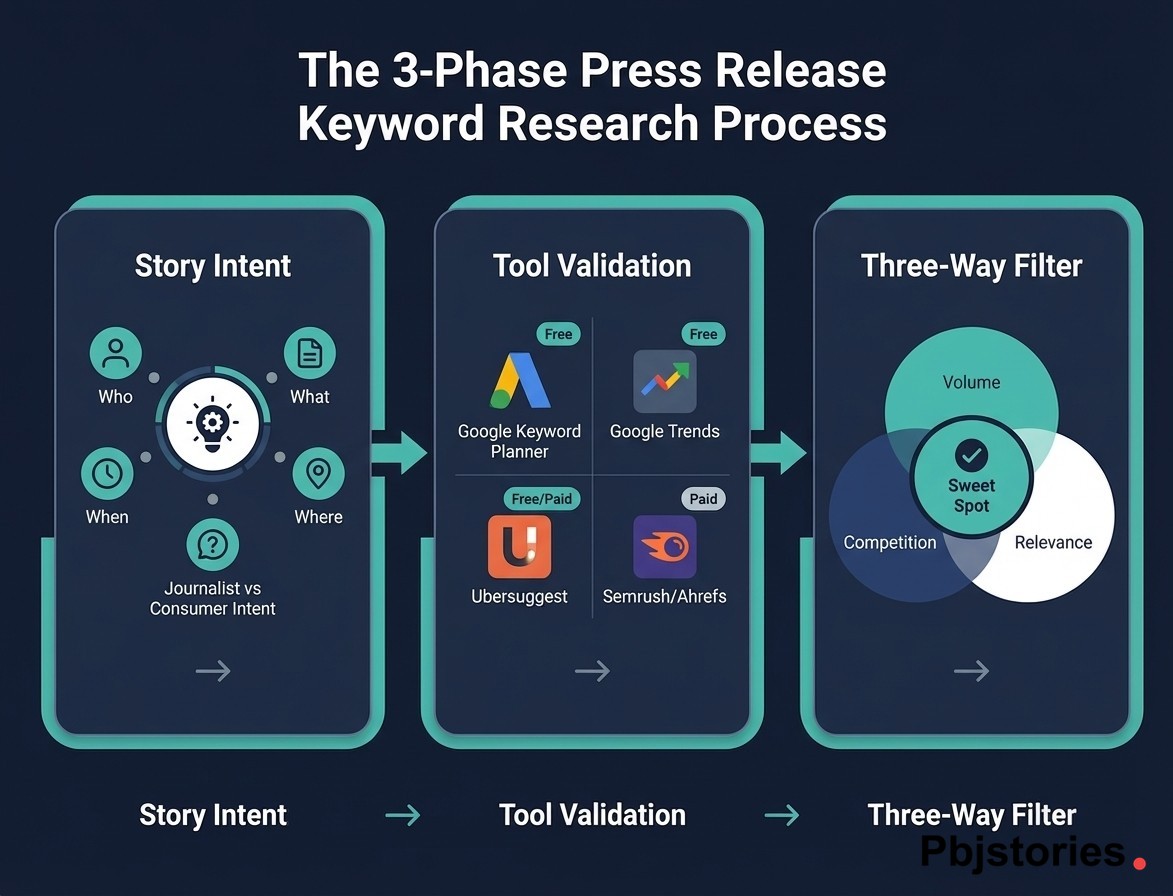
Effective keyword research follows three phases: start with your story intent, validate phrases using research tools, then filter candidates by balancing volume, competition, and relevance.
Start with Your Story and Audience Intent
Keyword research for a press release begins with the news angle, not a keyword tool. Before opening any software, ask two questions: what would a journalist type into Google to find this story, and what would a potential customer search?
The 5 W's (who, what, when, where, why) serve as a natural keyword generation framework. Every news angle contains searchable entities: company names, product categories, locations, and industry terms. Answering each question surfaces the core phrases real people use.
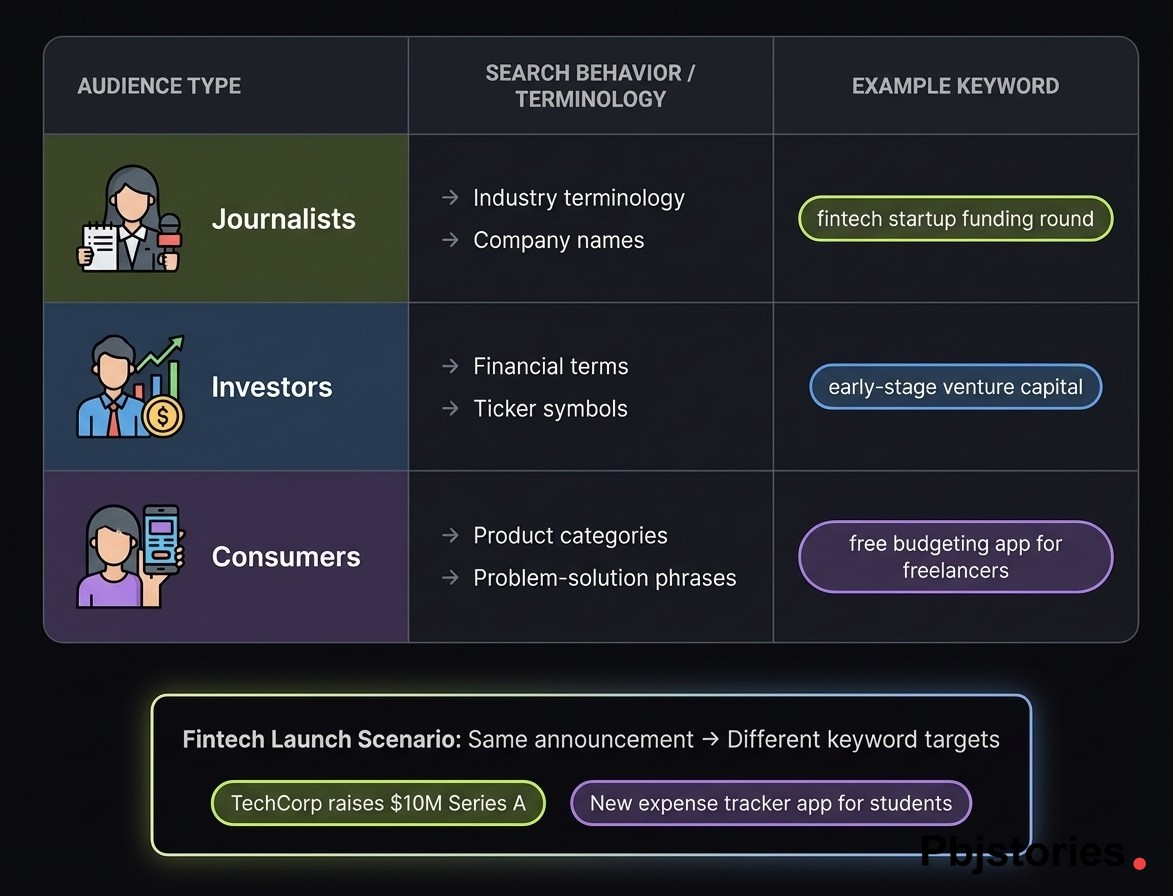
Different audiences search differently. Journalists use industry terminology and company names. Investors look for financial terms and ticker symbols. Consumers search for product categories and problem-solution phrases.
Consider a fintech startup launching a budgeting app. A journalist might search "fintech startup funding round," while a consumer types "free budgeting app for freelancers." The same announcement produces entirely different keyword targets depending on which audience you prioritize.
Use Keyword Research Tools to Refine Your List
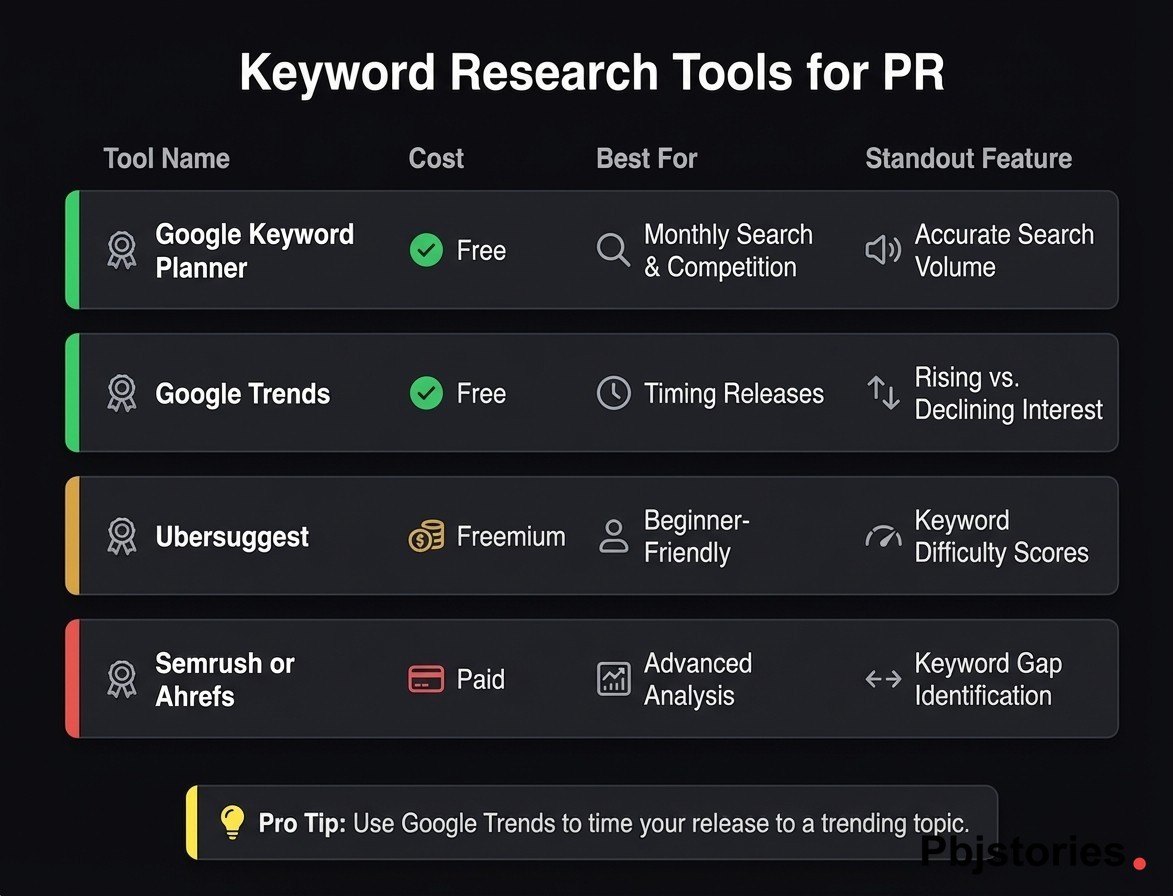
Once you have a brainstormed list from your story angle, validate those phrases with data. Four tools cover most needs:
Google Keyword Planner (free): shows monthly search volume and competition level
Google Trends (free): confirms whether a topic is rising or declining in interest
Ubersuggest (freemium): beginner-friendly interface with keyword suggestions and difficulty scores
Semrush or Ahrefs (paid): advanced SERP competition analysis and keyword gap identification
Google Trends deserves special attention for press releases because it reveals timing. A phrase trending upward signals active public interest, which aligns directly with the newsworthiness journalists and editors look for.
Focus your refinement on long-tail keywords, phrases of three to five words. A press release targeting "cloud accounting software for small business" faces far less competition than one targeting "accounting software," and it matches the specific intent of someone ready to act.
Balance Search Volume, Competition, and Relevance
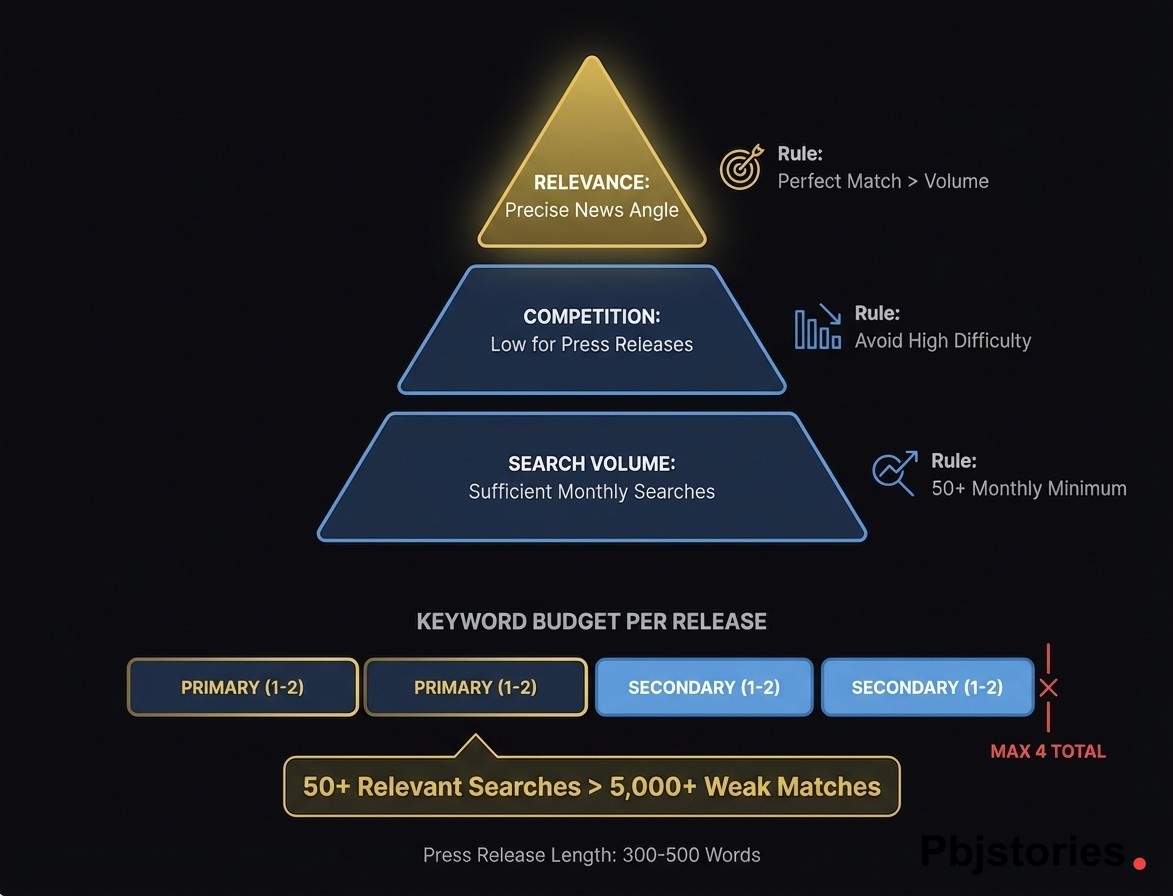
Every keyword candidate must pass a three-way filter: sufficient search volume, low enough competition for a press release to realistically surface, and direct relevance to the news angle. Relevance beats volume every time.
A keyword with 50 monthly searches that precisely matches your story will outperform a 5,000-volume term that is only tangentially related. Distribution platforms and Google News prioritize topical alignment over raw popularity.
Press releases are short-form content, typically 300-500 words. That limited word count leaves no room for keyword overload. Select 1-2 primary keywords and 1-2 secondary keywords per release. More than that dilutes your message and weakens the relevance signal for each phrase.
Where to Place Keywords in Your Press Release
The headline carries the most weight because search engines and journalists scan it first. Place your primary keyword phrase here naturally.
Compare these two versions. Bad: "Company Pleased to Announce Exciting New Product Launch." Good: "Acme Launches Cloud Accounting Software for Small Business Owners." The optimized headline contains a searchable keyword phrase while the original relies on cliches with zero search value.
Your lead paragraph should reinforce the primary keyword within the first 100 words, since both Google News and distribution platforms index opening sentences heavily. The body copy needs only 1-2 additional natural mentions. Any hyperlinks should use descriptive anchor text containing relevant keywords rather than generic "click here" phrasing.
The boilerplate is often overlooked. Include your brand name and core industry terms here because this section appears on every release, building consistent entity signals over time.
Also understand the difference between keywords and tags on distribution platforms. Keywords are phrases woven into your actual content. Tags are category labels for industry, topic, and geography that platforms like PR Newswire, Business Wire, or GlobeNewswire use to categorize your release. Leaving tag fields blank limits distribution reach.
One reliable test: read the release aloud. If any keyword placement sounds forced, rewrite that sentence. For full structural guidance, see this press release writing guide.
Press Release Keyword Examples: Good vs. Bad
The difference between keyword stuffing and natural optimization becomes obvious when you compare two versions of the same announcement.
Keyword-stuffed version: "TrackFlow project management software update gives teams the best project management software update for remote team collaboration tool needs, making this project management software update the top task automation feature on the market."
Naturally optimized version: "TrackFlow released a project management software update that lets remote teams automate recurring tasks directly within shared boards. The new task automation feature reduces manual status updates by syncing deadlines across departments."
The second version reads like journalism. Each keyword appears once in context, serving the sentence rather than hijacking it. See how real companies handle this in our press release examples.
For a sample press release keywords list on this announcement: the primary keyword is "project management software update," and secondary keywords are "remote team collaboration tool" and "task automation feature."
The same news angle shifts keywords depending on the audience. B2B releases target phrases like "enterprise workflow efficiency." B2C releases target "easy project tracking app" because consumers search for usability and price.
Common Press Release Keyword Mistakes to Avoid
Repeating the same phrase 8-10 times in a 400-word release destroys readability and triggers spam filters on both search engines and distribution platforms. One primary keyword used 2-3 times is sufficient for a short-form press release.
Targeting overly broad terms is equally wasteful. A press release will never rank for "software" or "technology." Long-tail phrases like "cloud accounting software for small business" match the narrow scope of a single announcement.
Many PR professionals treat cliched language as keyword strategy. Phrases like "pleased to announce," "industry-leading," and "next-generation" have zero search volume because no journalist or consumer types them into Google.
Another overlooked error: leaving tag fields blank on distribution platforms. Tags control how platforms categorize and surface your release, so default categories limit visibility. And avoid reusing identical keywords across every release. Each announcement covers a different news angle and deserves its own keyword set. Brand name is the one exception. For broader guidance, review these press release tips.
How to Measure Keyword Performance After Distribution
Choosing press release keywords means nothing if you never check whether they drove visibility. Measurement turns keyword selection from guesswork into a repeatable system.
Google Search Console reveals impressions and clicks for your target keyword phrases within one to two weeks of distribution. Filter by the specific URLs where your release appeared to isolate performance data.
Monitor referral traffic in Google Analytics to identify which distribution platforms sent visitors to your site. This data shows where your keywords resonated most.
Then track media pickups. Journalists who republish or reference the release signal that your keyword choices matched their search behavior. These organic pickups produce earned dofollow backlinks, the indirect SEO payoff that makes press release optimization worthwhile.
PBJ Stories distributes to 500+ news outlets including Google News and Yahoo Finance, which broadens the measurable surface area for tracking keyword performance across sources.
Press Release Keywords FAQ
How Many Keywords Should I Use in a Press Release?
Use 1-2 primary keywords and 1-2 secondary keywords per release. Press releases typically run 300-500 words, so anything beyond that dilutes your message and risks keyword stuffing. Each release should focus on one clear news angle, and your keyword choices should reflect that single topic.
Do Press Release Keywords Actually Help with SEO?
Direct link value is limited because most distribution services apply nofollow tags to outbound links. However, keywords improve discoverability on Google News and distribution platforms, which drives media pickups. Those pickups produce organic dofollow backlinks from journalists who reference your story independently. Consistent keyword-optimized releases also strengthen brand entity signals, reinforcing E-E-A-T and Knowledge Panel presence over time.
What Are the Best Keyword Research Tools for Press Releases?
Google Keyword Planner provides free search volume and competition data. Google Trends is uniquely valuable for press releases because it confirms whether a topic is trending upward, aligning with newsworthiness. Ubersuggest offers a beginner-friendly freemium option, while Semrush or Ahrefs deliver advanced competitive analysis for paid users.
Should I Use Long-Tail Keywords in a Press Release?
Yes. Long-tail keywords (3-5 word phrases) carry lower competition and more specific intent. A press release about a niche topic will never rank for "software," but it can surface for a precise phrase like "cloud accounting software for small business." This specificity also matches how journalists search, since reporters covering a beat use detailed queries rather than generic terms. See how these phrases fit into standard PR structure with this press release template.
Can I Use the Same Keywords in Every Press Release?
No. Each release covers a different news angle and should target keywords specific to that story. Reusing identical phrases across releases signals repetitive, low-value content to search engines, reducing the likelihood of any single release ranking well. Your brand name is the one keyword that should remain consistent across every announcement.
Choosing the right press release keywords is only half the equation. The other half is making sure those keywords reach journalists, search engines, and readers through high-authority channels. PBJ Stories combines AI-powered writing with SERP-driven keyword research and distribution to 500+ news outlets so your releases rank for the terms that actually matter.
If you want to put your next announcement in front of the right audience, write and distribute your press release with PBJ Stories and see the difference targeted optimization makes.
Get PR tips delivered weekly
Join 3,200+ PR professionals getting actionable tips on press release writing, distribution, and media outreach.
No spam. Unsubscribe anytime.