
Knowing how to write a press release means structuring a newsworthy announcement so journalists can scan it in seconds, trust the facts, and publish it with minimal editing. Most releases fail not because the news is weak, but because the format is wrong, the lead buries the story, or the pitch never reaches the right reporter.
The difference between a release that earns coverage and one that gets deleted comes down to a handful of repeatable decisions: choosing a genuine news angle, following AP style conventions, writing quotes that sound human, and targeting journalists who actually cover your beat. Each of those decisions has a clear method behind it.
What follows is a full breakdown of press release format, annotated examples for events, product launches, and new businesses, plus distribution tactics that get your announcement in front of editors rather than lost in their inbox. Whether you are a startup founder sending your first release or a PR professional refining your workflow, every section addresses a specific part of the process from draft to delivery.
What Is a Press Release and Why Does It Still Matter?
A press release is an official written statement distributed to journalists and media outlets to announce something newsworthy. It follows AP style, uses third-person voice throughout the body, and presents facts in a format editors can publish with minimal revision.
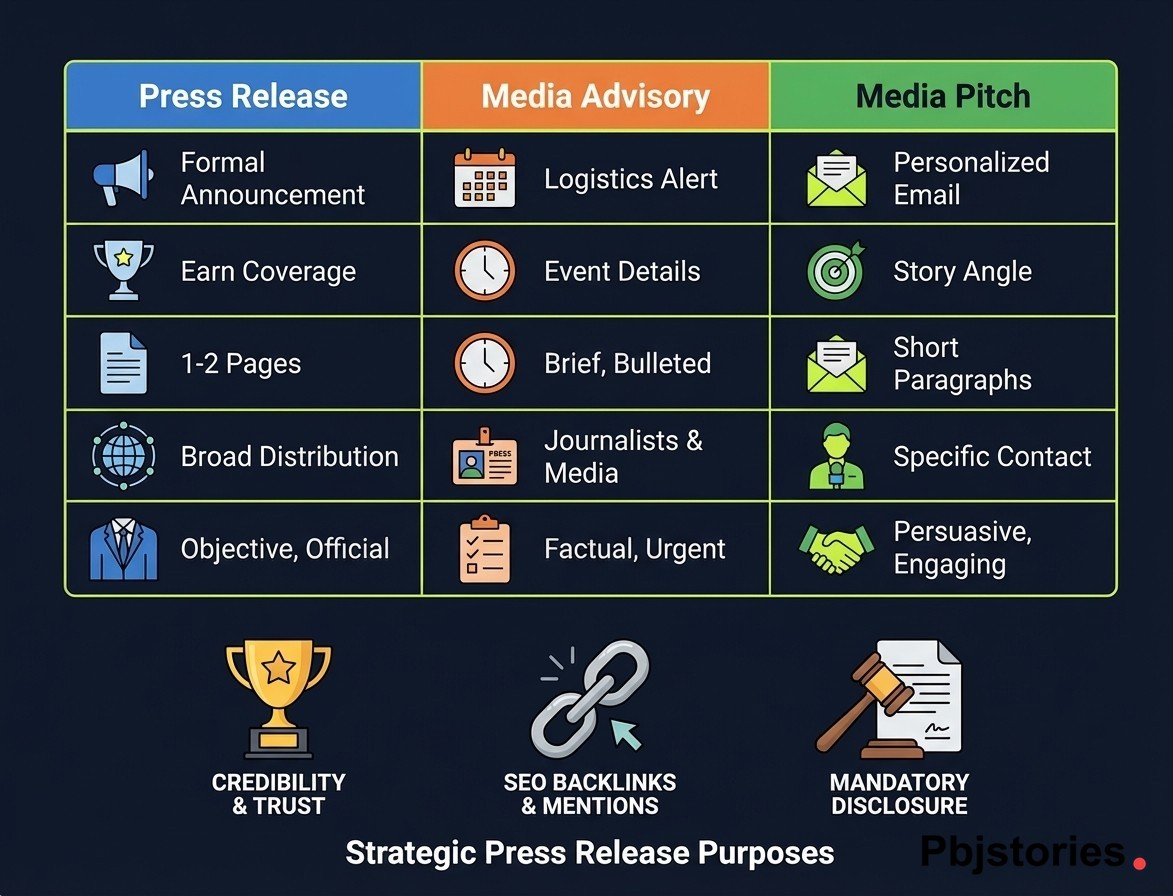
Press releases serve three strategic purposes. First, they earn media coverage and "As Seen In" credibility that builds public trust. Second, distribution through wire services and news outlets generates backlinks and brand mentions that strengthen search visibility. Third, publicly traded companies and regulated organizations use them to fulfill mandatory disclosure requirements.
Beginners often confuse three distinct PR documents. A press release is a formal announcement distributed broadly. A media advisory is a shorter logistics alert covering only the date, time, location, and key participants. A media pitch is a personalized email sent to a specific journalist explaining why a story fits their beat.
One critical distinction separates effective releases from wasted effort: a press release is not a blog post or advertisement. If the announcement lacks genuine news value, journalists will ignore it. Product launches, partnerships, research findings, and community milestones qualify. Routine company updates and self-congratulatory messaging do not.
The 7 Essential Parts of a Press Release
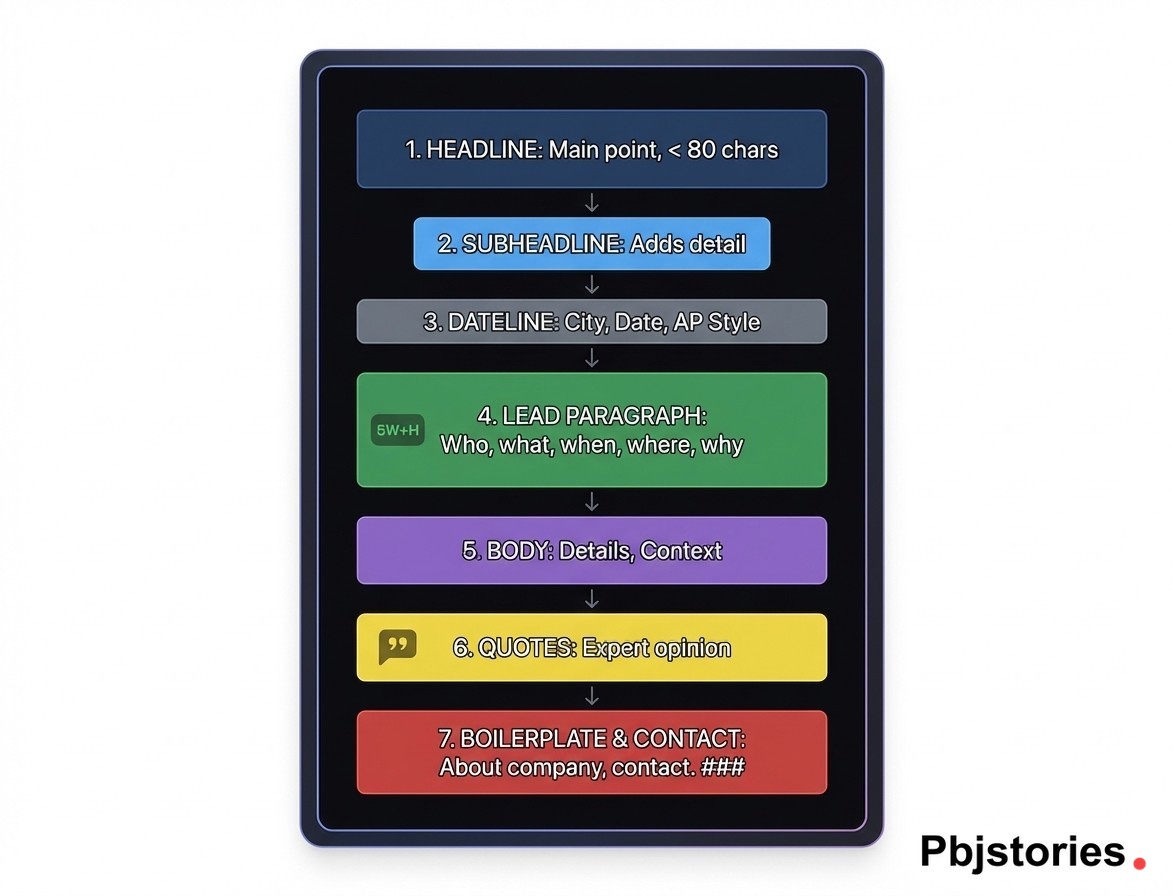
Every professionally formatted press release contains seven standard components: headline, subheadline, dateline, lead paragraph, body, quotes, and boilerplate with contact information. Each serves a distinct function that journalists expect to find in a specific order.
Headline, Subheadline, and Dateline
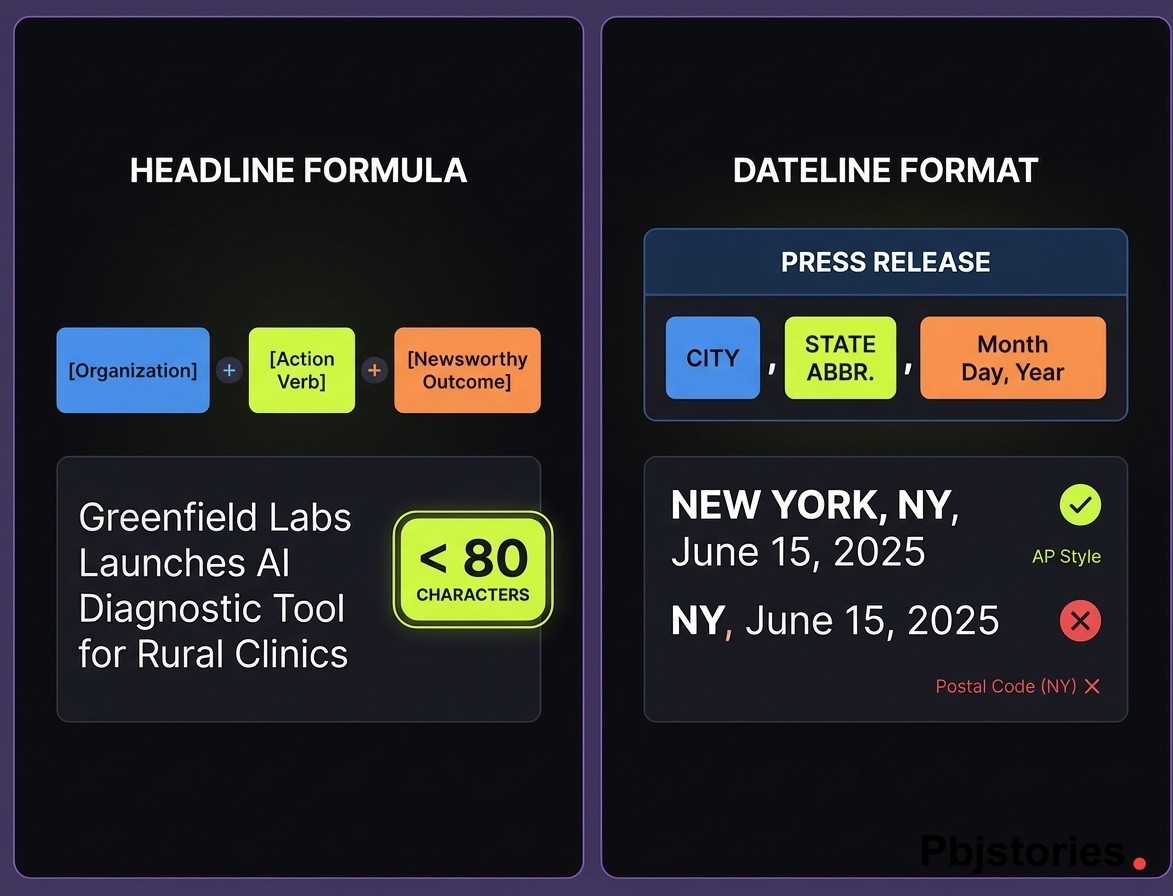
The headline summarizes the core news in a single active-voice line, ideally under 80 characters. A reliable formula follows this pattern: [Organization] + [Action Verb] + [Newsworthy Outcome]. For example: "Greenfield Labs Launches AI Diagnostic Tool for Rural Clinics." Editors scan dozens of releases daily, so vague or passive headlines get skipped immediately.
The subheadline is optional. It adds a secondary detail the headline cannot fit, such as a partnership name, availability date, or key metric. Subheadlines typically appear in italics directly below the main headline.
The dateline opens the lead paragraph and follows AP style format: CITY, STATE ABBREVIATION, Month Day, Year. For example: NEW YORK, NY, June 15, 2025. State names in datelines use standard AP abbreviations, not postal codes. Omitting or misformatting the dateline signals inexperience to editors.
Lead Paragraph and Body
The lead paragraph is the single most important part of a press release. Editors decide whether to keep reading based on it alone, so it must answer the 5W+H (who, what, when, where, why, how) in two to three sentences. Put the most newsworthy fact first, not the company background.
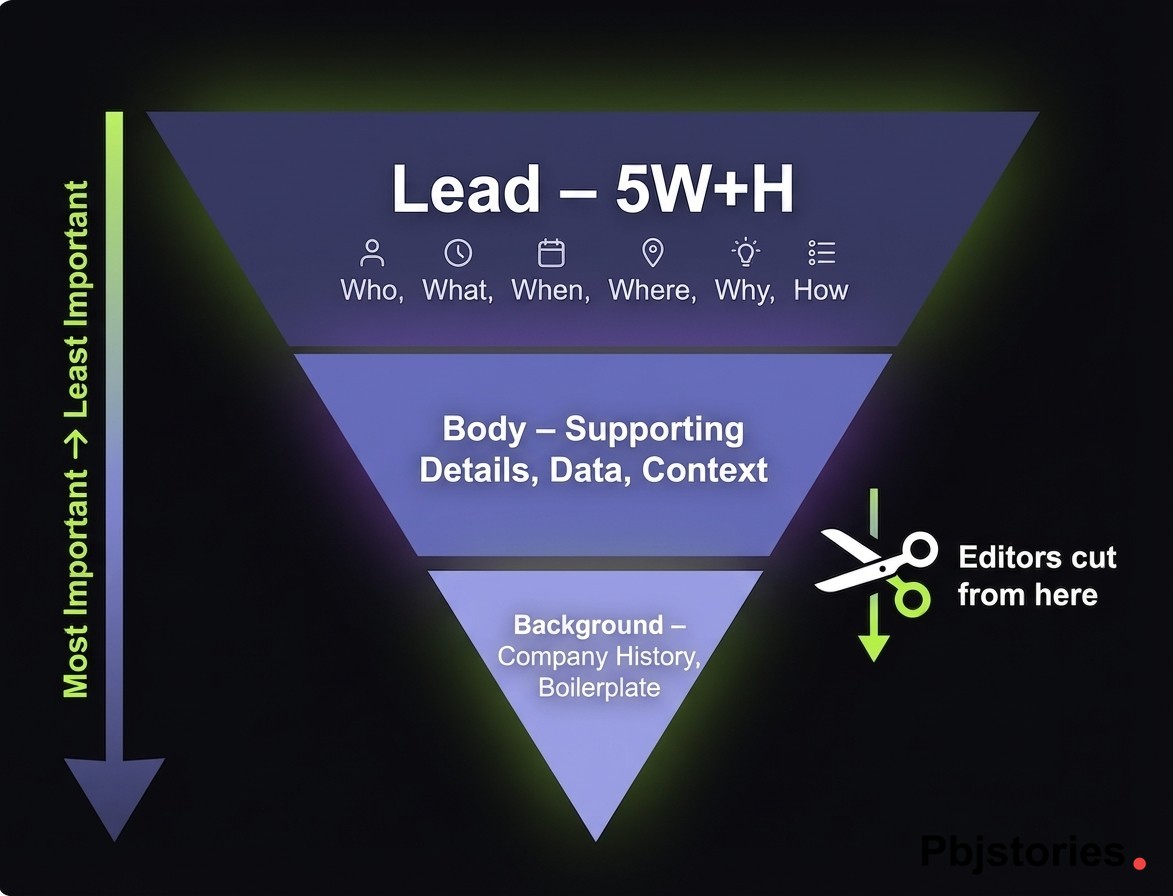
Body paragraphs then expand on the lead with supporting details, data, and context. These follow the inverted pyramid structure: critical information sits at the top, while background details occupy the bottom.
Why does this structure matter? Journalists routinely trim press releases from the end to fit space constraints. The inverted pyramid ensures that cutting the final paragraphs never removes essential facts. According to AP style conventions, this format also mirrors how news stories are written, making the release feel familiar and publishable.
Quotes, Boilerplate, Contact Info, and End Notation
Include one to two direct quotes from a named spokesperson, founder, or subject-matter authority. Strong quotes add perspective that raw facts cannot convey, such as motivation, vision, or stakes. Most press release quotes fail because they recycle corporate jargon like "thrilled to announce" or "excited to partner." Instead, write quotes the way a real person speaks: short, specific, and opinionated.
The boilerplate is a standardized "About [Organization]" paragraph placed after the body. It covers mission, founding year, headquarters, and scale in three to four sentences. This paragraph stays identical across every release your organization sends.
Below the boilerplate, list the media contact's full name, title, phone number, and email. Without this information, journalists simply cannot follow up.
End every release with three centered hash marks (###). This notation signals editors that no additional pages follow.
How to Write a Press Release in 7 Steps
These seven steps move sequentially from identifying a newsworthy angle to formatting and distributing the final release to targeted media contacts.
Find Your Newsworthy Angle and Define Your Audience
Newsworthiness is the foundation of every effective press release. A product launch, strategic partnership, milestone, research finding, or community initiative qualifies as genuine news. A routine company update or self-promotional announcement does not. If a journalist would not consider covering it, the release will be ignored.
Lead with impact, not with your company bio. Editors skip releases that open with corporate background, so start with the outcome or change your announcement creates, then layer in organizational context.
Your target audience determines everything from tone to distribution list. Local media, industry trade publications, and national outlets each require different angles for the same story. A funding round pitched to a tech trade journal emphasizes market opportunity, while the same story pitched locally highlights job creation.
Identifying target keywords during this planning stage also helps the release rank in search results, extending its reach beyond the initial media push.
Write a Compelling Headline and Lead Paragraph
Use active voice, include the organization name, and focus on the outcome. Avoid clickbait, puns, or vague language. A strong headline follows a clear pattern: [Organization] + [Action Verb] + [Newsworthy Outcome]. Passive or generic phrasing loses attention immediately.
The lead paragraph should place the single most newsworthy fact in its first sentence, then answer the remaining 5W+H questions within two to three sentences. Aim for under 35 words in that opening sentence.
Compare these two approaches:
Weak: "Company X is pleased to announce the launch of a new product designed to improve efficiency."
Strong: "Company X launched [product] to reduce supply-chain delays for mid-size retailers, available starting July 2025."
The weak version buries the news behind a meaningless pleasantry. The strong version leads with impact, names the audience, and includes a concrete date.
Draft the Body, Add Quotes, and Follow AP Style
The body should consist of two to four short paragraphs that expand on the lead with supporting data, context, and one direct quote from a named spokesperson. Each paragraph adds a new layer of detail, following the inverted pyramid so editors can trim from the bottom without losing essential facts.
AP style conventions matter because inconsistent formatting signals amateur work. Spell out numbers one through nine and use numerals for 10 and above. Abbreviate state names in datelines. Write dates as month day, year, with no ordinal suffixes: "June 15, 2025," not "June 15th." Use title case for proper nouns and active voice throughout.
Keep the entire release between 300 and 500 words, roughly one page. Brevity increases the chance yours gets read. For a deeper breakdown of ideal length, see the press release length guide.
Review, Format, and Distribute to the Right Contacts
Proofread every detail before sending. A single factual error, misspelled name, or incorrect date will cause most editors to stop reading. Check AP style compliance: number usage, date formatting, state abbreviations, and title capitalization.
Format the final document with "FOR IMMEDIATE RELEASE" in bold caps at the top, single-spaced body text, clear section breaks between the lead, body, quotes, and boilerplate, and ### centered beneath the last line.
Distribution breaks into three paths:
- Paid wire services (PR Newswire, Business Wire, EIN Presswire) push releases to broad outlet networks automatically
- Direct outreach to targeted journalists offers higher engagement but requires building media lists manually
- AI-powered platforms combine writing, optimization, and distribution to hundreds of outlets in one workflow
Tuesday through Thursday mornings generate the strongest journalist response because newsrooms are fully staffed and not buried under weekend backlogs. Avoid Friday afternoons entirely. For deeper distribution strategies, plan your send schedule around editorial calendars in your industry.
Press Release Examples for Events, Products, and New Businesses
Annotated examples are the fastest way to internalize proper press release structure. They show format decisions in context rather than theory alone. For scored, real-world samples, see our full press release examples page.
Event Press Release Example
Event releases must front-load logistics. Journalists need date, time, location, and ticketing details to determine relevance for their audience. A quote from the organizer should appear within the first two paragraphs to add a human angle.
FOR IMMEDIATE RELEASE
AUSTIN, TX, June 15, 2025 -- The Central Texas Food Bank hosts its 10th Annual Harvest Gala on Sept. 20, 2025, at the Austin Convention Center to raise $500,000 for childhood hunger programs. Doors open at 6 p.m. Tickets start at $150 at centraltexasfoodbank.org. (Dateline, lead with 5W+H, logistics up front.)
"Every dollar funds 3 meals for a child in Travis County," said Maria Chen, executive director. (Specific, human quote.)
The evening features a silent auction, live music, and keynote remarks from local chef David Ruiz. (Supporting details follow inverted pyramid.)
Product Launch and New Business Press Release Examples
A product launch release should lead with the problem being solved, not a feature list. For example: "NovaBrew introduces a portable cold-brew system that cuts brew time from 12 hours to 30 minutes, available starting July 1 for $89." A quote from the CEO then explains why the product matters to the target customer.
New business releases follow similar logic but lead with the market gap. "Two former hospital administrators launched ClearPath Health in Austin to address the lack of affordable billing transparency tools for independent clinics." Founding team credentials build immediate credibility with editors.
Boilerplates should adapt to the organization type. A startup boilerplate emphasizes founding year, mission, and funding stage. An established company highlights scale, revenue milestones, or global presence. A nonprofit focuses on the communities served and measurable impact.
Common Press Release Mistakes and How to Avoid Them
The overarching principle from experienced PR professionals is simple: write the release so a busy journalist could publish it as-is. Six recurring mistakes prevent that from happening.
Leading with company background instead of the news. "XYZ Corp is pleased to announce" wastes the most valuable real estate in the release. Put the impact or outcome in sentence one.
Writing in first person. Phrases like "We are excited to" break the third-person convention expected throughout the body. First person belongs only inside direct quotes attributed to a named spokesperson.
Making the release too long or too promotional. Anything beyond 500 words gets skimmed; anything that reads like an advertisement gets deleted. Journalists treat overly salesy language as spam because it creates extra editing work.
Burying the news below background context violates the inverted pyramid structure editors rely on. Similarly, omitting contact information prevents journalists from following up, killing a story before it starts.
Finally, ignoring AP style conventions, such as incorrect date formats or inconsistent number usage, signals amateur work to editors who screen dozens of releases daily.
How to Write and Send a Press Release Pitch Email
A polished press release still needs a delivery vehicle. Most journalists receive releases as an attachment or embedded link inside a short pitch email, not as standalone documents. Without that pitch, your release sits unopened in a crowded inbox.
Structure the email around four elements: a subject line containing the news hook, two to three sentences explaining why this story matters to that journalist's specific audience, a link to the full press release, and a one-line sign-off with your direct contact info.
Personalization separates pitches that get opened from those that get deleted. Address the journalist by name, reference a recent article they published, and explain why your story fits their beat. Generic mass emails signal laziness, so editors skip them.
Building targeted media lists takes hours. PBJ Stories distributes to 500+ outlets automatically, handling the outreach so you can focus on the story itself. For foundational context on formatting before you pitch, review what a press release covers.
Press Release FAQ
How Long Should a Press Release Be?
The ideal length is 300-500 words, roughly one page. Releases under 200 words lack substance, while those over 600 words get skimmed or ignored. Brevity increases the chance a journalist reads yours in full.
Should a Press Release Be Written in First or Third Person?
Always use third person throughout the release body. First person ("I" or "we") belongs only inside direct quotes attributed to a named spokesperson. Editors immediately flag releases written in first person as unprofessional.
What Is the Inverted Pyramid in Press Release Writing?
The inverted pyramid places the most critical newsworthy information at the top, supporting details in the middle, and background context at the bottom. Editors frequently cut content from the end to fit space constraints, so this structure ensures essential facts survive every edit.
Do Press Releases Help With SEO?
Yes. Press releases distributed through wire services and news outlets generate brand mentions and backlinks that improve search visibility. Most wire service links are nofollow, but they still contribute to entity recognition and brand signals in Google. However, press releases should prioritize news value first and treat SEO as a secondary benefit.
What Is a Boilerplate in a Press Release?
A boilerplate is the standardized "About [Organization]" paragraph placed at the end of every press release. It covers what the organization does, its founding year, headquarters location, and scale or mission in three to four sentences. This paragraph remains consistent across all releases to reinforce brand identity.
How Do You Make a Press Release Stand Out to Journalists?
Lead with genuine impact or a compelling data point rather than company background. Three factors matter most:
- Newsworthiness: the story must be relevant to the journalist's beat
- Clean formatting: write so a publication could run the release as-is
- Personalized outreach: a tailored pitch email dramatically increases open rates because it shows you understand the reporter's audience
Generic mass-distributed releases rarely get coverage. Relevance and readability outperform volume every time.
Writing a press release that actually earns coverage takes the right format, a newsworthy angle, and distribution broad enough to reach relevant journalists. But managing all three, from AP-style formatting to keyword research to outlet targeting, can consume hours that founders and marketing teams rarely have to spare.
PBJ Stories simplifies that entire workflow by combining AI-powered writing with SERP-driven keyword optimization and distribution to 500+ news outlets, including Google News and Yahoo Finance. Whether you need a single release or ongoing coverage at scale, the platform handles writing, optimization, and publishing in one place. Start your next press release at pbjstories.com and put your story in front of the outlets that matter.
Get PR tips delivered weekly
Join 3,200+ PR professionals getting actionable tips on press release writing, distribution, and media outreach.
No spam. Unsubscribe anytime.