
The ideal press release length falls between 300 and 500 words, roughly one page. That range gives journalists enough context to write a story without burying the news in filler. Go shorter and you risk leaving out critical details. Go longer and most editors will stop reading before they reach your key quote.
Length matters more than most communicators realize. Newsroom editors scan hundreds of pitches daily, and distribution platforms like PR Newswire and Business Wire impose their own word limits that affect both visibility and pricing. Every section of a release, from the headline to the boilerplate, has an optimal range that balances informativeness with brevity.
The breakdown below covers exact word counts for each section, explains when a longer release is justified, and provides practical techniques for trimming excess copy. Whether you're announcing a product launch, a funding round, or a crisis response, the right length depends on the type of news, the target outlet, and the platform carrying your press release.
How Long Should a Press Release Be? The Short Answer
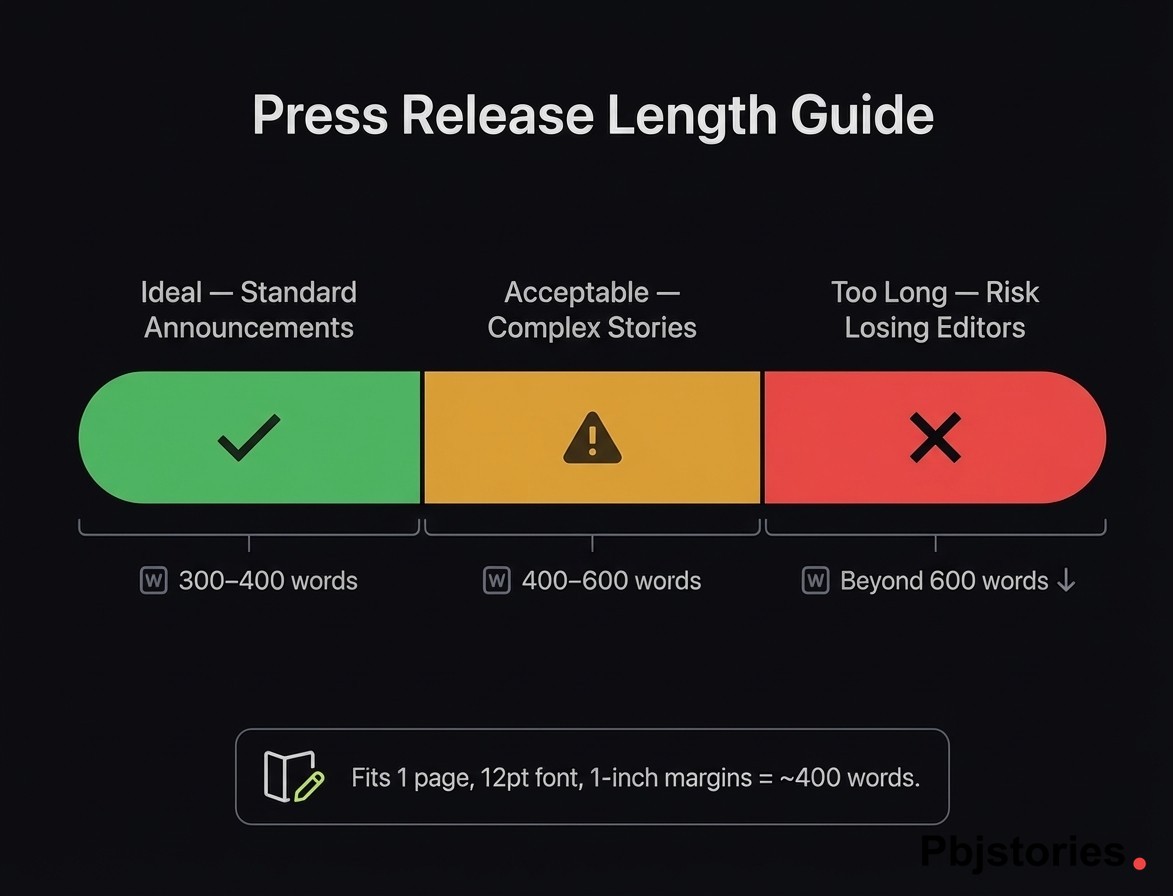
Aim for 300-400 words for most announcements. This range delivers enough substance for journalists while respecting their time, and it naturally fits on a single page when formatted in 12pt font with 1-inch margins. Anything that spills onto a second page signals poor editing to newsroom editors triaging dozens of pitches per hour.
This standard reflects how Associated Press style shapes newsroom expectations. AP style favors tight, front-loaded writing where the most newsworthy facts appear first. Journalists trained in the inverted pyramid structure expect press releases to mirror that same discipline.
Complex announcements like mergers, acquisitions, or major research findings can justify 500-600 words. Beyond 600, though, the release risks losing readers before they reach the core message.
Distribution platforms also enforce limits. PR Newswire, BusinessWire, and GlobeNewsWire each set character or word thresholds that affect how releases display and what they cost. Exceeding those limits can trigger higher fees or truncated content.
So the target is clear. Write 300-400 words for straightforward news, allow up to 500-600 for complex stories, and always confirm your release fits within your chosen platform's requirements.
Ideal Length for Each Section of a Press Release
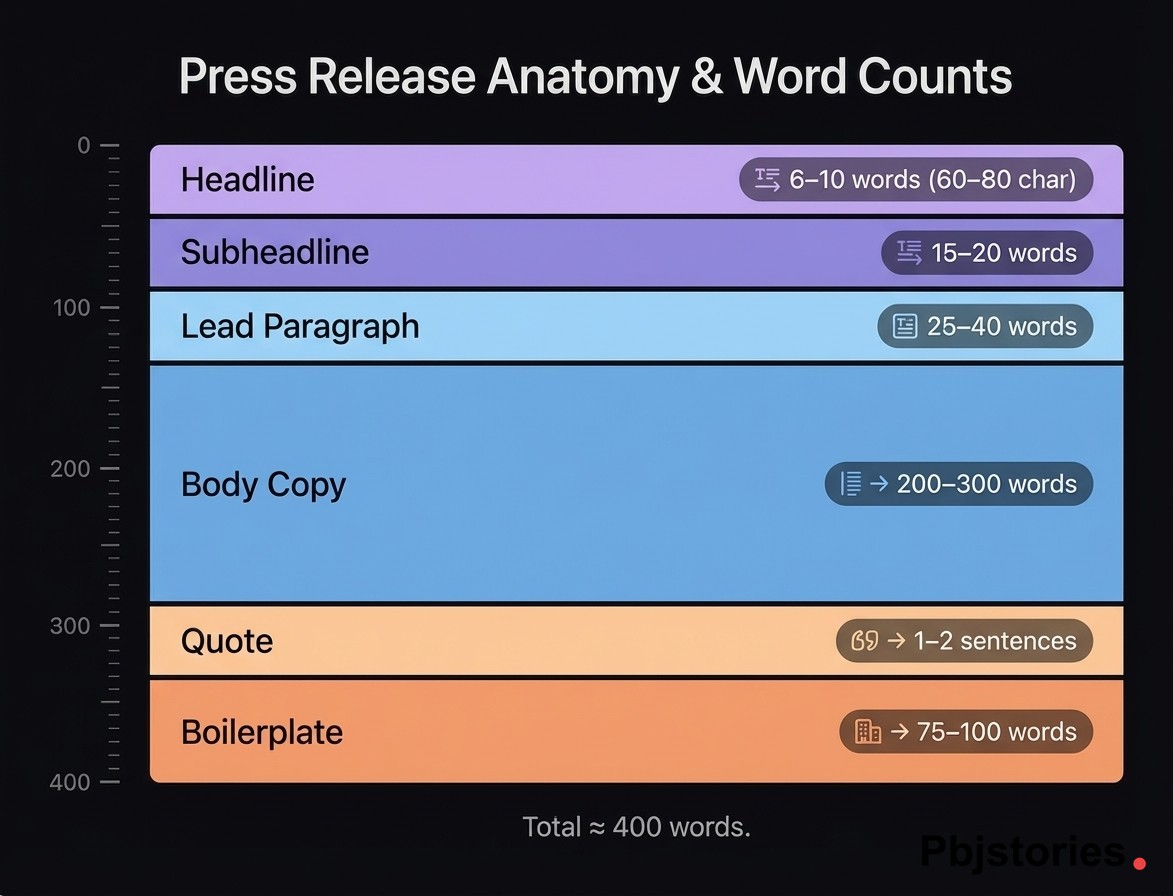
Every section serves a distinct purpose, so no single component should consume a disproportionate share of the total word count. Here are the recommended lengths:
- Headline: 6-10 words (60-80 characters)
- Subheadline: 15-20 words
- Lead paragraph: 25-40 words
- Body copy: 200-300 words
- Quote: 1-2 sentences
- Boilerplate: 75-100 words
These targets add up to roughly 400 words, naturally enforcing the one-page standard most journalists expect.
Headline and Subheadline Length
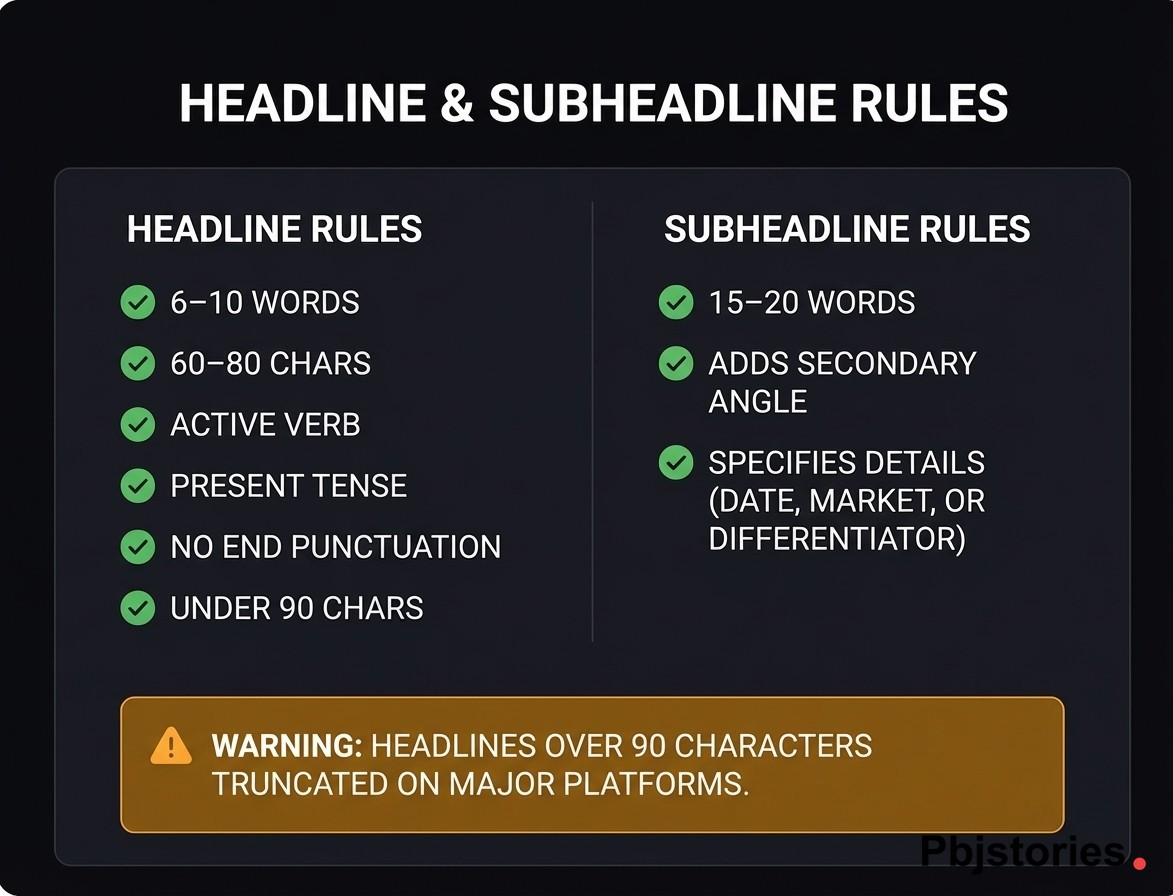
Aim for 6-10 words, roughly 60-80 characters, in your headline. Journalists triage dozens of pitches per hour, so shorter headlines get scanned and understood faster. AP style conventions reinforce this: use active verbs, present tense for current events, and skip end punctuation.
Distribution platforms often truncate headlines beyond 80-90 characters, so brevity serves a technical purpose beyond readability.
The subheadline should run 15-20 words and carry a secondary news angle the headline cannot fit. If the headline names the product, the subheadline can specify the launch date, target market, or key differentiator. Together, both lines give editors enough context to decide whether the full release deserves their attention.
Lead Paragraph, Body Copy, and Quote Guidelines
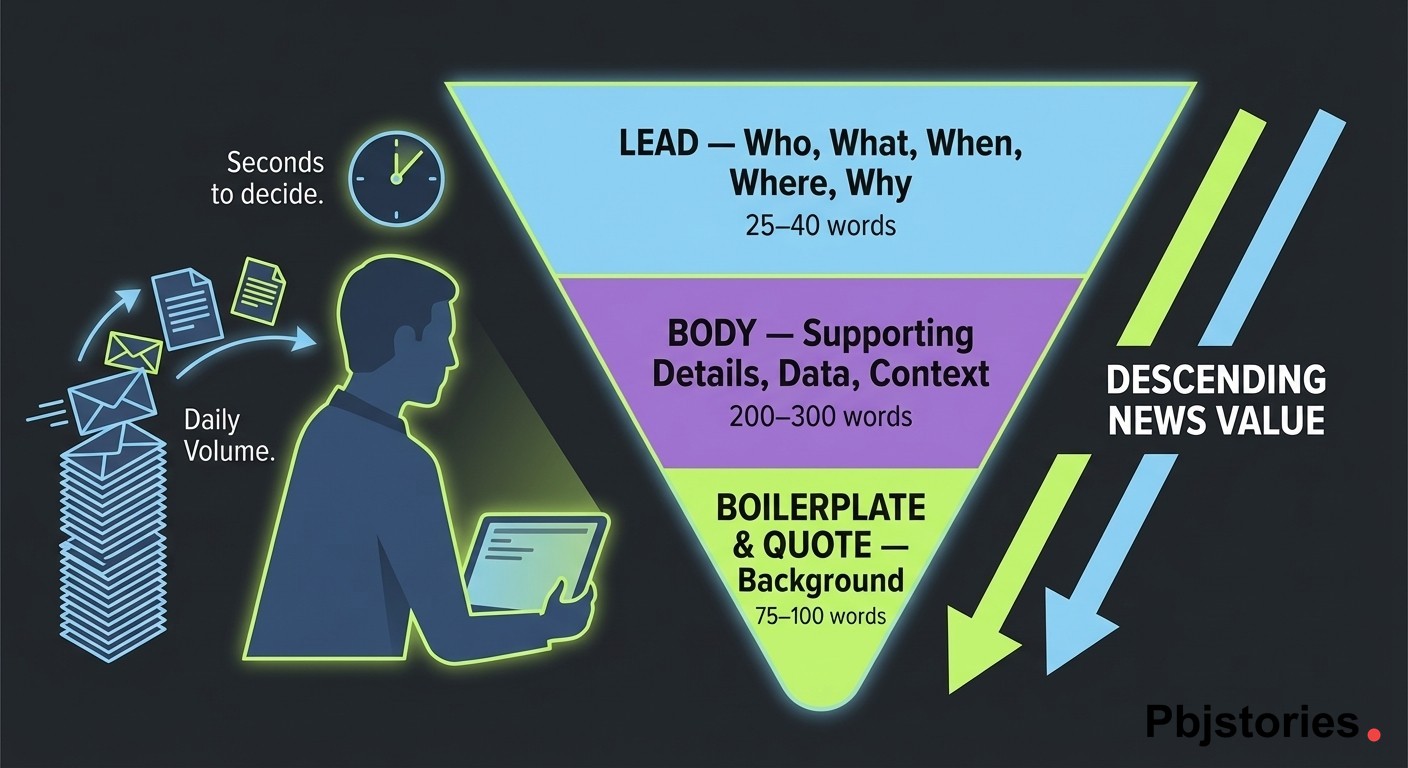
The lead paragraph follows the inverted pyramid structure, answering who, what, when, where, and why in 25-40 words. Journalists may stop reading after the first sentence, so front-loading the core news ensures your story survives even the quickest scan.
Body copy should total 200-300 words and expand on the lead with supporting details, data points, and context. Every sentence must earn its place. Redundant background or filler adjectives waste space that could carry actual news value.
Limit quotes to 1-2 sentences from a single spokesperson. Multiple executive quotes rarely add journalistic value; they exist to satisfy internal stakeholders, not reporters. One concise, attributable quote that adds perspective is far more effective. For deeper guidance on structuring each element, see this press release writing guide.
Boilerplate: How Long Should Your Company Description Be?
Keep your boilerplate to 75-100 words. This "About [Company]" block sits at the bottom of every release, so invest time editing it once rather than rewriting it per announcement. Only update it after a genuine milestone, such as a new funding round, acquisition, or market expansion.
An overly long company description eats directly into the word budget journalists actually care about: the news itself. Every extra sentence in the boilerplate is a sentence stolen from your story.
Why Press Releases Should Be Short: What Journalists Actually Expect
Journalists at major outlets receive hundreds of press releases every day and spend only seconds deciding whether one deserves attention. Conciseness directly affects whether your announcement gets picked up or deleted.
The inverted pyramid structure, taught in journalism schools and enforced by AP style guidelines, is the format newsrooms expect. Wire-service story formats place the most newsworthy information in the opening sentences, with supporting details layered beneath in descending importance. Editors assume your release mirrors that format. If it doesn't, they move on.
PR professionals consistently report in industry forums that shorter, tighter releases generate more media coverage. A focused 350-word release built around a single news angle outperforms a 700-word release that tries to cover multiple stories. The scored press release examples on this site all fall within the 400-600 word range.
This principle extends to search visibility as well. Keyword-optimized press releases rank better when they target one clearly defined topic rather than diluting relevance across several themes. A single news angle strengthens both journalist engagement and organic search performance.
When a Press Release Can Be Longer Than One Page
The one-page rule holds for most announcements, but complex news sometimes demands more space. Mergers, major research findings, and crisis communications often require legal context or multiple stakeholder perspectives that cannot be compressed into 400 words without losing critical detail.
Length by Announcement Type: Product Launch vs. Funding vs. Crisis
Product launches and executive hires are straightforward news, so 400 words or fewer typically covers the full story. The announcement has a single focal point, and unnecessary background only dilutes it.
Funding announcements often require 450-550 words. Investor names, round details, capital allocation plans, and forward-looking statements each carry news value that journalists expect to see.
Mergers, acquisitions, and crisis communications can justify 500-600 words. Legal context, stakeholder backgrounds, and multiple quotes from executives on both sides of a deal add necessary substance that shorter formats cannot accommodate.
Regardless of total length, the inverted pyramid still applies. The core news must appear entirely on page one. If a journalist stops reading after the lead paragraph, they should still understand what happened, who is involved, and why it matters.
Distribution Platform Word Limits
PR Newswire, BusinessWire, and GlobeNewsWire each enforce their own character and word limit guidelines that determine how releases are displayed, truncated, and priced. Longer releases on some platforms fall into higher pricing tiers, so word count has a direct cost implication beyond editorial concerns.
Staying within 400-500 words typically keeps distribution fees at base rates across most major wire services. Exceeding platform thresholds can also trigger formatting issues, pushing content below the fold or cutting off boilerplate sections entirely.
PBJ Stories distributes to 500+ outlets including Google News and Yahoo Finance, with AI-assisted formatting that keeps releases within optimal limits automatically. For more on structuring releases for distribution, see these press release distribution tips.
How to Cut a Press Release Down to the Right Length
Start by eliminating passive voice constructions. "The product was launched by the company" becomes "The company launched the product," saving words while adding clarity. Then strip filler adjectives: "very," "really," and "extremely" add zero news value.
Cut any sentence that restates information already conveyed elsewhere in the release. Redundancy is the fastest way a 500-word draft balloons to 700.
Consolidate executive quotes down to one. A single strong quote from the most relevant spokesperson carries more weight than three diluted ones included to satisfy internal politics. Similarly, remove background paragraphs that duplicate what your boilerplate already covers.
Read the release aloud. Run-on sentences and unnecessary qualifiers become obvious when spoken, since your ear catches what your eye skips.
AI writing tools can generate a focused first draft quickly, freeing PR professionals to spend their limited time on messaging refinement and stakeholder approvals, which routinely cause more delays than the writing itself.
A press release template enforces concise formatting from the start, making heavy editing less necessary.
Common Press Release Length Mistakes to Avoid
Cramming multiple news angles into a single release is the most frequent error. Each announcement deserves its own release. Splitting focus weakens every angle and confuses journalists trying to identify the story.
Including three or more executive quotes to appease internal stakeholders adds bulk without adding news value. One strong quote from the most relevant spokesperson is sufficient.
Repeating company background in the body copy and the boilerplate wastes precious words. The boilerplate exists for that purpose, so let it do its job. Other common mistakes include:
- Headlines exceeding 12-15 words, which get truncated on distribution platforms and in email subject lines
- Releases under 250 words that omit critical context journalists need
- Stuffing target keywords artificially to inflate length, which hurts readability and reduces media pickup
Every sentence should earn its place. If a line restates something already covered, cut it.
How Long Does It Take to Write a Press Release?
Most PR professionals spend 1-4 hours on the actual writing, depending on announcement complexity and whether core messaging has already been defined. A straightforward product update with clear talking points can be drafted in under an hour. A merger or crisis statement with regulatory language takes considerably longer.
And the writing itself is often the fast part. Stakeholder approvals from legal, executive, and marketing teams routinely add days to the timeline. Unclear messaging from the organization is the biggest time sink, forcing the writer into strategic positioning work on top of drafting.
Press Release Length FAQ
How Many Words Should a Press Release Be?
A press release should be 300-500 words, with 300-400 words as the target for standard announcements. Longer releases, up to 500-600 words, suit complex news like mergers or major research findings. However, information density and inverted pyramid structure matter more than hitting an exact number, since a tightly written 350-word release outperforms a padded 500-word one every time.
Can a Press Release Be Two Pages?
One page is the gold standard, but a second page is occasionally acceptable for complex announcements like mergers, acquisitions, or major research findings. If your release extends to two pages, the most critical information must still appear entirely on page one. Always close with the "###" or "-30-" end mark to signal editors that no additional content follows.
Why Is '###' or '-30-' Written at the End of a Press Release?
The "-30-" mark originated from telegraph and wire service conventions, where operators used it to signal the end of a transmission. Editors needed a clear indicator that no additional copy followed, so this shorthand became standard in newsrooms across the United States. "###" is the modern equivalent used on press releases in 2026. Including either mark signals professionalism and familiarity with AP style formatting.
How Far in Advance Should a Press Release Be Sent Out?
Timing depends on the publication's editorial cycle:
- Daily online outlets: 1-3 days before the announcement date
- Weekly publications: approximately one week in advance
- Monthly magazines: 2-3 months for print cycle inclusion
An embargoed release is sent early with a "do not publish before" date, giving journalists time to prepare coverage. Non-embargoed releases are fair game for immediate publication upon receipt.
What Format Should a Press Release Be Sent In?
Paste the full text directly into the email body. Journalists are far less likely to open attachments, so a Word document or PDF often goes unread. PDFs work for media kits or newsroom archives, but never for initial outreach. Plain text in the email ensures your news gets seen immediately.
Getting the length right is only part of the equation. A press release also needs the right keywords, proper AP style formatting, and distribution to outlets that actually drive visibility. PBJ Stories simplifies the entire process, from AI-assisted writing and SERP-driven keyword optimization to distribution across 500+ news outlets including Google News and Yahoo Finance. If you want your next release to hit the ideal length and reach the right audience, explore how it works and publish with confidence.
Get PR tips delivered weekly
Join 3,200+ PR professionals getting actionable tips on press release writing, distribution, and media outreach.
No spam. Unsubscribe anytime.