
The most effective press release tips come down to one principle: write real news the way journalists need it, then put it in front of the right people. Most releases never get picked up because they lack a genuine news angle, bury the lead, or land in the wrong inbox. Reporters at outlets indexed by Google News and Yahoo Finance receive hundreds of pitches per week and delete anything that reads like marketing copy.
Getting coverage requires more than good writing. Structure, AP style formatting, keyword placement, and targeted distribution each play a distinct role in whether your release earns a headline or hits the trash folder. A poorly formatted release signals inexperience, while a well-crafted one builds credibility before the journalist even finishes the lead.
From headline construction and quote writing to building a media list and timing your pitch emails, the difference between a release that generates coverage and one that gets ignored is rarely luck. It is process. And that process is learnable, whether you are a startup founder sending your first announcement or a PR professional refining a press release template for a client campaign.
What Makes a Press Release Newsworthy (and When to Skip Writing One)
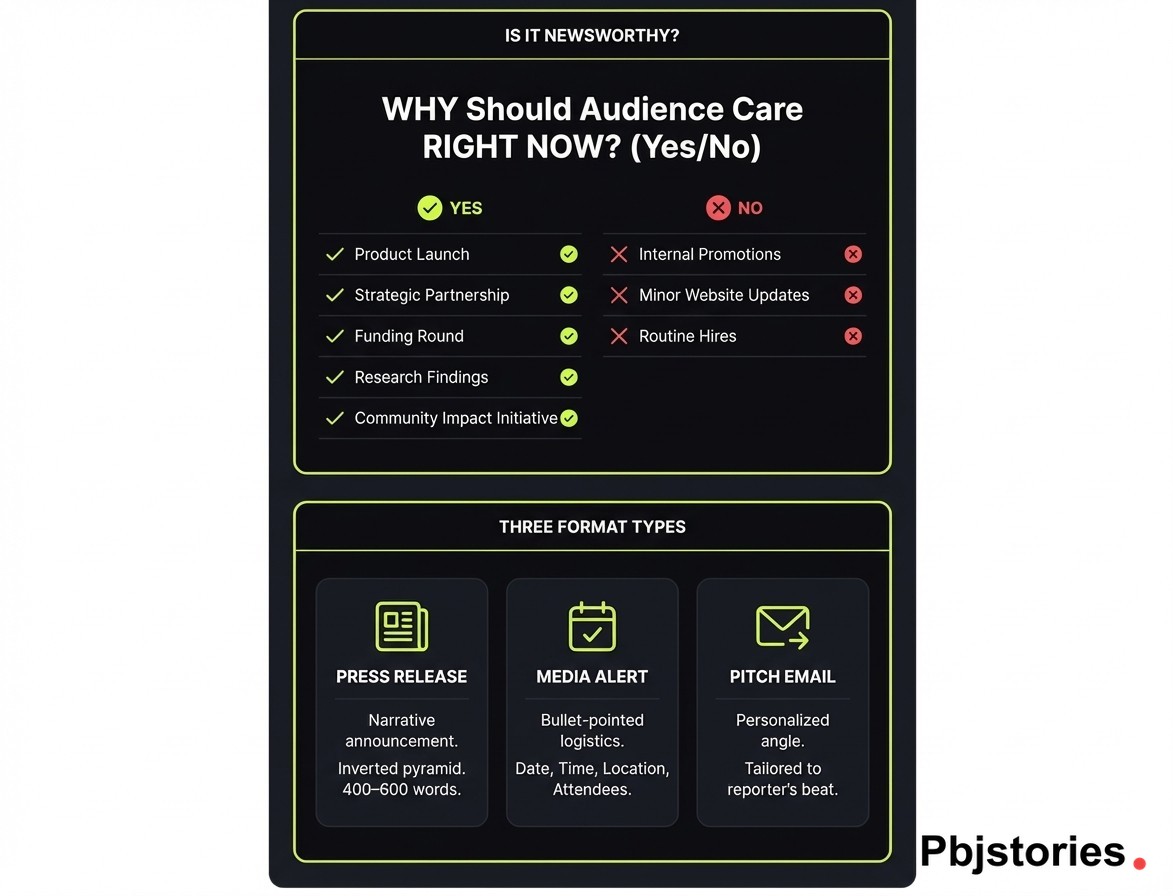
The number one reason press releases fail is the absence of actual news. Before writing a single word, ask the question every reporter asks: "Why should my audience care right now?" If you cannot answer that in one sentence, you have a blog post, not a press release.
Topics that qualify as genuinely newsworthy include product launches, strategic partnerships, funding rounds, data-driven research findings, and community impact initiatives. Internal promotions, minor website updates, and routine hires almost never warrant a release because they lack relevance beyond your organization.
Many PR missteps also come from choosing the wrong format entirely. A press release is a narrative news announcement built around the inverted pyramid. A media alert is a short, bullet-pointed document covering event logistics like date, time, location, and attendees. A pitch email is a personalized message sent directly to a reporter with an angle tailored to their beat. Writing a full press release for a ribbon cutting, for example, wastes effort when a media alert plus direct outreach would generate better results.
One critical mindset shift: a press release is a support document for pitching, not a standalone marketing piece. It gives journalists the facts they need to write their own story.
Press Release Structure: The 7 Essential Elements
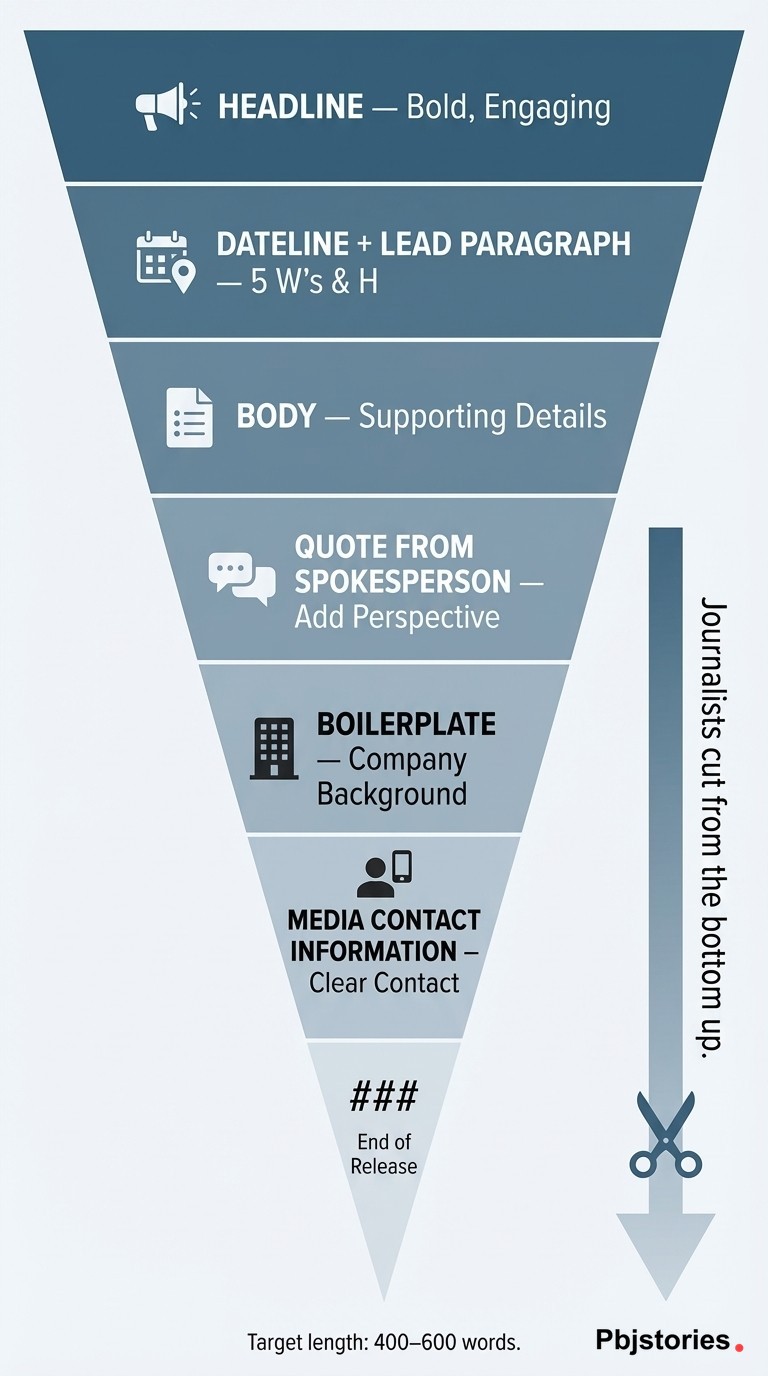
Every press release follows seven core components: headline, dateline, lead paragraph, body, quote from a spokesperson, boilerplate (company background), and media contact information. The document ends with the ### symbol, a longstanding convention that signals the end of the release.
These elements follow the inverted pyramid structure borrowed from journalism. The most critical news sits at the top, supporting details fill the middle, and background occupies the bottom. Journalists routinely cut from the bottom up, so your lead paragraph must stand alone as a complete story.
Most PR professionals target 400 to 600 words, though the acceptable range spans 300 to 800. Conciseness matters more than hitting a specific count. For deeper guidance on length, see this breakdown on press release word count.
How to Write a Press Release Headline That Captures Attention
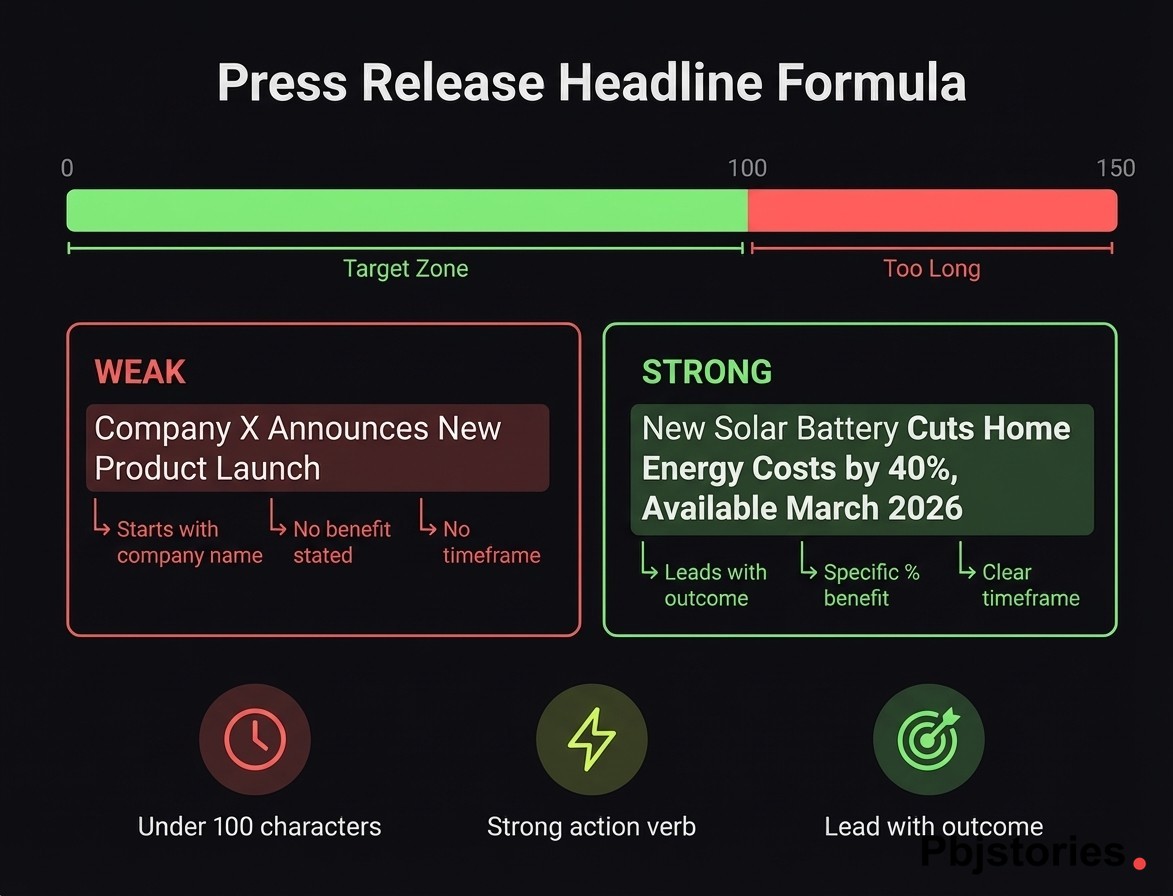
Keep your headline under 100 characters, lead with the outcome, and use strong action verbs. Journalists scan dozens of releases daily, and the headline is their first filter. If it reads like an ad, it gets deleted immediately.
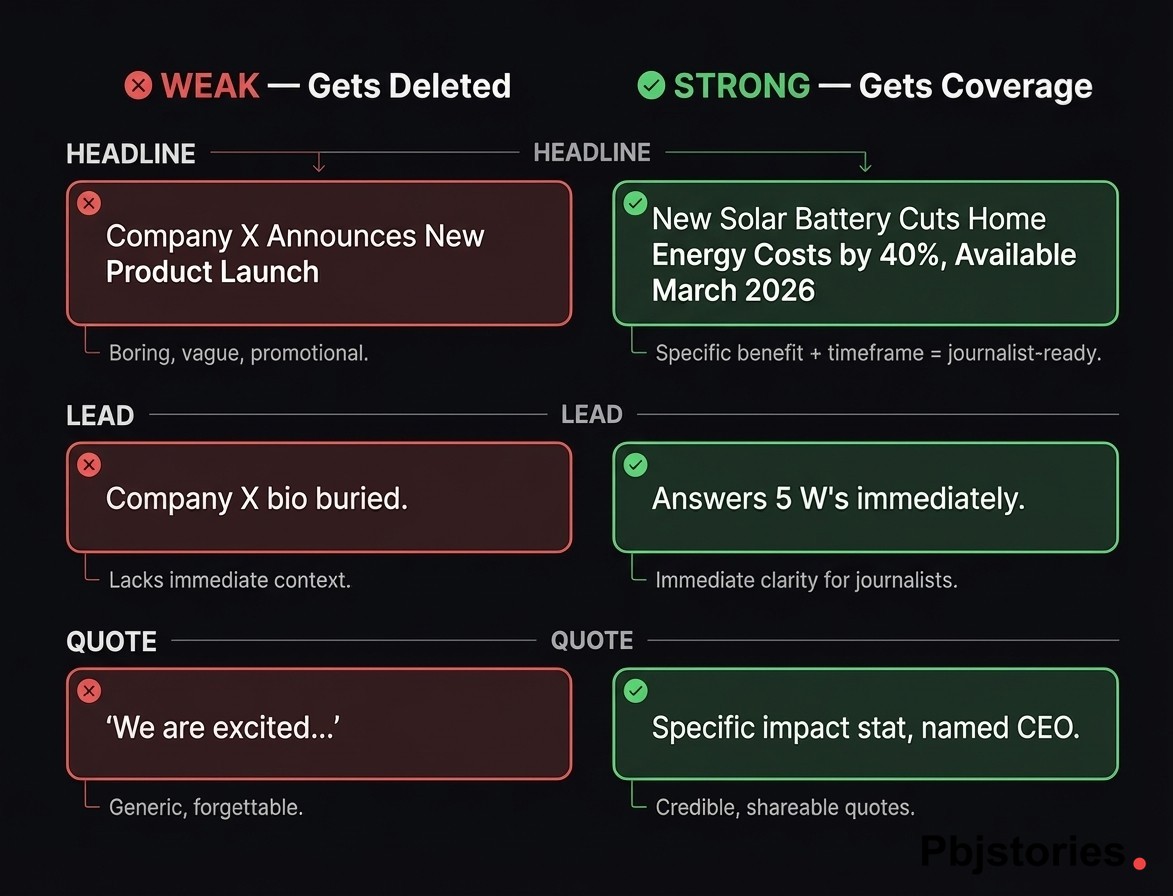
Lead with impact, not the company name. Weak: "Company X Announces New Product Launch." Strong: "New Solar Battery Cuts Home Energy Costs by 40%, Available March 2026." The second version works because it delivers a specific benefit and a timeframe a reporter can use directly.
Crafting the Lead Paragraph Using the 5 W's
The lead paragraph must answer who, what, when, where, and why (plus how) within the first one to two sentences. Journalists often copy-paste the lead directly into their stories, so this paragraph functions as your release's most quotable asset.
A weak lead buries the news behind a company biography: "Company X, a leader in education technology, today announced a new tutoring platform." A strong lead starts with impact: "Seven million children in rural communities now have access to free online tutoring after Company X launched its platform across 12 states this month."
The difference is structure, not length. The strong version answers all five W's immediately, giving a reporter everything needed to run the story. If your lead cannot stand alone as a complete news summary, rewrite it. For a full walkthrough of this framework, see the guide on how to write a press release.
Writing Quotes That Journalists Actually Want to Use
Phrases like "We're thrilled" and "We're honored" get cut by every editor because they add zero information. A strong quote provides what straight facts cannot: opinion, future vision, or emotional context from a named spokesperson.
Compare these two approaches:
Weak: "We are excited to bring this product to market."
Strong: "This battery technology means a family of four can cut their energy bill in half without changing a single habit," said Jane Lee, CEO of SolarVolt.
The second version works because it quantifies impact and sounds like something a real person would say out loud. Attribute quotes to a specific name and title, whether that is a CEO, founder, or project lead. If your quote could appear in any company's release with the name swapped out, rewrite it.
Press Release Writing Tips: AP Style, SEO, and Common Mistakes
The AP Stylebook sets the standard for news writing, and journalists expect press releases to follow it. Key rules include spelling out numbers one through nine, using numerals for 10 and above, writing dates as Month Day, Year (January 15, 2026) without ordinals, placing titles before names, and skipping the Oxford comma.
Beyond formatting, brevity matters more than polish. Strip out jargon and write for a non-technical reader. If your grandmother cannot understand the lead paragraph, rewrite it until she can.
A single typo signals carelessness to every reporter who opens your release. Read the draft aloud to catch awkward phrasing, then have a second person verify all names, titles, and dates before distribution.
SEO Optimization: Keywords, Links, and Multimedia in Press Releases
Online press releases live on news sites and can rank in search results, so keyword placement matters. Position your primary keyword naturally in the headline, lead paragraph, and one subheading. Forcing it into every sentence triggers spam filters and alienates journalists.
Include one to two hyperlinks in the body with descriptive anchor text pointing to a product page, report, or landing page. "Click here" tells neither the reader nor search engines what the destination contains. Anchor text like "2026 energy storage report" performs better for both audiences.
Multimedia consistently boosts pickup rates. Attach a high-resolution image at 300 dpi minimum, embed video when available, or include an infographic. Journalists are more likely to feature a release that arrives with ready-to-publish visuals.
For identifying low-competition terms a release can realistically rank for, press release keyword research built around SERP data outperforms guesswork. But the primary audience remains the journalist, not the algorithm.
Before-and-After: Common Press Release Mistakes
The most frequent press release mistakes follow predictable patterns:
No actual news. A release about an internal team restructuring wastes reporter time and damages your credibility for future pitches.
Burying the lead. Starting with "Founded in 2014, Company X is a leading provider..." pushes the news below the fold. Lead with the impact instead.
Wrong journalists. A tech reporter deletes your local bakery announcement on sight. Relevance determines pickup rate.
Wrong format. A grand opening needs a media alert with logistics, not a 500-word narrative. Sometimes a personalized pitch email works better than either.
For more scored, real-world comparisons, see our press release examples page.
How to Distribute a Press Release and Pitch Journalists
Distribution works through two channels: wire services and direct journalist outreach. Wire services like PR Newswire and Business Wire publish your release across 500+ outlets, including Google News and Yahoo Finance, guaranteeing placement on major news aggregators.
Direct outreach targets individual reporters who cover your beat. A journalist who writes an original story about your news produces earned media, and that coverage carries significantly more credibility and SEO value than syndicated placements alone.
The most effective PR campaigns combine both. Wire distribution builds broad visibility, while personalized pitches generate the high-impact articles that drive real audience trust.
Building a Targeted Media List
A media list is a curated database of journalists, editors, and bloggers who cover your specific industry or beat. Start with 15 to 25 highly relevant contacts rather than blasting 500 irrelevant inboxes. Quality of targeting directly determines pickup rate.
Research reporters by reading their recent articles. Reference a specific story in your pitch to show you understand their beat. Generic mass emails get ignored.
Maintain your list quarterly. Reporters change beats, switch outlets, and go freelance. An outdated contact wastes your pitch and burns a relationship before it starts.
Email Pitch Etiquette: Timing, Follow-Up, and Personalization
Send pitches Tuesday through Thursday mornings, before 10 AM in the journalist's time zone. Monday inboxes are flooded from the weekend, and Friday emails get buried before anyone reads them.
Personalize the subject line and opening sentence. Reference a specific article the reporter published and explain why your news fits their beat. Generic blasts signal laziness and get deleted.
Paste the full press release in the email body below your pitch. Attachments often go unopened or trigger spam filters. Follow up once, three to five business days later. More than one follow-up crosses into spam territory.
Do reporters remember one-time senders? Rarely. Offer yourself as an ongoing source across multiple topics, and that relationship pays off far beyond a single release.
Press Release Tips FAQ
What Are the 7 Parts of a Press Release?
The seven parts are: headline, dateline, lead paragraph, body, quote from a spokesperson, boilerplate (company background), and media contact information. The release ends with the ### closing mark. Each element serves journalists who need facts fast and readers who need context.
What Are the 5 W's in a Press Release?
Who, what, when, where, and why, plus how. All five should be answered in the lead paragraph so a journalist can grasp the full story from the first two sentences. The lead is the most quoted section, so clarity here determines whether your release gets coverage. For a deeper walkthrough, see this guide on writing a press release.
How Long Should a Press Release Be?
The ideal range is 300 to 800 words, with most PR professionals targeting 400 to 600 words. Conciseness matters more than hitting a specific count. If the story is fully told in 350 words, do not pad it to 600. Additional guidance on press release length covers how word count affects journalist engagement.
Should Press Releases Be Optimized for SEO?
Yes, especially for online distribution. Place your target keyword in the headline and lead paragraph. Add one to two hyperlinks with descriptive anchor text, and include multimedia such as images or video. Write for the journalist first, search engines second. Keyword stuffing undermines credibility with reporters and editors alike.
When Should You Use a Media Alert Instead of a Press Release?
Media alerts are for events, press conferences, and photo opportunities where logistics matter more than narrative. They are short, bullet-pointed, and action-oriented, listing the date, time, location, and key attendees. If you are announcing a grand opening or ribbon cutting, a media alert paired with direct outreach is often more effective than a full press release.
What Are the Most Common Press Release Mistakes?
The biggest mistake is announcing something nobody outside your company cares about. Other frequent errors include burying the lead behind company background, using empty quotes like "We're thrilled," sending to irrelevant journalists, and writing a full release when a pitch email or media alert would work better. Each of these wastes journalist trust, which is difficult to rebuild. For foundational context on how releases function, see what is a press release.
Writing a strong press release is only half the challenge. Getting it in front of the right journalists, optimized for the right keywords, and published across credible outlets is what turns a good announcement into real coverage. PBJ Stories handles that entire workflow, from AI-assisted writing in AP style to SERP-driven keyword targeting and distribution across 500+ news sites including Google News and Yahoo Finance.
Whether you are a startup founder sending your first release or an SEO team building entity authority at scale, PBJ Stories gives you agency-level distribution without the agency retainer. Write and distribute your release and see how targeted distribution turns announcements into measurable results.
Get PR tips delivered weekly
Join 3,200+ PR professionals getting actionable tips on press release writing, distribution, and media outreach.
No spam. Unsubscribe anytime.