
Knowing how to distribute a press release effectively determines whether your announcement reaches thousands of readers or disappears into journalists' overflowing inboxes. Most companies invest hours crafting the perfect release, then undermine the entire effort by blasting it to a random list of contacts with no targeting, no timing strategy, and no follow-up plan.
The gap between writing a press release and actually getting media coverage is where most campaigns fail. Journalists at outlets like TechCrunch, Reuters, and local news desks receive hundreds of pitches daily, so distribution method, format, and timing all influence whether your story gets picked up or ignored.
Seven proven distribution methods, from free direct outreach to paid wire services like Business Wire and PR Newswire, each serve different goals and budgets. The right combination depends on whether you need earned editorial coverage, broad syndication across news aggregators, or long-term SEO value through contextual backlinks and indexed press pages.
TL;DR
- Wire services (PR Newswire, Business Wire) push your release to hundreds of outlets automatically — best for broad reach
- Direct email outreach to targeted journalists generates higher quality coverage but requires building media lists
- Send press releases Tuesday through Thursday, 9-11 AM in the journalist's time zone for highest open rates
- Always paste the full release in the email body — journalists rarely open attachments
- Track results: media pickups, backlinks generated, Google News indexing, and referral traffic — not just "outlets reached"
- Find a keyword people actually search for using free tools like Google Keyword Planner, then optimize your headline and lead for it — press releases that rank in search drive long-term traffic, and the best backlinks are the ones that get clicks
What Is Press Release Distribution and Why Does It Matter
Press release distribution is the process of delivering a finished release to journalists, newsrooms, media outlets, and online platforms where it can be picked up and published. Writing a strong release is only half the work. Without a deliberate distribution strategy, even the most newsworthy announcement sits unread.
Organizations distribute press releases for three core reasons. The first is earned media coverage, where journalists independently decide to report on your news. The second is building SEO authority through backlinks and syndication across high-domain-authority websites. The third applies specifically to public companies that must meet regulatory disclosure requirements through filings with the SEC.
Syndication to recognizable outlets like Google News, Yahoo Finance, and AP-affiliated sites also creates an "as seen in" credibility signal. Prospects and partners who see your brand on familiar platforms are more likely to trust your company, since third-party placement carries more weight than self-promotion.
Distribution methods range from free manual outreach to paid wire services costing over $1,000 per release. Each serves a different goal, budget, and timeline. The sections below break down seven approaches with honest cost comparisons so you can choose what fits your situation.
7 Ways to Distribute a Press Release: Free Outreach to Paid Wire Services
The right approach depends on your budget, timeline, and whether you need earned media coverage or broad syndication across news aggregators. Most successful campaigns combine several methods, using direct journalist pitches for editorial coverage and wire services for wider reach and SEO benefits.
Build a Targeted Media List of Journalists and Outlets
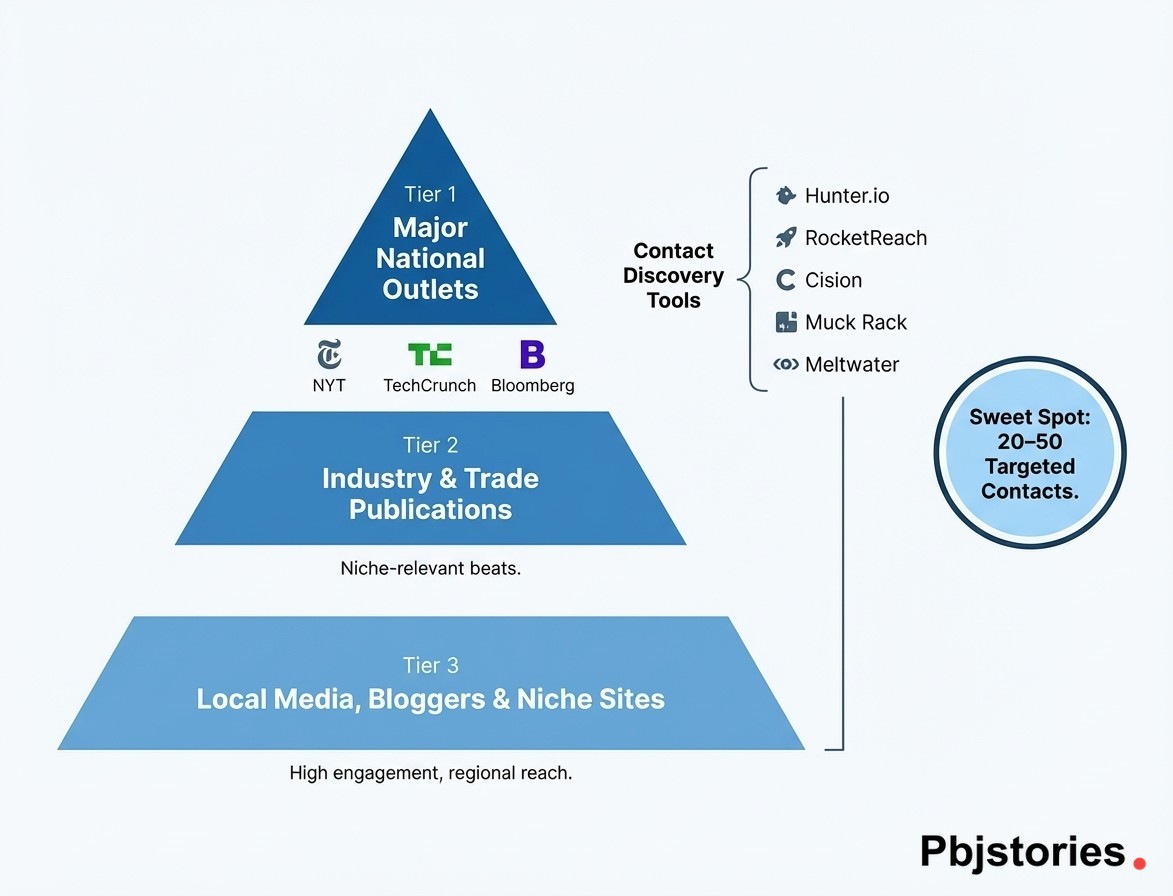
A focused list of 20--50 relevant journalists will consistently outperform a mass blast to 500 random contacts. Relevance drives response rates, since journalists only cover stories that fit their beat and audience.
You can build a media list from scratch without expensive subscriptions. Start by reading articles in your industry and noting the bylines. Check each reporter's author page on the publication website for contact details and recent coverage topics. LinkedIn profiles and Twitter/X bios often reveal a journalist's beat and direct email address.
For individual email lookups, tools like Hunter.io and RocketReach can surface verified contact information. If you run an ongoing PR program, media database platforms such as Cision, Muck Rack, or Meltwater provide searchable journalist directories with beat filters and outlet data.
Before adding anyone to your list, review their last five to ten articles. Sending a SaaS funding announcement to a food columnist wastes both your time and theirs.
Organize contacts into three tiers for prioritized outreach:
Tier 1: Major national outlets (The New York Times, TechCrunch, Bloomberg)
Tier 2: Industry and trade publications relevant to your niche
Tier 3: Local media, bloggers, and niche sites with engaged audiences
This tiered structure helps you tailor pitch angles and allocate follow-up effort where it matters most.
Email Your Press Release Directly to Reporters and Newsdesks
Direct email outreach remains the most effective method for earning genuine media coverage. It allows personalization and real relationship-building. A tailored pitch to 30 relevant reporters will generate more editorial pickups than a blast to thousands of generic contacts.
Paste the full press release text into the email body. Never attach it as a PDF. PDF attachments trigger spam filters, make it harder for journalists to copy quotes, and significantly reduce your chances of coverage. Skip image attachments in your initial email too. Instead, offer to send high-resolution photos or graphics if the journalist expresses interest.
Your subject line determines whether the email gets opened or deleted. Keep it under 65 characters, lead with the newsworthy angle, and avoid ALL CAPS or exclamation marks. "Denver Startup Raises $4M to Expand Rural Broadband" works. "EXCITING NEWS!!!" does not.
For local coverage specifically, contact assignment desks, news directors, and local TV producers directly. These gatekeepers decide daily story lineups, and a well-targeted local pitch consistently outperforms any wire service for regional stories.
Use Newswire Services Like Business Wire, PR Newswire, and GlobeNewswire
Wire services syndicate your press release simultaneously across a network of media outlets, financial terminals, and news aggregators. Business Wire, PR Newswire, and GlobeNewswire are the three dominant players, each maintaining distribution relationships with thousands of newsrooms.
These services are most useful for specific goals:
- Broad syndication and SEO backlinks from high-authority domains
- "As seen in" placements from recognizable outlets like Yahoo Finance
- Regulatory disclosures required by SEC-listed public companies
- Reaching financial media through Bloomberg Terminal and Reuters feeds
Wire distribution is paid placement, not earned media. Journalists who pick up a wire story are typically rewriting syndicated content rather than choosing to cover your company based on editorial interest. The distinction matters because earned coverage carries significantly more credibility.
Be cautious with budget wire services that distribute exclusively to AI-generated content farms. Backlinks from low-domain-authority sites can actually harm your SEO profile. Always verify where a service publishes before paying.
Self-Host Press Releases on Your Website or Online Newsroom
Every press release should live permanently on a dedicated newsroom or press page on your own website. Self-hosting creates an indexable page that can rank in Google for your target keywords, building long-term organic visibility that outlasts any single wire distribution.
An organized newsroom with archived releases signals credibility to journalists researching your company. Reporters frequently check a brand's press page before responding to a pitch, so a well-maintained archive reinforces trust.
Include multimedia assets like high-resolution images, videos, and brand logos directly on the newsroom page. This saves journalists the extra step of requesting assets, which speeds up their editorial process and increases your chances of coverage.
Link to your newsroom page from every press release email you send. Journalists who find your initial announcement interesting will click through to explore past releases and additional context.
Distribute Through Social Media and LinkedIn
LinkedIn is especially effective for B2B announcements and funding news. Posts from company founders reach your professional network directly. A founder's LinkedIn post about a Series A round often generates more engagement than a wire pickup, since connections already have context about the company.
Tag relevant journalists and publications in your posts on LinkedIn, Twitter/X, and Facebook to increase visibility. Many reporters monitor their social mentions and may click through to your full release.
Treat social media as free amplification rather than a primary distribution channel. It complements direct outreach and wire syndication by extending the lifespan of your announcement beyond the initial news cycle.
How to Email a Press Release to Journalists: Format, Templates, and Follow-Up
Email remains the channel most journalists prefer for receiving pitches. But formatting and tone determine whether your message gets opened or deleted, so every element from subject line to follow-up timing needs to be deliberate.
Press Release Email Template That Gets Opened
Structure your email as a short pitch first, full press release second. Busy journalists decide within seconds whether to keep reading, so front-load the value.
Open with a personalized greeting that references the journalist's recent work. For example: "Hi Sarah, I read your piece on Series B trends in fintech and thought this might fit your coverage." This single sentence signals you did your homework.
Follow with a 2--3 sentence pitch explaining why their audience would care. Connect your news directly to the journalist's beat. Then add a clear separator line and paste the full press release text below it.
End with your contact information, a phone number, and an offer to provide images or arrange interviews on request.
Subject lines should lead with the newsworthy angle in under 65 characters:
- Product launch: "New AI Tool Cuts Supply Chain Costs by 30%"
- Funding round: "[Company] Raises $12M to Expand Into European Markets"
- Event: "500 Climate Leaders to Convene in Austin This March"
Personalization is the single biggest factor separating emails that get opened from those that get deleted. A generic "Dear Editor" greeting virtually guarantees your pitch lands in the trash.
How to Follow Up Without Being Annoying
Wait 2--3 business days before sending a follow-up email. Anything sooner feels pushy and signals that you value your timeline over the journalist's workload.
Keep the follow-up to two or three sentences. Ask if they had a chance to review your pitch, offer one additional angle or data point, and make it easy to decline. A simple "No worries if this isn't a fit" removes pressure and actually increases response rates.
Twitter/X DMs work as a secondary follow-up channel, since many reporters actively monitor direct messages. A brief, friendly nudge can surface your pitch without cluttering their inbox further.
Never follow up more than twice on the same press release. If two attempts generate no response, move on.
Track email opens using tools like Mailtrack or HubSpot so you can distinguish between journalists who saw your pitch but passed and those who never opened it. That distinction sharpens your next outreach.
Wire Services vs. Direct Outreach: Honest Pros and Cons
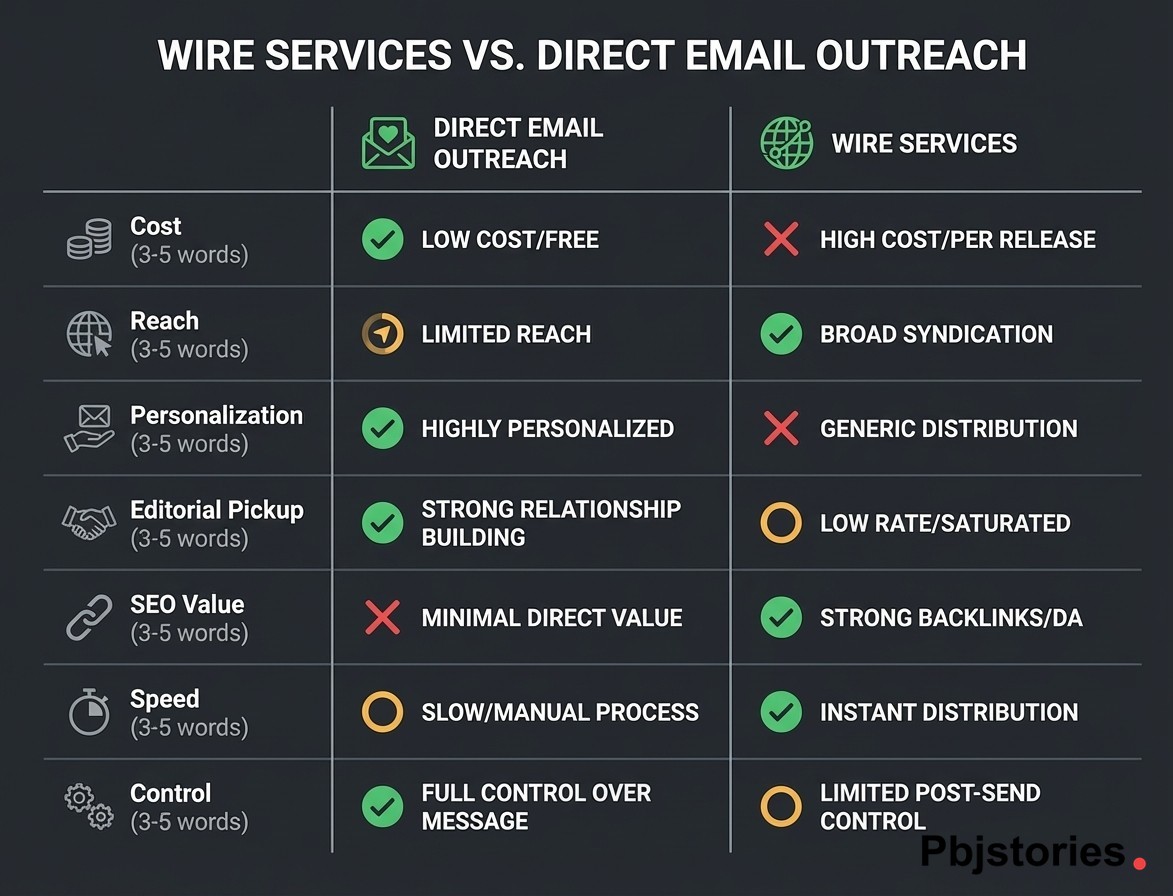
Many first-timers assume that paying for a wire service guarantees media coverage. It does not. Wire syndication and earned media through direct journalist outreach are fundamentally different, and confusing the two leads to wasted budgets and disappointed expectations.
Direct outreach puts your press release in front of specific reporters who cover your industry. The pros are significant:
- Free or low-cost, requiring only your time
- Builds genuine journalist relationships that pay off across multiple announcements
- Higher chance of real editorial coverage, which carries more credibility
- Personalized pitches signal relevance, so reporters are more likely to engage
The downsides: direct outreach is time-intensive, requires careful list-building, and reaches a smaller audience initially.
Wire services like Business Wire and PR Newswire solve different problems. They syndicate your release instantly to hundreds of outlets, financial terminals, and news aggregators. Pros include broad reach, SEO backlinks from high-authority domains, "as seen in" placements for social proof, and SEC compliance for public companies. On the other hand, wire pickups often appear alongside ads rather than editorial content, and pricing ranges from $100 to $1,500+ per release.
The most effective strategy combines both. Pitch your top 20--50 target journalists directly for earned coverage, then supplement with wire distribution for broader syndication. For a detailed comparison of distribution options, see best press release distribution services.
How Much Does Press Release Distribution Cost: Free vs. Paid Compared
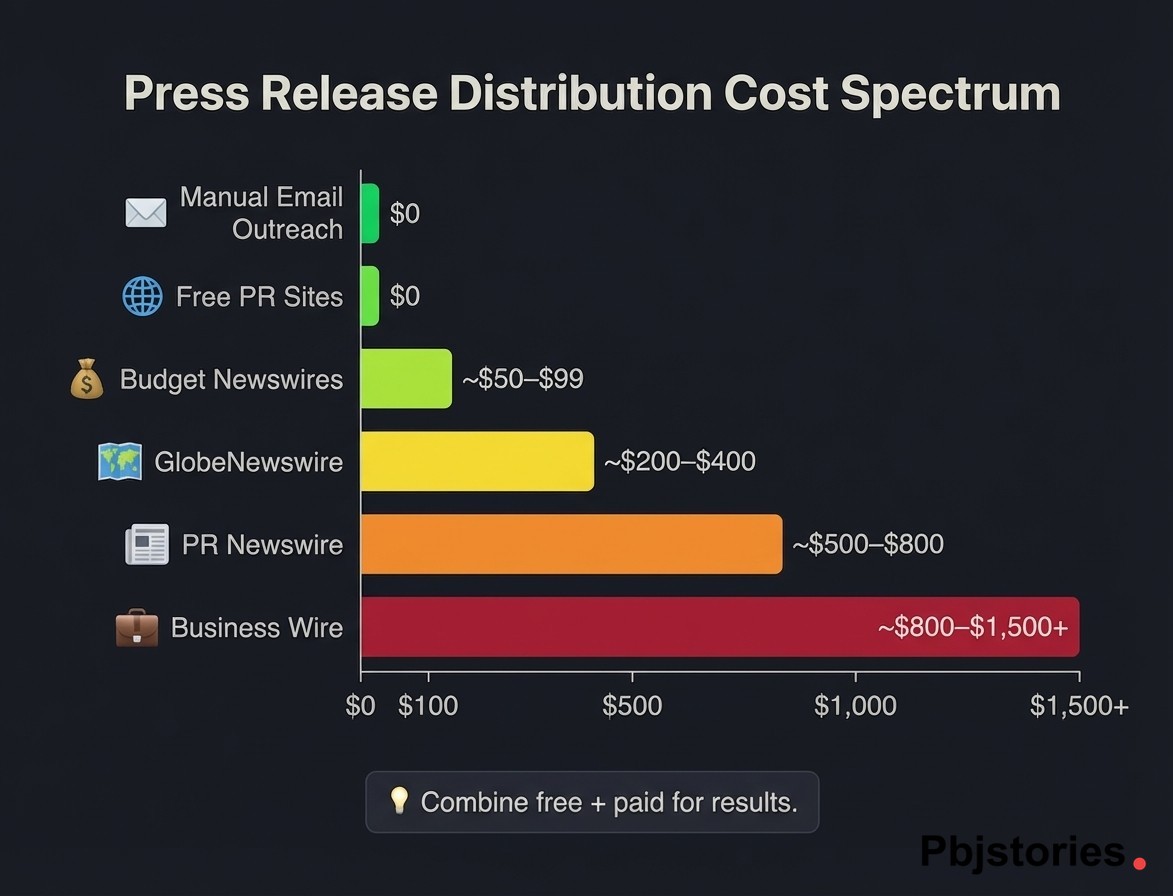
Distribution costs range from $0 to over $1,500 per release, depending on the method and reach you need.
DIY email outreach: $0 beyond your time. You build a media list, personalize pitches, and send directly. Free online PR submission sites also cost nothing but deliver minimal reach.
Budget wire services: EIN Presswire and Newswire.com charge roughly $100--$300 per release for basic national distribution. These provide decent syndication but limited targeting.
Major wire services: Business Wire, PR Newswire, and GlobeNewswire range from $400--$1,500+ per release depending on distribution scope and add-ons like multimedia embeds or analytics reports.
PR software subscriptions: Cision, Muck Rack, and Meltwater run $3,000--$10,000+ annually. These are media databases for ongoing PR programs, not per-release distribution tools.
The cheapest option is not always the smartest one. Some low-cost services syndicate exclusively to AI content farms and low-domain-authority sites, and those backlinks can hurt your SEO rather than help it. Search engines devalue links from spammy sources, so always verify where your release will appear before paying. For a deeper comparison, explore press release distribution platforms.
Best Time to Send a Press Release for Maximum Pickup
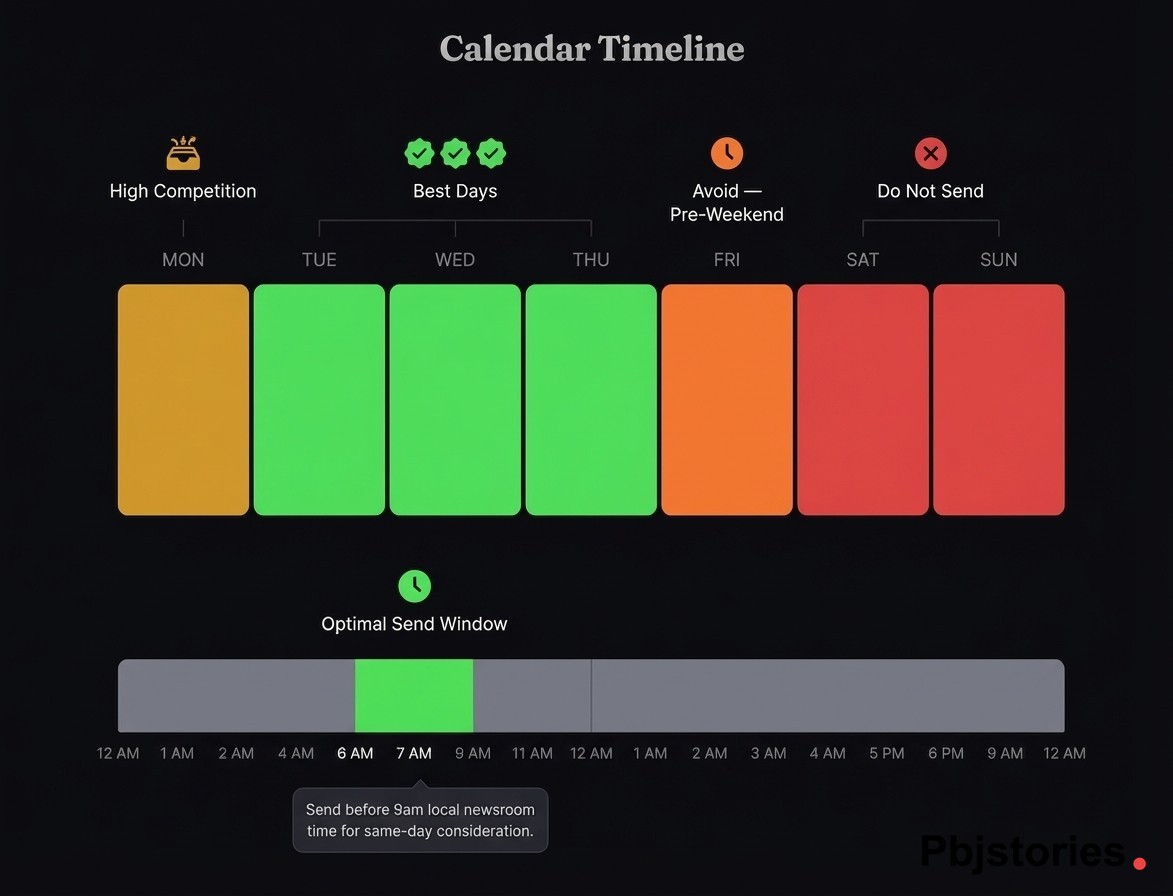
Tuesday through Thursday between 9 AM and 11 AM in the recipient's time zone consistently generates the highest open rates and media pickup rates. Journalists are settled into their workflow during midweek mornings, actively scanning for stories to cover.
Avoid Mondays. Reporters are clearing weekend inbox backlog and prioritizing assignments from editors. Fridays perform poorly too, since newsrooms shift toward weekend planning and engagement drops sharply.
Never send late afternoon or evening unless you are deliberately targeting a different time zone. Messages arriving after 3 PM typically get buried under the next morning's fresh pitches.
Breaking news is the exception. If your announcement is genuinely time-sensitive, send it immediately regardless of day or hour.
Also consider the broader news cycle. Sending on the same day as a Federal Reserve announcement, a major election, or a competitor's product launch means your release competes against stories that will dominate coverage. Check scheduled events before locking in your send date. For a deeper breakdown, see best time to send a press release.
How to Measure Press Release Distribution Success
Most people send a press release and never track what happened afterward. Without measurement, you cannot identify which methods, journalists, or timing produced results, making it impossible to improve future campaigns.
Focus on these key metrics after every distribution:
- Email open rates and click-through rates from tools like Mailtrack or HubSpot
- Number of media pickups and syndications across outlets
- Referral traffic to your website from press release links (check Google Analytics)
- Backlink acquisition using Ahrefs, SEMrush, or Google Search Console
- Social media mentions and shares across LinkedIn, Twitter/X, and Facebook
Set up Google Alerts for your company name and key phrases from the release. Pickups sometimes appear on outlets you never pitched directly, and alerts catch those you would otherwise miss.
Wire service platforms typically provide analytics dashboards showing impressions, outlet pickups, and geographic reach. Use these reports alongside your own tracking to build a complete picture.
The most valuable use of this data is refining your media list. Journalists who covered your last announcement are significantly more likely to cover the next one. Prioritize them in future outreach, and gradually remove contacts who consistently ignore your pitches. Measurement turns a one-time effort into a repeatable, improving system.
Common Press Release Distribution Mistakes to Avoid
Sending a generic mass blast to hundreds of journalists without personalization is the fastest way to get flagged as spam. Reporters can tell when a pitch was copied to 500 inboxes, and many email providers will filter bulk sends automatically.
Attaching the press release as a PDF instead of pasting it into the email body reduces your chances of coverage. PDFs trigger spam filters and force journalists to download a file before deciding whether the story is relevant.
Choosing the cheapest wire service without verifying where releases actually appear is a costly mistake. Some budget providers syndicate exclusively to AI-generated content farms, which can harm your domain authority rather than build it.
Skipping the follow-up is equally damaging. One polite email 2--3 days later significantly increases response rates.
Not having a dedicated newsroom page on your website forces journalists to dig for basic information. And distributing a poorly written release wastes every effort, because no distribution method can compensate for a missing news angle. Start with a strong press release foundation before planning any outreach.
Press Release Distribution FAQ
How Do I Distribute a Press Release for Free?
The most effective free method is direct email outreach to journalists who cover your industry. Combine that with self-hosting releases on your website newsroom, sharing on LinkedIn and Twitter/X, and submitting to free online PR submission sites.
Free distribution demands significantly more manual effort. You need to build media lists, research each journalist's beat, and personalize every pitch. Yet that effort often produces better earned media coverage than paid wire services, since editors value tailored pitches over syndicated blasts.
Should I Use a Newswire or Email Journalists Directly?
Direct outreach yields better earned media and real editorial coverage. It allows personalized pitching to reporters who actually cover your beat. Wire services are better for broad syndication, SEO backlinks, and "as seen in" credibility on recognizable outlets.
Best results come from combining both approaches. Pitch your top-priority journalists directly, then use wire distribution for wider reach and search visibility. For more on the backlink benefits of syndication, see our guide on press release SEO.
Should I Attach My Press Release as a PDF or Paste It in the Email?
Always paste the full press release text directly into the email body. PDF attachments trigger spam filters, are harder for journalists to copy from, and significantly reduce response rates.
If a journalist expresses interest in covering the story, offer to send high-resolution images, videos, or brand assets separately at that point.
How Many Journalists Should I Send My Press Release To?
A targeted list of 20--50 highly relevant journalists will outperform a mass blast to 500+ random contacts. Fewer, well-researched pitches generate higher response rates. Before adding anyone to your list, review their beat, recent articles, and publication focus to confirm your news fits their coverage area.
How Do I Find Journalist Email Addresses?
Start with journalist bylines and author pages on publication websites, which often include direct contact details. LinkedIn profiles and Twitter/X bios are another reliable source, as many reporters list their email publicly to receive pitches.
For individual lookups, tools like Hunter.io and RocketReach can surface verified email addresses. For ongoing PR programs, a media database subscription such as Cision or Muck Rack provides regularly updated contact data across thousands of journalists.
Distributing a press release effectively requires the right combination of targeting, timing, and platform reach. PBJ Stories simplifies this workflow by combining AI-powered writing with SERP-driven keyword optimization and distribution to 500+ high-authority news outlets, including Google News and Yahoo Finance. Instead of juggling multiple tools and media lists, you get a single platform that handles everything from drafting in AP style to publishing across hundreds of sites.
Whether you're a startup founder sending your first release or an SEO professional building entity authority at scale, PBJ Stories offers a per-release pricing model that eliminates the need for expensive agency retainers. Explore distribution options and see how a streamlined process can turn your next announcement into real media coverage.
Get PR tips delivered weekly
Join 3,200+ PR professionals getting actionable tips on press release writing, distribution, and media outreach.
No spam. Unsubscribe anytime.