
Press release SEO remains one of the most misunderstood tactics in digital marketing, largely because the strategy that worked in 2012 bears almost no resemblance to what drives results today. Mass-syndicated keyword-stuffed releases are dead. But properly optimized press releases distributed through Google News-indexed outlets still generate measurable rankings, brand authority, and even citations in AI-generated search answers.
The challenge is that most businesses either dismiss press releases entirely or execute them with outdated methods that trigger Google penalties instead of rankings. Meanwhile, practitioners who understand modern entity signals, structured distribution, and AI visibility are quietly using press releases to dominate local search results and appear in AI Overviews.
From keyword targeting and structural formatting to distribution platform selection and performance measurement, every element of the process has shifted. The strategies below reflect how press release optimization actually works against Google's current algorithms, large language model citation patterns, and the realities of earning media coverage in 2026.
What Is Press Release SEO and Does It Still Work in 2026?
Press release SEO combines keyword targeting, structured formatting, and strategic distribution to earn search visibility, brand authority, and media pickups from a single piece of content. Yes, it still works, but the mechanics have fundamentally changed.
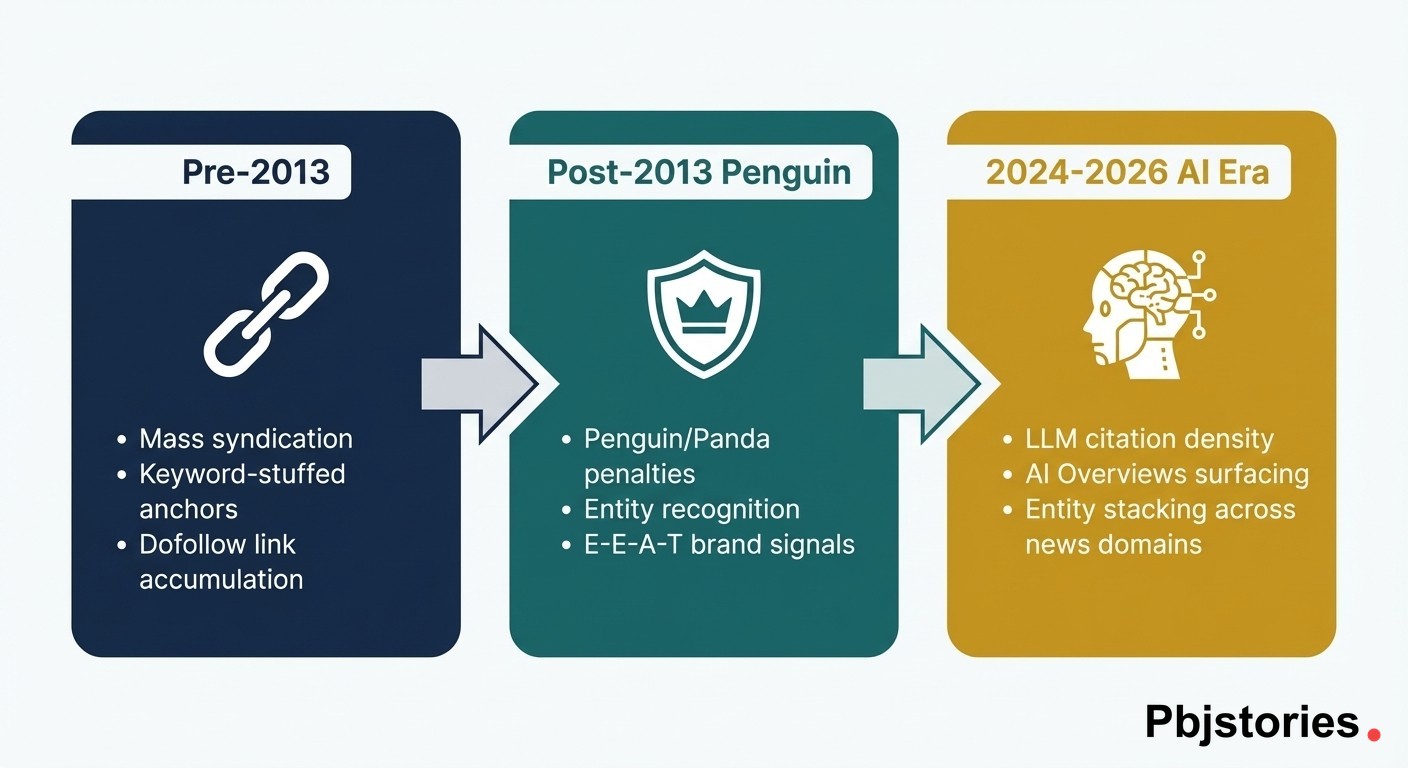
Before 2013, press releases functioned as direct link-building tools. Google's Penguin and Panda updates devalued mass-syndicated links, and the old playbook of keyword-stuffed anchor text became a liability.
However, modern press releases drive SEO through three indirect mechanisms. First, brand mentions across Google News-indexed outlets strengthen E-E-A-T signals. Second, journalists who discover your release and write original stories generate valuable secondary backlinks. Third, consistent mentions across authoritative domains create entity-level trust signals that reinforce Google Knowledge Panels.
The value shifted from link equity to brand authority. And that shift matters more than ever.
From Backlinks to AI Trust Signals: How Press Releases Have Evolved
Before 2013, SEO practitioners stuffed press releases with keyword-rich anchor text and syndicated them across hundreds of directories to accumulate dofollow backlinks. Google's Penguin algorithm update penalized this approach, devaluing mass-syndicated links and flagging unnatural anchor text patterns.
The focus then shifted to entity recognition. Modern press releases earn value through consistent brand mentions across Google News-indexed outlets, reinforcing what Google associates with a brand entity. This process, known as entity stacking, creates citation chains: when Yahoo Finance, AP syndication partners, and industry publications all reference the same brand in factual contexts, search engines gain confidence in that brand's legitimacy and topical relevance.
The bigger shift is happening now. Large language models like ChatGPT and Google's AI Overviews pull training data from credible newswire content. Google AI Mode and Bing Copilot already surface press release content as authoritative source material. AI models rely on citation density across trusted domains, so press releases directly influence how these systems describe and recommend brands. That represents a paradigm well beyond traditional backlink thinking.
Real Results: Traffic, Local Pack, and AI Overview Case Studies
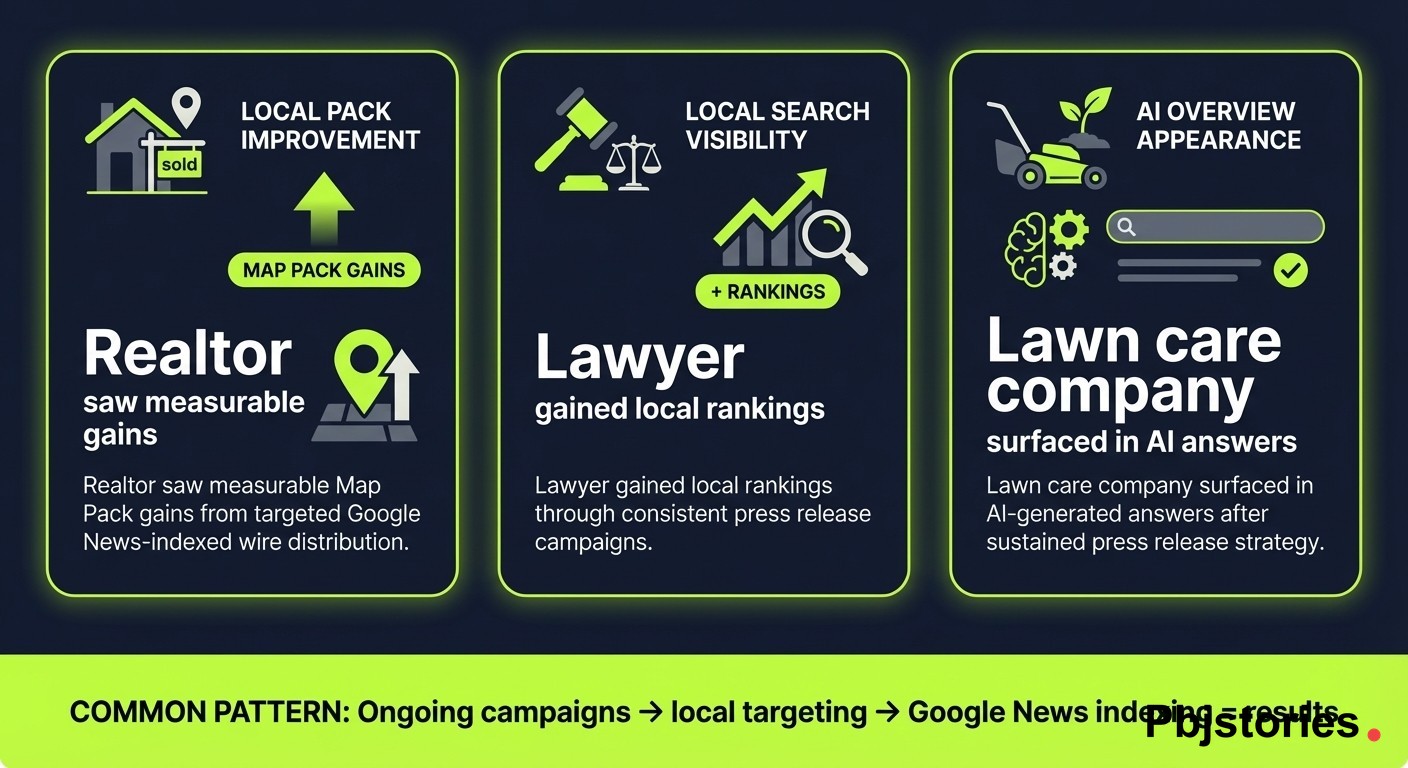
Sterling Sky's publicly documented testing provides the strongest evidence. A realtor running targeted press release campaigns saw measurable Local Pack improvements, while a lawyer gained visibility in local search results after consistent distribution through Google News-indexed wire services. Perhaps most notable: a lawn care company began appearing in AI Overviews after sustained releases, demonstrating how press release content now feeds directly into AI-generated answers.
Separately, Prezly documented the Cogent Realty case study, showing measurable organic traffic gains from SEO-optimized press releases distributed to credible outlets.
The pattern across all cases is consistent. Results came from ongoing campaigns, not single releases. Locally targeted content paired with distribution through wire services feeding Google News indexes produced the strongest outcomes, generating the authority signals that both traditional search and AI models rely on.
SEO Benefits of Press Releases: Backlinks, Visibility & Brand Authority
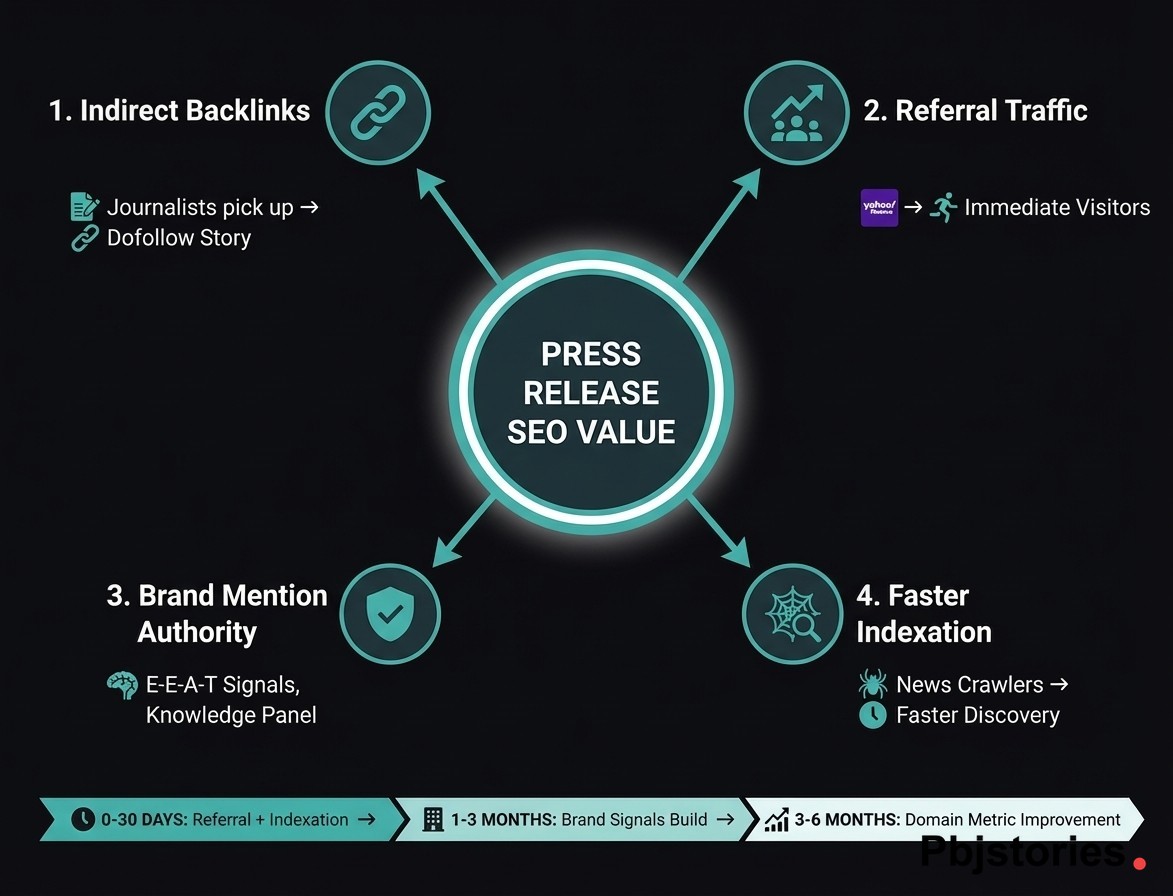
Beyond ranking signals, press releases deliver SEO value through four distinct channels: indirect backlink acquisition, referral traffic, brand mention accumulation, and faster indexation of new pages.
Most links from wire distribution are nofollow, so direct link equity transfer is minimal. The real backlink value comes from secondary pickups. When a journalist reads your release on PR Newswire or GlobeNewswire and writes an original story linking to your site, that link is typically dofollow and carries genuine authority.
Brand mentions across Google News-indexed outlets like Yahoo Finance and AP syndication create entity-level trust signals. Google associates consistent mentions with higher E-E-A-T scores, which can trigger or enrich Knowledge Panel appearances. These signals compound over time as search engines cross-reference brand citations across authoritative domains.
Be realistic about domain authority gains. A single release won't move your DR meaningfully. A sustained campaign of 1–2 releases per month, distributed through credible wire services like those PBJ Stories offers, can produce measurable domain metric improvements over 3–6 months. Referral traffic from syndicated outlets adds an immediate benefit while the longer-term authority signals build.
How to Optimize a Press Release for SEO
Effective optimization requires focus on three areas: keyword strategy, structural formatting, and technical elements like links, multimedia, and schema markup. Each directly influences how search engines and AI models process your release. For a step-by-step walkthrough, see our dedicated press release SEO optimization guide.
Keyword Research and Natural Placement
Press release SEO starts with targeting keywords your release can actually rank for. Instead of competing for ultra-competitive head terms, focus on low-competition, high-relevance queries identified through SERP analysis. Look for keywords where the current top results are thin, outdated, or lack authoritative news coverage. Those gaps represent realistic ranking opportunities for a well-optimized release.
Placement follows a clear priority order. Include the primary keyword in the headline, again within the first 250 words, and two to three times naturally throughout the body. Secondary keywords and location-specific terms should appear across subheadings and later paragraphs.
Resist the urge to force keywords. Google and major wire services like PR Newswire actively reject or devalue releases with unnatural keyword density. Write for journalists and readers first. A SERP-driven approach surfaces terms a release can realistically compete for, rather than guessing at targets.
Writing SEO-Friendly Headlines, Subheadings, and Boilerplates
Your headline determines whether journalists and search engines engage with the release. Include the primary keyword naturally, front-load the most critical information (who, what, where), and keep total length under 80 characters so Google displays it fully in search results.
Subheadings serve double duty. They break up the release body for readability and create additional keyword placement opportunities. Wire services like PR Newswire support HTML H2/H3 tags, so use them to reinforce secondary keywords and location terms throughout the release structure.
The boilerplate is an underused SEO asset. This section gets syndicated identically across every outlet, generating consistent entity signals at scale. Include branded keywords, your city or region, and a concise description of what the company does. This repetition across Google News-indexed domains reinforces your brand entity with every distribution. For proper boilerplate structure, see our how to write a press release guide.
Links, Multimedia, and Schema Markup
Limit your release to 1–2 links maximum, and use branded anchor text like "visit our newsroom" or your company name. Keyword-rich anchors signal manipulation to Google and risk penalties, mirroring the exact patterns Penguin was designed to detect.
Publish the release on your own domain before syndicating through any wire service. This establishes your site as the canonical source, so search engines attribute the original content to you rather than to syndication outlets.
Multimedia significantly increases journalist pickup rates. Embed images with keyword-optimized alt text, include video content where relevant, and for locally targeted releases, add a Google Map embed showing your business location.
On your own published version, apply Article schema markup to enhance rich result eligibility. If the content fits, add FAQPage or HowTo schema as well. Wire-distributed versions won't support structured data, which is precisely why your domain copy matters most for search visibility.
Press Release Distribution: Platforms, Outreach & Local SEO Tactics
Distribution quality outperforms volume. A release syndicated across 50 Google News-indexed outlets generates stronger SEO signals than 500 low-authority sites. Indexing authority determines how search engines and AI models weigh brand mentions.
Comparing Press Release Distribution Services
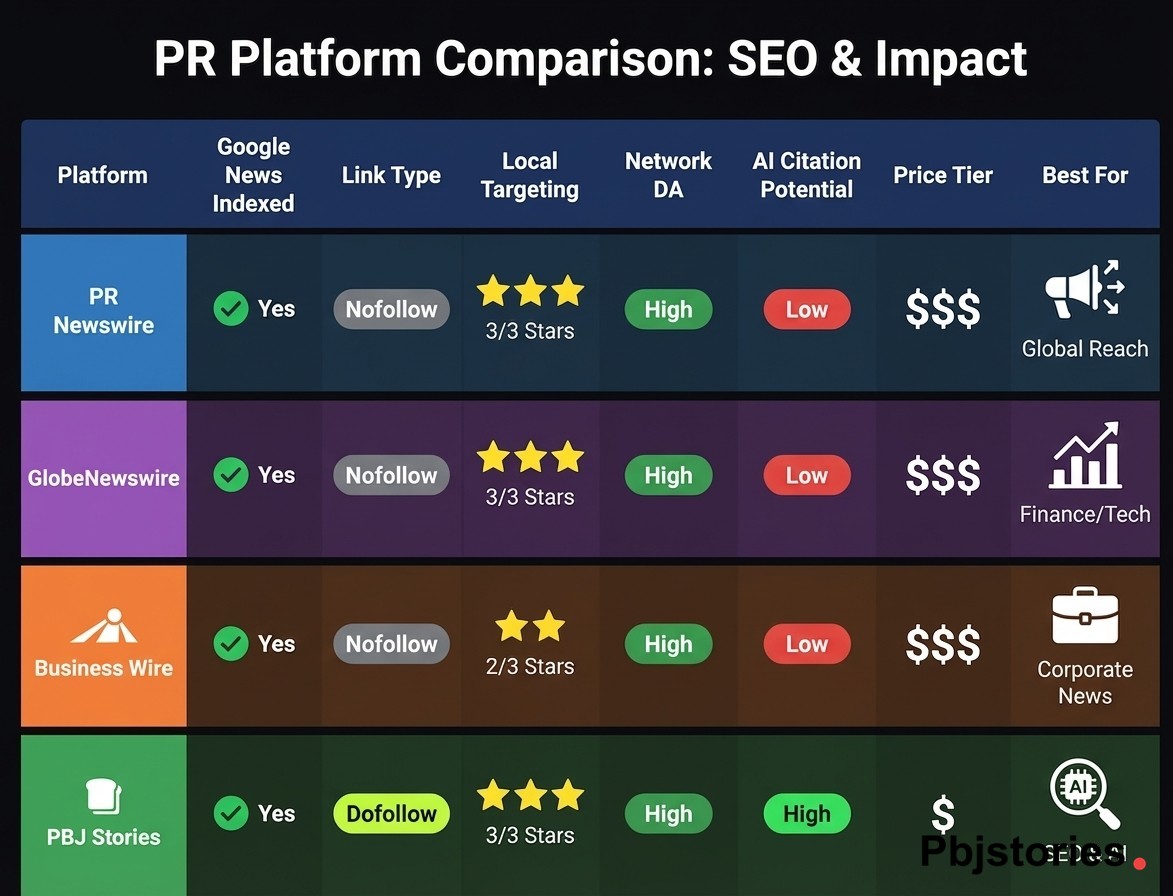
Not all wire services deliver equal SEO value. The gap between a $50 distribution and a $500+ distribution is enormous. Cheaper wires typically syndicate to low-authority sites that search engines and AI models largely ignore. For a detailed pricing and feature comparison, see our best press release distribution services guide.
PR Newswire offers the widest reach with strong Google News inclusion, though premium pricing ranges from $500 to $1,500+ per release.
GlobeNewswire serves financial and investor-focused releases particularly well.
EIN Presswire starts around $100 and maintains solid syndication reach for tighter budgets.
EZNewswire provides access to Reuters and AP syndication at mid-range pricing.
The core distinction: releases distributed through premium wires land on Google News, Yahoo Finance, and industry-specific outlets that generate real brand entity signals. Budget wires produce volume without meaningful pickup.
Wire distribution alone rarely generates original journalist coverage, however. Pairing syndication with manual outreach to 10–20 relevant reporters maximizes the chance of secondary pickups and dofollow backlinks.
Press Releases for Local SEO: GBP, Local Keywords, and Map Embeds
Locally targeted press releases strengthen Google Business Profile rankings by reinforcing your business entity across Google News-indexed local outlets. When local news sites publish content mentioning your business name, service area, and address, Google gains additional confidence in your GBP listing's relevance for local queries.
Effective local optimization requires weaving city, neighborhood, and region names naturally throughout the release body. Embed a Google Map showing the business location, and ensure NAP (Name, Address, Phone) details match your GBP listing exactly. Inconsistencies dilute entity signals.
Sterling Sky's testing documented Local Pack improvements for realtors and service businesses after locally optimized press release campaigns. Results came from sustained effort, not single releases. For measurable local SEO benefit, maintain a cadence of 1–2 locally targeted releases per month per GBP listing, each covering genuinely newsworthy local angles: community involvement, regional partnerships, or location-specific service expansions.
Common Press Release SEO Mistakes to Avoid
Most failed press release campaigns share the same preventable errors:
- Using keyword-rich anchor text instead of branded anchors. This mirrors the manipulation patterns Google's Penguin update was built to penalize.
- Publishing a single release and expecting results. SEO benefits compound through a consistent cadence of 1–2 releases per month, not isolated efforts.
- Choosing the cheapest wire service without verifying Google News indexation. A $50 distribution reaching only low-authority syndication sites adds noise without meaningful signal.
- Writing promotional content instead of genuinely newsworthy stories. Quality outlet editors flag and remove these, killing pickup potential.
- Stuffing releases with more than two links. Multiple outbound links raise spam flags across both wire services and search algorithms.
- Failing to publish on your own domain first. Without establishing canonical authority before syndication, wire copies may outrank your site.
One more trap: spammy group-buy syndication networks frequently promoted on Reddit. These bulk services distribute to disreputable sites that can actively harm brand reputation while delivering zero SEO value.
How to Measure Press Release SEO Success
Tracking the right metrics separates strategic campaigns from guesswork. Monitor these six KPIs after every release:
- New referring domains within 30 days, monitored in Ahrefs or Moz
- Referral traffic from syndicated outlets, measured in Google Analytics
- Keyword ranking movements via Google Search Console
- Brand mention volume using monitoring tools
- Media pickup rate: original stories versus syndicated copies
- Social share counts across platforms
Benchmark all metrics seven days before distribution, then compare at 7, 14, and 30-day intervals post-release. This before-and-after framework isolates the press release's direct impact from other marketing activity.
Beyond direct KPIs, track indirect signals that reveal deeper brand authority shifts. Monitor branded search volume increases in Google Search Console. Rising brand queries indicate growing awareness. Also check whether your Knowledge Panel appears or gains new attributes after sustained campaigns.
And don't overlook AI visibility. Query ChatGPT and Google AI Mode periodically to see if your brand surfaces in relevant answers. Consistent press release distribution through Google News-indexed outlets builds the citation chains these models rely on for recommendations.
Press Release SEO: FAQ
Are Press Release Backlinks Nofollow or Dofollow?
Most links distributed through wire services are nofollow, so they do not pass direct link equity to your domain. These nofollow placements still generate brand visibility, referral traffic, and entity recognition across authoritative news outlets.
The real backlink value comes from secondary pickups. When a journalist reads your release and writes an original story linking to your site, those links are typically dofollow. Editorial links follow standard publishing conventions rather than wire service policies.
How Often Should You Send Press Releases for SEO?
Aim for 1–2 press releases per month for sustained results. One-off releases rarely produce measurable long-term benefit. They fail to maintain link velocity or keep your brand visible in Google News indexes and AI training data.
Consistent cadence matters, but every release must be genuinely newsworthy: product launches, partnerships, research findings, community events, or milestone announcements. Fabricated news erodes credibility with journalists and editors, undermining the authority signals you're building.
Do Press Releases Influence AI Overviews and ChatGPT Answers?
Growing evidence from SEO practitioners confirms that AI search tools and large language models cite press release content distributed through credible newswires. These models pull training data from Google News-indexed domains like Yahoo Finance and AP syndication networks, so consistent releases create citation chains that AI engines reference when generating answers.
This area is evolving quickly. Early adopters building sustained press release presence on authoritative outlets are already seeing their brands surface in AI-generated summaries and recommendations.
Can Press Releases Improve Google Business Profile Rankings?
Yes. Locally targeted press releases with city-specific keywords, consistent NAP details, and Google Map embeds have produced measurable Local Pack improvements in documented case studies. The mechanism is entity reinforcement: when local news outlets publish content mentioning your business name, address, and service area, Google gains additional confidence in your GBP listing's relevance for local queries.
Press release SEO works best when writing, keyword targeting, and distribution operate as a single workflow rather than disconnected steps. PBJ Stories brings all three together on one AI-powered platform, helping startups, SEO teams, and PR agencies write and distribute releases to 500+ high-authority news outlets including Google News and Yahoo Finance.
If you are ready to build entity authority, earn contextual backlinks, and get your brand cited in AI-generated answers, PBJ Stories offers a per-release pricing model that replaces expensive agency retainers with measurable, repeatable results.
Get PR tips delivered weekly
Join 3,200+ PR professionals getting actionable tips on press release writing, distribution, and media outreach.
No spam. Unsubscribe anytime.