
Knowing how to optimize a press release for SEO requires more than stuffing keywords into a headline and blasting it across a wire service. Since Google discounted manipulative press release links in 2013, the strategy has evolved toward brand mentions, entity stacking, citation building, and visibility inside AI search tools like Google AI Mode and ChatGPT.
Most press releases published today fail to generate any measurable search impact. They use generic headlines, skip schema markup, ignore nofollow link requirements, and distribute through low-authority channels that neither journalists nor search crawlers take seriously.
The difference between a press release that builds lasting SEO value and one that disappears within 48 hours comes down to specific, repeatable optimizations across five areas: keyword targeting, link structure, technical markup, multimedia, and distribution strategy.
Why Press Releases Still Matter for SEO and AI Visibility
Press releases no longer pass direct link equity, but they remain one of the most effective tools for brand mentions, citation building, entity stacking, and AI indexing. The skepticism is understandable. Google discounted manipulative press release links back in 2013. Yet the value has shifted considerably since then.
Google confirmed that press releases are not classified as site reputation abuse, keeping them a legitimate tactic when executed correctly. Search engines still index wire service content, so each release reinforces your brand entity across authoritative domains.
Press releases feed signals into Google's Knowledge Panel, AI Overviews, and large language models like ChatGPT and Bing Copilot. They build the entity associations that determine how your brand appears in AI-generated answers.
How Google Treats Press Release Links and Content
Google indexes press release content but has discounted manipulative links since the 2013 updates to its Webmaster Guidelines. Any links within a press release should use rel="nofollow" attributes by default. Dofollow keyword-rich anchors, such as "best marketing platform" or "cheap SEO service," risk triggering manual penalties in Google Search Console.
The real SEO value lies elsewhere. Google recognizes brand mentions and entity associations from press releases even without passing direct link equity. Consistent mentions of your company name, executives, and products across authoritative news outlets strengthen entity signals that feed Knowledge Panels and search results.

How AI Search Tools and LLMs Index Press Releases
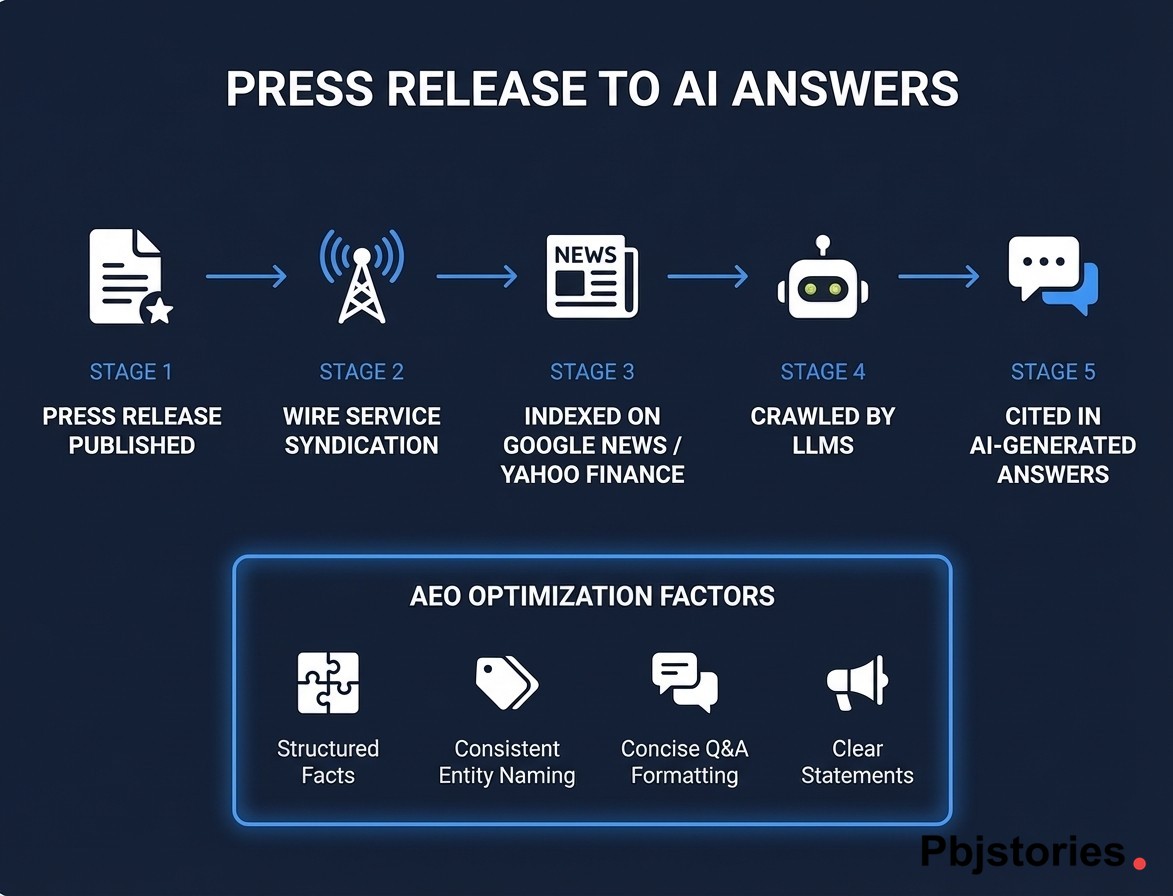
Google AI Mode, ChatGPT, and Bing Copilot pull answers from indexed content across high-authority news outlets, including Google News and Yahoo Finance. Wire services syndicate to these outlets, so press releases published through reputable distributors become part of the retrieval data that AI assistants reference.
Factual, brand-focused, and locally relevant releases are most likely to appear in AI-generated answers. Community discussions on Reddit have reported ChatGPT citing press release content directly when prompted about local businesses or recent product launches.
This shift has given rise to Answer Engine Optimization (AEO) for press releases. Structured facts, consistent entity naming (exact company name, location, product names), and concise Q&A-style formatting all increase the likelihood of LLM pickup. Clear who-does-what statements help AI tools extract and attribute information accurately.
Keyword Research and Strategic Placement for Press Releases
Keyword research must happen before writing, not after. Analyzing SERPs for low-competition phrases reveals terms a press release can realistically rank for. Competing against established editorial content with a syndicated release rarely works on high-volume keywords.
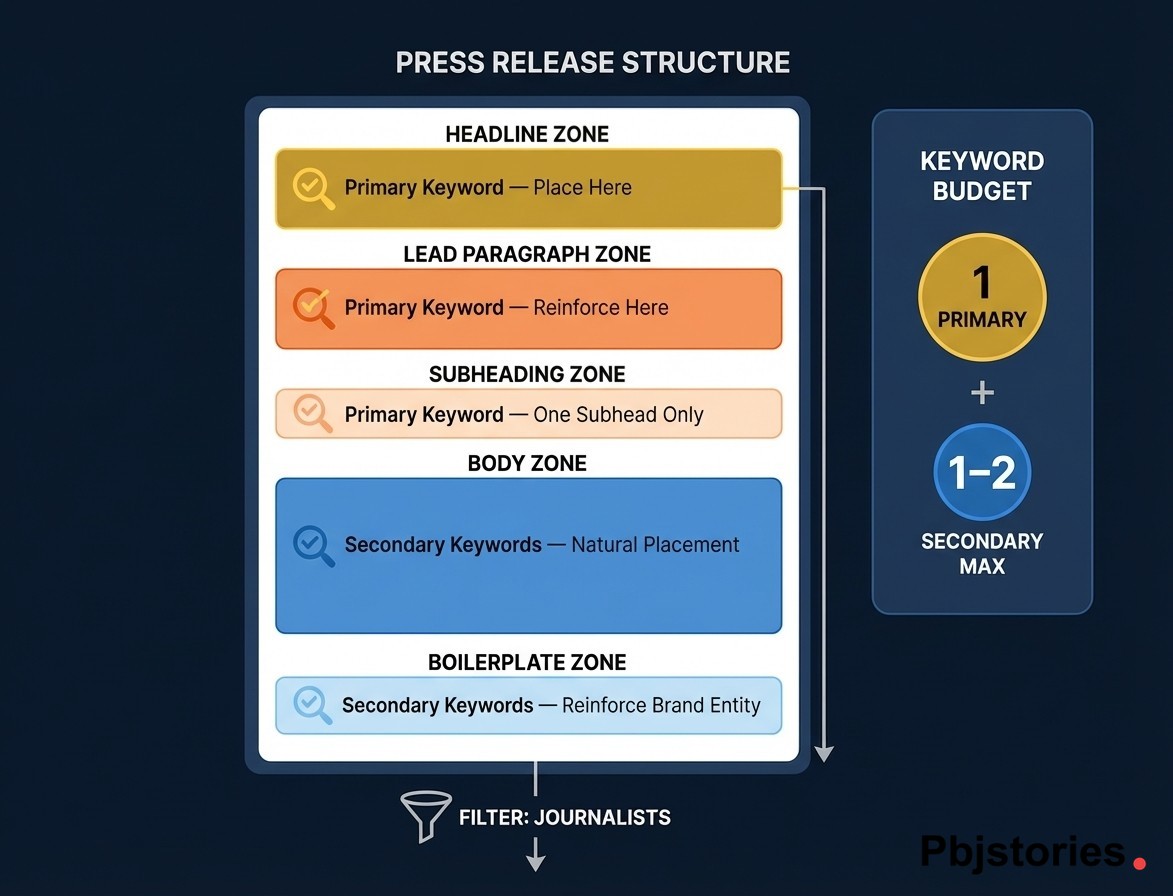
Target one primary keyword and one to two secondary keywords per release. More than that pushes the content toward keyword stuffing, which Google has penalized in press releases since 2013.
Strategic placement matters as much as keyword selection. Include the primary keyword in the headline, the lead paragraph, and one subheading. Secondary keywords should appear naturally within the body and the boilerplate. Every placement must read as newsworthy copy first, not SEO copy.
Journalists are the first filter. If a release reads like search engine spam, reporters skip it, and so does any meaningful editorial pickup.
Writing SEO-Friendly Headlines That Attract Journalists and Search Engines
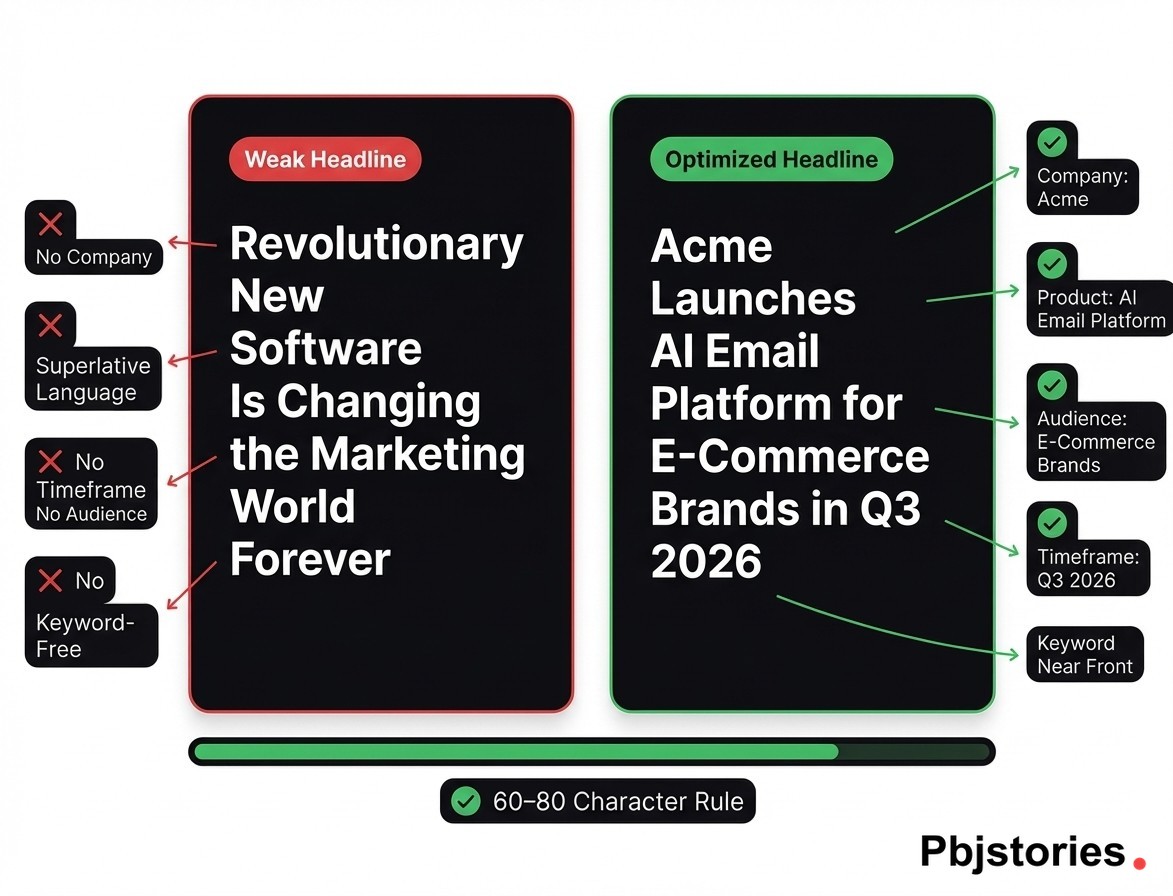
Keep headlines between 60–80 characters, place the primary keyword near the front, and communicate clear news value. Journalists scan hundreds of pitches daily, so vague or inflated language gets deleted instantly.
Avoid superlatives like "revolutionary" or "groundbreaking." Editors dismiss them as marketing fluff, and Google devalues empty modifiers that add no factual substance.
Compare these two approaches. Weak: "Revolutionary New Software Is Changing the Marketing World Forever." Optimized: "Acme Launches AI Email Platform for E-Commerce Brands in Q3 2026." The second headline names the company, the product category, the audience, and the timeframe.
Subheadlines or deck copy can carry secondary keywords while the main headline stays clean and newsworthy. This lets you target additional search phrases without cluttering the primary line that journalists actually read.
Structuring the 5 W's for Maximum Search Visibility
Every press release lead paragraph must answer five questions: Who is making the announcement, What is the news, Where it is happening, When it takes effect, and Why it matters. Pack all five into 25–30 words. Search engines and AI tools prioritize opening sentences for snippet extraction and AI Overview sourcing.
Keep the total press release body between 500–800 words. This length gives Google enough indexable substance while staying concise enough for journalists to read and republish. Shorter releases lack the depth needed for meaningful ranking; longer ones get ignored in newsrooms. For more detail on ideal length, see this guide on how long should a press release be.
Follow this structure for consistent results:
- Headline with primary keyword and clear news value
- Lead paragraph answering all 5 W's
- 2–3 body paragraphs with supporting details, data, and attributed quotes
- Boilerplate containing company description, founding details, and NAP (Name, Address, Phone) information
The boilerplate reinforces entity recognition across every outlet that syndicates the release, strengthening both local citation signals and Knowledge Panel data over time.
Link Optimization: Nofollow Tags, Anchor Text, and Avoiding Google Penalties
All press release links should use rel="nofollow" attributes. Google's John Mueller and the Webmaster Guidelines have been explicit about this, and violating the standard risks manual penalties in Google Search Console.
Limit each release to 1–2 links maximum. Multiple keyword-anchored links signal manipulation to Google's algorithms, which can trigger both algorithmic demotions and manual actions.
Use branded anchor text, such as your company name or product name, or naked URLs. Keyword-rich anchors like "best SEO tool" or "cheap press release service" are exactly what Google's guidelines flag as manipulative. Industry guidance on anchor text reinforces this: vary your anchors and keep them brand-focused.
Sometimes wire services syndicate dofollow links you never requested. Google Search Console's disavow tool serves as a safety net to neutralize unwanted link equity before it causes ranking problems.
Multimedia, Schema Markup, and Technical Press Release SEO
Optimized images, structured data, and embedded video form the technical layer that separates professional press release SEO from amateur efforts. These elements directly influence how search engines and AI tools classify, display, and prioritize your content.
Optimizing Images, Videos, and Infographics
Every press release should include at least one relevant image, whether a product photo, event image, or headshot of the quoted executive. Journalists are more likely to pick up releases that arrive with ready-to-publish visuals.
File naming matters for search engine indexing. Use descriptive, keyword-relevant filenames like "acme-product-launch-2026.jpg" instead of "IMG_4032.jpg." Alt text should describe the image content naturally, include a relevant keyword, and stay under 125 characters because search engines truncate longer descriptions.
Embedded videos hosted on YouTube or Vimeo increase dwell time and pickup rates. Add a descriptive title and transcript so search crawlers can index the video content. Infographics summarizing key data points boost social sharing and give journalists a visual asset worth republishing alongside your story.
Using NewsArticle and Organization Schema for Press Releases
Adding NewsArticle schema from Schema.org helps search engines classify your release as news content, which increases the likelihood of Google News indexing. Without this markup, crawlers may treat the page as generic web content.
Organization schema belongs in the boilerplate section. It reinforces entity recognition by structuring your company name, logo URL, founding date, and social profiles into machine-readable data. This structured format strengthens how Google's Knowledge Panel associates your brand with the announcement.
If the release includes a Q&A section, FAQPage schema can trigger rich results in SERPs. Most wire services apply these markups automatically. However, self-published releases on your own newsroom require manual implementation.
Press Release Distribution: Platforms, Outreach, and Local SEO
Even a perfectly optimized press release delivers zero SEO value if distribution fails. Where and how you publish determines whether your content reaches journalists, search indexes, and AI assistants.
PR Wire Services vs. Manual Journalist Outreach
Two distribution models exist: wire services and direct journalist pitching. Each serves a different SEO function, and the strongest strategy in 2026 combines both.
Wire services like Business Wire and PR Newswire provide scale, syndicating to 250–500+ outlets with guaranteed placement on Google News and Yahoo Finance. They also handle NewsArticle schema and nofollow attributes consistently, reducing manual technical work.
Manual outreach to niche journalists produces higher-quality editorial coverage. Journalists write original stories around your news, so these placements often include genuine dofollow backlinks. However, this approach requires relationship building and cannot scale beyond 5–10 targeted pitches per release.
The best approach: use wire distribution for baseline AI indexing and citation velocity, then pitch individually to relevant reporters for editorial pickup.
One common complaint is that most wire services distribute to low-authority spam sites. The distinction matters. Syndication to 500 low-DA outlets adds nothing. Syndication to AP, Yahoo Finance, Google News, and Bloomberg-affiliated outlets drives real entity recognition and search visibility. Evaluate platforms based on outlet authority, schema support, and nofollow handling rather than price alone.
Optimizing Press Releases for Local SEO and Google Business Profile
Press releases build NAP (Name, Address, Phone) citations across news outlets, reinforcing the local search signals that Google uses to validate business legitimacy. Each syndication creates a consistent mention of your business name, address, and phone number on an authoritative domain, improving citation accuracy across the local search ecosystem.
Include city, state, and neighborhood names in both the headline and lead paragraph for locally relevant announcements. This geographic specificity strengthens relevance signals for location-based queries.
Target local media outlets and regional publications during distribution. Consistent brand mentions across authoritative news sources can directly influence Google Business Profile visibility. Publishing press releases at least twice monthly per location helps maintain citation velocity for local rankings.
Press Release SEO Checklist
Use this as a quick reference before publishing any release:
- SERP-driven keyword research completed before writing
- Primary keyword placed in headline and lead paragraph
- 5 W's answered within the first 25–30 words
- Total word count between 500–800 words
- 1–2 links only, all using rel="nofollow" with branded anchor text
- At least one optimized image with descriptive filename and alt text under 125 characters
- NewsArticle and Organization schema applied
- Distribution targeting high-authority outlets indexed by Google News
- Local NAP info included in the boilerplate if geographically relevant
FAQ: Press Release SEO Questions Answered
Do Press Releases Still Help SEO in 2026?
Yes, but their role has shifted from direct link equity to brand visibility, entity stacking, citation building, and feeding AI/LLM indexes. Google confirmed that press releases are not classified as site reputation abuse, so they remain a legitimate tactic. The value now lies in how search engines and AI assistants recognize and reference your brand across authoritative news outlets.
Should Press Release Links Be Nofollow or Dofollow?
Google expects press release links to use rel="nofollow" attributes. Keyword-rich dofollow links risk manual penalties in Google Search Console because they violate Webmaster Guidelines. Use branded anchor text and limit links to 1–2 per release.
What Is the Ideal Word Count for an SEO Press Release?
500–800 words provides enough content for meaningful search engine indexing while keeping the release concise enough for journalist pickup. Shorter releases lack the substance needed for Google to index the page meaningfully. Longer releases get ignored in newsrooms.
Can Press Releases Improve Local SEO Rankings?
Yes. Press releases build NAP citations, generate local brand mentions across news outlets, and strengthen geographic relevance signals that influence Google Business Profile visibility. Include city and state names in headlines and lead paragraphs, then target local media outlets for distribution.
How Are AI Tools Like ChatGPT Using Press Release Content?
LLMs and AI search assistants index content from major wire services and news outlets like Google News and Yahoo Finance. Factual, entity-rich, brand-focused press releases published on high-authority outlets are most likely to surface in AI-generated answers. Structuring releases with clear entity naming and concise Q&A formatting increases the probability of AEO pickup.
Optimizing a press release for SEO requires the right keywords, strong entity signals, and distribution across outlets that search engines actually trust. PBJ Stories handles all three through its AI-powered platform, combining SERP-driven keyword research with distribution to 500+ high-authority news sites including Google News and Yahoo Finance.
If you want press releases that rank, build entity authority, and generate contextual backlinks without a $5,000/month agency retainer, try PBJ Stories and see measurable results from your next release.
Get PR tips delivered weekly
Join 3,200+ PR professionals getting actionable tips on press release writing, distribution, and media outreach.
No spam. Unsubscribe anytime.