

Choosing the right press release distribution platforms comes down to matching your budget, goals, and audience with a service that delivers measurable results. Most comparison articles recycle vendor marketing copy without addressing what PR professionals and startup founders genuinely care about: real pricing, honest trade-offs, and whether wire distribution still moves the needle in 2026.
The gap between a $0 free release on PRLog and a $2,500 PR Newswire package is enormous, yet the difference in outcomes is not always proportional to cost. Small businesses overspend on premium newswires when a targeted, keyword-optimized release through a mid-range platform would generate stronger search visibility. Meanwhile, enterprise teams underspend on distribution and wonder why their announcement never surfaces beyond a single syndicated page.
What follows is a direct comparison of every major platform, from the legacy Big 3 newswires to budget-friendly alternatives and AI-powered options like PBJ Stories, with transparent pricing, verified strengths and weaknesses, and guidance on maximizing ROI regardless of your starting budget.
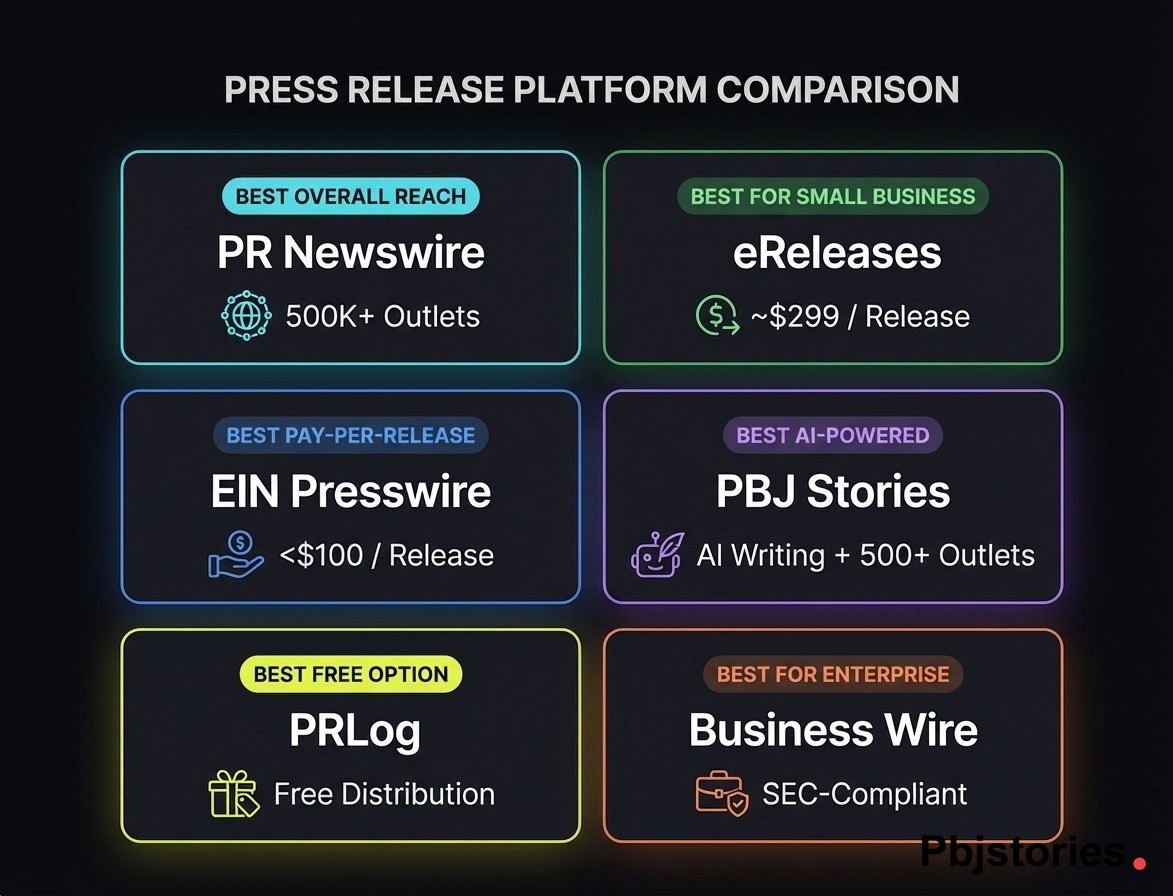
Quick Picks: Best Press Release Distribution Platform by Use Case
The best press release distribution platform depends on your budget, company size, and primary goal, whether that's SEO visibility, journalist coverage, or regulatory compliance.
Best overall reach: PR Newswire distributes to 500,000+ media outlets globally, making it the largest network for maximum exposure.
Best for small businesses: eReleases provides editorial guidance and newswire access starting around $299 per release with no annual contract.
Best pay-per-release value: EIN Presswire offers basic distribution under $100, ideal for companies testing wire services for the first time.
Best AI-powered writing + distribution: PBJ Stories combines SERP-driven keyword optimization with distribution to 500+ outlets, replacing the need for a separate copywriter or agency.
Best free option: PRLog provides basic search engine indexing at no cost, though without journalist targeting.
Best for enterprise and IR: Business Wire is preferred for SEC-compliant financial disclosures because of its regulatory distribution infrastructure.
How to Choose a Press Release Distribution Platform
Four criteria separate a smart investment from wasted budget: distribution reach, targeting options, pricing model, and reporting analytics. Evaluating platforms across all four prevents overspending on vanity metrics like raw outlet counts.
PR professionals commonly refer to PR Newswire, Business Wire, and GlobeNewswire as the "Big 3" newswires. However, smaller platforms often deliver better ROI for specific use cases, since they focus on niche audiences or flexible pricing instead of massive syndication networks.
Within the PESO model (Paid, Earned, Shared, Owned), wire distribution falls squarely under paid media. Understanding this distinction helps PR teams allocate budget correctly and set realistic expectations for what wire services actually produce versus earned media tactics like direct journalist pitching.
Distribution Reach and Media Network Size
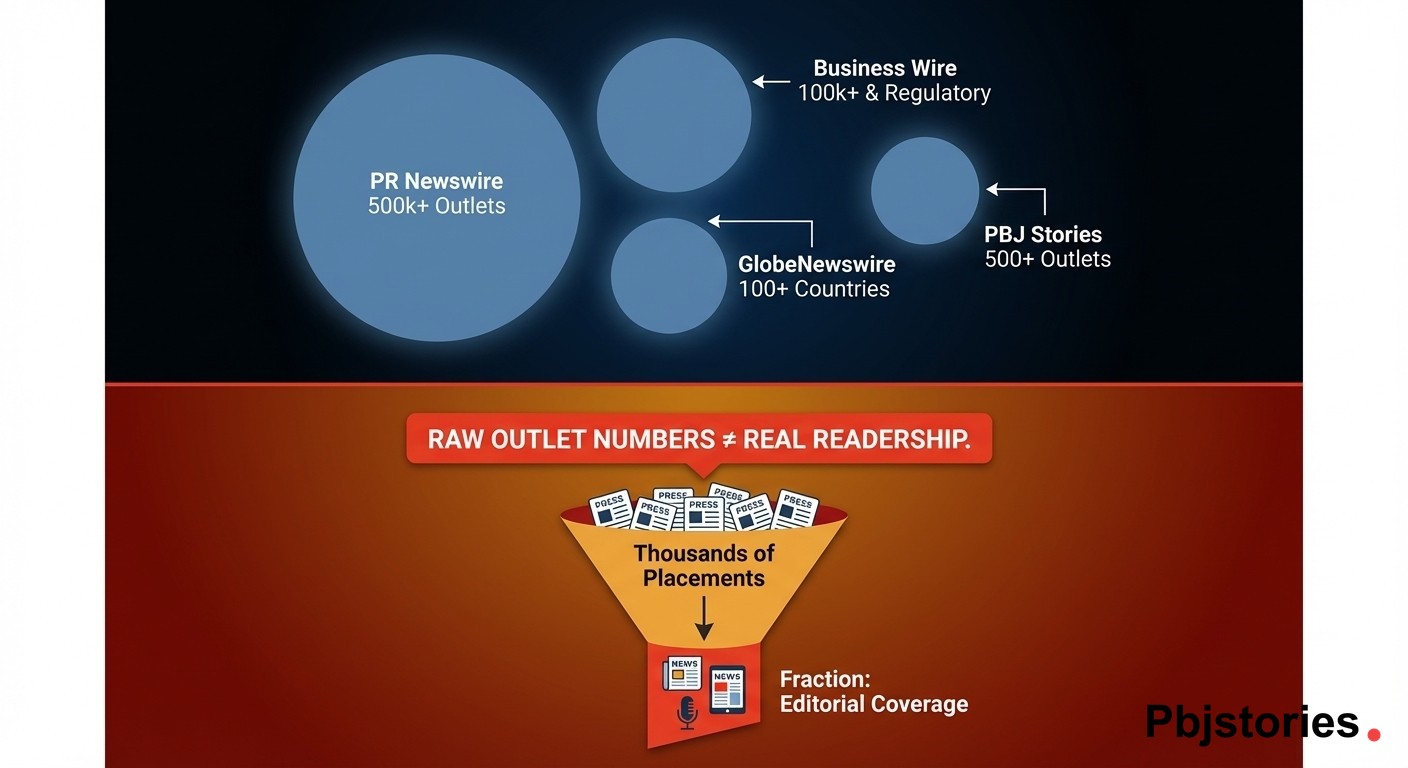
Reach refers to the total number of media outlets, newsrooms, and syndication partners a platform delivers your release to. PR Newswire claims distribution to 500,000+ outlets globally. Business Wire covers 100,000+ media outlets and regulatory systems. GlobeNewswire distributes across 100+ countries.
Raw outlet numbers are misleading, though. Many syndication partners are low-traffic websites that republish releases automatically, generating zero real readership. The metric that actually matters is how many placements land on the editorial side of legitimate publications versus buried press release pages.
Experienced PR professionals put it bluntly: most syndicated placements end up on low-authority sites with no real readers, and only a small fraction produce genuine coverage. Evaluating a platform's distribution quality requires looking beyond headline numbers at the actual publications where your release appears.
Industry and Geographic Targeting Options
Targeting directs your release to journalists by beat, industry vertical, or geographic region. PR Newswire and Business Wire offer the most granular options, including industry-specific circuits for healthcare, technology, and finance, along with regional targeting down to US state-level, European, and Asian markets.
Smaller platforms like eReleases provide industry targeting but lack that geographic precision. For region-specific needs, Newsfile is stronger for Canadian media distribution, while Pressat covers UK outlets more effectively.
Targeted distribution consistently outperforms broad blasts. Journalists receive fewer irrelevant pitches, which increases the likelihood of genuine engagement. Companies operating in a single vertical or geography should prioritize targeting quality over raw outlet volume, since a release reaching 200 relevant reporters delivers more value than one blasted to 10,000 mismatched contacts.
Pricing Models: Pay-Per-Release vs. Subscription vs. Free
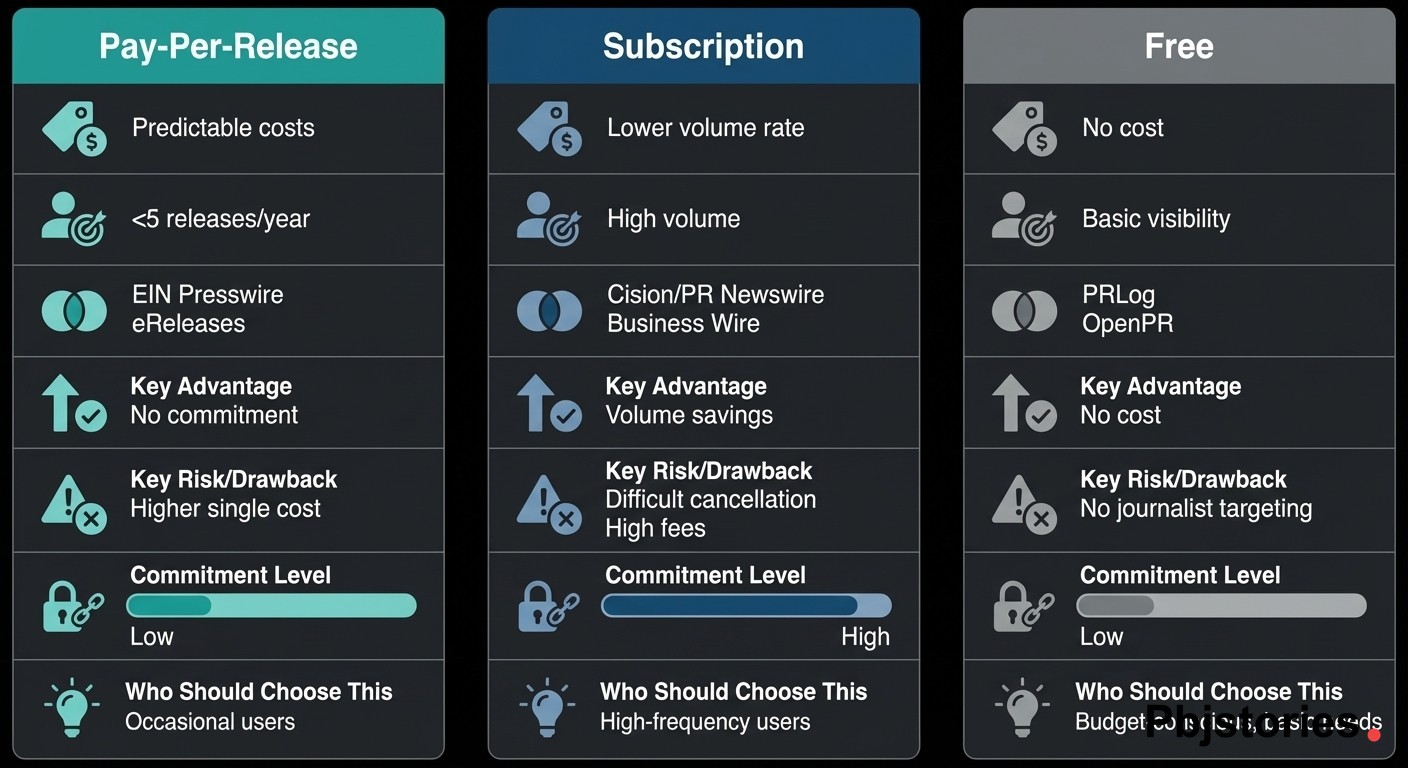
Three pricing structures dominate the press release distribution market: pay-per-release, subscription or annual contract, and free with limited features.
Pay-per-release platforms like EIN Presswire and eReleases charge per distribution. This model works best for small businesses and startups sending fewer than five releases per year, keeping costs predictable with no long-term commitment.
Subscription models from Cision/PR Newswire and Business Wire lock companies into annual contracts. Per-release rates drop at volume, but the total commitment is significant. PR professionals frequently warn about Cision's annual fees and difficult contract cancellation process.
Free platforms such as PRLog and OpenPR provide basic online visibility. They offer no major media outlet placement or journalist targeting, since their distribution networks lack newsroom partnerships. They serve one purpose: creating an indexed web page for search engines.
Best Press Release Distribution Platforms Compared
Each platform below receives an honest assessment of strengths, weaknesses, and real pricing. These evaluations draw from PR professional feedback and publicly available user discussions.
The Big 3 Newswires: PR Newswire vs. Business Wire vs. GlobeNewswire
PR Newswire, owned by Cision, operates the largest distribution network with 500,000+ media outlets globally. Over 70 years in operation, it has built strong US and international reach along with robust multimedia support for images, video, and infographics. Expect $500 to $2,500+ per release depending on geographic targeting, word count, and add-ons. Annual contracts are required for the best rates, and some users report billing friction.
Business Wire, a Berkshire Hathaway subsidiary, is the preferred wire for financial and investor relations disclosures. Its SEC and regulatory compliance features are built into the workflow, which is why public companies and enterprise communications teams favor it. Pricing runs comparable to PR Newswire, but its enterprise focus makes it less flexible for smaller organizations.
GlobeNewswire, part of Notified, offers competitive pricing against the other two while covering 100+ countries with strong multilingual release support. Muck Rack partners with GlobeNewswire for distribution, adding a media database layer for journalist targeting. Some users find the platform interface less polished.
Most PR professionals consider these three roughly equivalent in actual reach. Differences come down to pricing structure, customer service quality, and regional strengths. The choice depends on which contract terms and account management experience your company prefers, not on dramatic differences in distribution quality.
Budget-Friendly Alternatives: eReleases, EIN Presswire, and Newswire.com
eReleases is purpose-built for small businesses that need professional distribution without annual contracts. Each release reaches 550 news content systems and 3,000+ newsrooms, with pricing between $299 and $499 per release. The platform includes editorial guidance from real editors, which helps teams without dedicated PR staff.
EIN Presswire operates on a pay-as-you-go model with tiered packages. Basic releases start under $100, making it the lowest barrier to entry among legitimate best press release distribution services. EIN Presswire also highlights AI/LLM discoverability as a core benefit, since releases syndicated to major outlets increasingly feed large language model training data.
Newswire.com bridges the gap between wire distribution and media outreach by bundling a media database, monitoring tools, and distribution into one platform. Mid-range pricing and a track record with thousands of brands make it a solid middle-ground option.
These mid-tier platforms frequently deliver better cost-per-result than the Big 3, especially for companies prioritizing branded search presence and backlink value over Fortune 500-level media coverage.
Free and Low-Cost Options: PRLog, OpenPR, and Others
PRLog offers a free tier that creates an indexed web page for basic online visibility. It provides no journalist targeting and no placement on major media outlets. The value is narrow: a crawlable URL supporting branded search presence.
OpenPR follows a similar free model with limited reach. It works acceptably for local businesses and nonprofits announcing community events, but the distribution ceiling is low.
Free platforms will not generate media coverage or journalist pickup. They exist to create a searchable web page carrying your announcement. Nothing more.
For organizations with zero PR budget, a smarter approach combines a free PRLog release with direct email outreach to 10–15 relevant journalists. That combination consistently outperforms free distribution alone, since personal pitches give reporters a reason to respond.
Press Release Distribution Pricing Breakdown for 2026
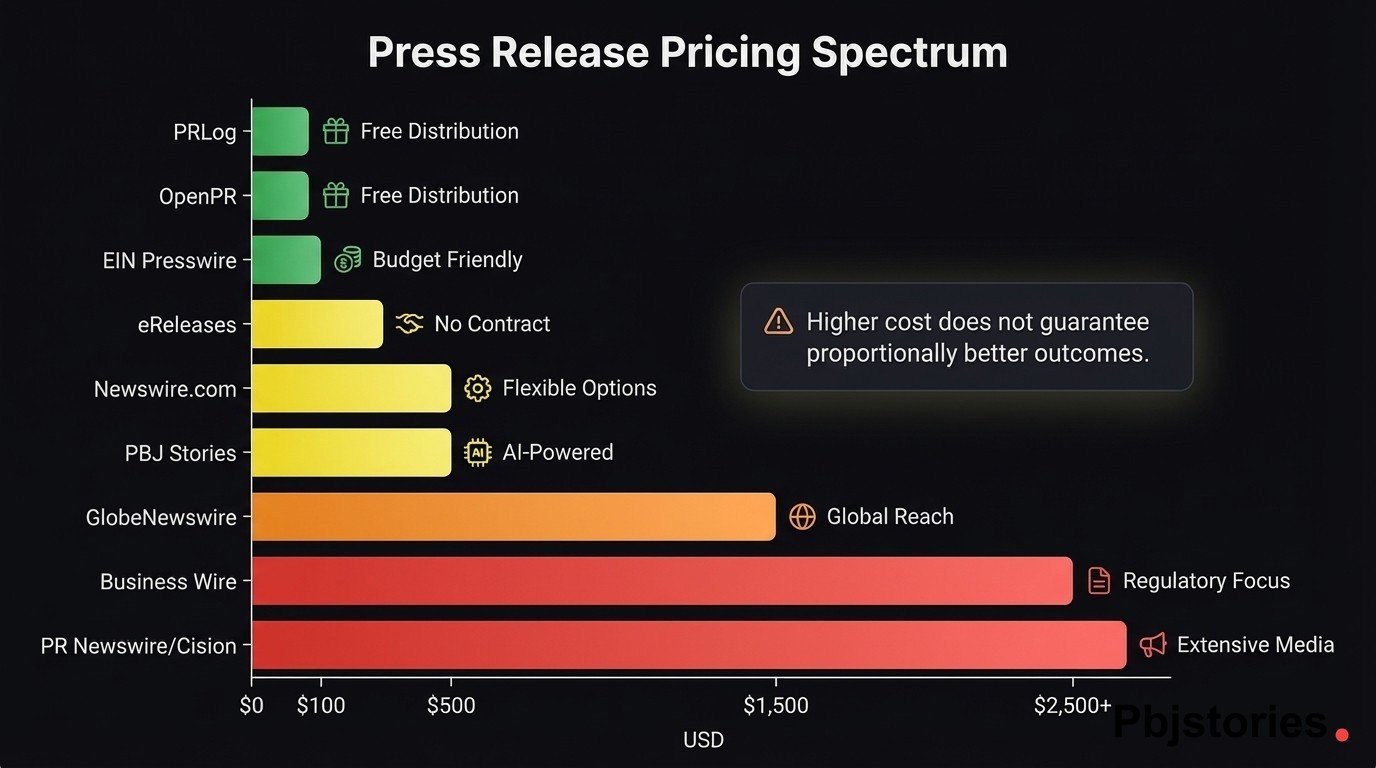
Costs range from $0 to $2,500+ per release depending on the platform tier and add-ons selected.
Free tier: PRLog and OpenPR cost nothing but provide no journalist targeting or major outlet placement.
Budget tier: EIN Presswire Basic starts around $49–$99 per release, suitable for first-time distribution.
Mid-range: eReleases charges $299–$499 per release with editorial support. Newswire.com falls between $199 and $599.
Premium tier: PR Newswire runs $500–$2,500+, Business Wire $500–$2,000+, and GlobeNewswire sits in a similar range.
Add-ons drive costs up quickly. Multimedia attachments, geographic targeting beyond a single region, extended word counts, and industry-specific circuits each increase the final price. Most premium vendors hide exact figures behind "contact us" forms, so these ranges reflect publicly available information and user-reported pricing.
For context, a typical PR agency retainer runs $3,000 to $10,000 per month. Self-service platforms cost a fraction of agency fees, especially for teams that write their own releases or rely on AI writing tools.
Are Press Releases Still Worth It in 2026? Wire Services vs. Direct Outreach
Yes, but only if expectations match reality. Most PR professionals now view wire distribution as a search visibility tool, not a media coverage tool. That distinction determines whether the investment pays off.
Wire services deliver measurable value in specific areas:
- SEO and contextual backlink building from high-authority domains
- Establishing presence on Google News, Yahoo Finance, and AP News
- Regulatory and financial disclosures requiring SEC compliance
- Building entity authority that strengthens Knowledge Panels
- Feeding AI and LLM training data, increasing brand visibility in tools like ChatGPT and Gemini
Wire distribution rarely produces journalist-written articles, however. Most placements are automated syndication, not editorial coverage. Wire services also generate minimal social media engagement and do nothing to build reporter relationships.
Direct journalist outreach consistently earns higher-quality coverage. Reporters respond to personalized, relevant pitches, but this approach demands time, media list research, and relationship capital that many teams lack.
The strongest PR strategy combines both methods. Wire distribution handles SEO, entity stacking, and AI discoverability at scale. Direct outreach targets high-value publications where editorial coverage moves the needle. Neither method alone is sufficient. Together, they cover paid and earned media within the PESO framework.
How to Maximize ROI from Press Release Distribution
Keyword optimization determines whether a release ranks or disappears. Target low-competition, high-relevance terms in your headline and body rather than generic industry phrases. SERP-driven keyword research identifies specific terms a release can realistically rank for in search results.
Entity stacking amplifies long-term value. By including consistent brand names, executive names, locations, and industry terms across multiple releases, you build topical authority that search engines and AI systems associate with your brand. This compounds over time, strengthening Knowledge Panel signals and branded search presence.
Releases indexed by high-authority news sites also become training data for large language models. Brands publishing well-optimized releases consistently appear more frequently in AI-generated answers from tools like ChatGPT and Gemini.
Measuring real ROI requires tracking the right metrics:
- Legitimate media pickups on editorial pages, not just syndication count
- Referral traffic from placement sites
- Backlink quality measured by domain authority of linking outlets
- Branded search volume changes over 30–90 days
Ignore vanity metrics like "published on 300+ sites." Most syndication placements sit on low-traffic pages with zero real readership.
Industry practice shows that releases distributed Tuesday through Thursday mornings, Eastern time, receive maximum journalist attention. And timing a release to coincide with relevant news cycles further increases pickup likelihood.
Frequently Asked Questions About Press Release Distribution
What Is the Best Press Release Distribution Service in 2026?
The best service depends on your goals and budget. PR Newswire offers the largest distribution network for maximum reach. eReleases is the strongest choice for small businesses, with editorial support and no annual contracts. EIN Presswire provides the best pay-as-you-go value. PBJ Stories combines AI writing, keyword optimization, and distribution for SEO-focused teams. For free distribution, PRLog remains the most established option.
How Much Does Press Release Distribution Cost?
Pricing ranges from $0 on PRLog and OpenPR to $2,500+ per release on PR Newswire with full targeting and multimedia. Mid-range platforms like eReleases and EIN Presswire fall between $99 and $499 per release. Cost increases with add-ons such as geographic targeting, multimedia attachments, and extended word counts. Requesting a quote before committing is essential, since most vendors hide exact figures behind contact forms.
Do Press Releases Actually Get Real Media Coverage?
Wire distribution alone rarely produces journalist-written articles. Most placements from wire services are automated syndication, not editorial coverage. For genuine media pickup, direct outreach to individual reporters remains far more effective, since it builds actual relationships.
Wire services deliver the most value for SEO, branded search results, AI discoverability, and regulatory compliance rather than earned media coverage.
Can Press Releases Improve SEO and AI Visibility?
Yes. Releases distributed to high-authority outlets like Google News and Yahoo Finance create contextual backlinks and build entity authority that search engines associate with your brand. Well-optimized releases targeting low-competition keywords can rank independently in search results.
Releases indexed by major news sites are also increasingly ingested by large language models. Consistent press release distribution is becoming a meaningful factor in AI-powered search visibility, since tools like ChatGPT and Gemini reference content from authoritative indexed sources.
Which Platform Is Best for Small Businesses with a Limited Budget?
Small businesses should prioritize pay-per-release platforms with no annual contracts. eReleases is purpose-built for this segment, with editorial support included at $299–$499 per release. EIN Presswire offers basic releases under $100, making it ideal for first-time distribution. PBJ Stories provides AI-assisted writing and distribution without agency retainer costs.
Avoid PR Newswire, Business Wire, and GlobeNewswire unless your budget supports $500+ per release. The incremental reach rarely justifies the cost for smaller brands.
Choosing the right distribution platform depends on your goals, whether that means maximizing media pickup, building entity authority for SEO, or simply getting a newsworthy announcement in front of the right audience without overspending. The best results come from combining strong writing, keyword-level optimization, and broad syndication in a single workflow.
PBJ Stories brings all three together. The platform uses AI to write AP-style releases, identifies low-competition keywords your release can actually rank for, and distributes to 500+ high-authority outlets including Google News and Yahoo Finance. If you want to skip the agency retainer and start building real visibility per release, explore PBJ Stories and see how it fits your next announcement.
Get PR tips delivered weekly
Join 3,200+ PR professionals getting actionable tips on press release writing, distribution, and media outreach.
No spam. Unsubscribe anytime.