
A press release does not strictly need to be one page, but one page is what journalists, wire editors, and distribution services like PR Newswire and Business Wire expect. The target is 300–500 words of body copy, with 400 as the sweet spot — enough room for the headline, dateline, lede, two or three body paragraphs, and one quote, and nothing else.
The one-page rule isn't a bureaucratic checkbox. It's a journalist-empathy signal. A reporter skimming a hundred pitches a day can tell within three seconds whether the writer respected that workflow, and a sprawling two-pager reads as "the writer couldn't find the news and hoped the editor would." The rule is arguably stricter today than in the fax-and-double-space 1990s, because Gmail clips long messages mid-pitch and Google News favors scannable density over comprehensiveness.
Below is the exact word count target by section, when a second page is genuinely justified, what counts toward the limit, and how to tighten a bloated draft into a publishable release. Start from a press release template if you want the structure already in place.
Does a Press Release Need to Be One Page? The Short Answer
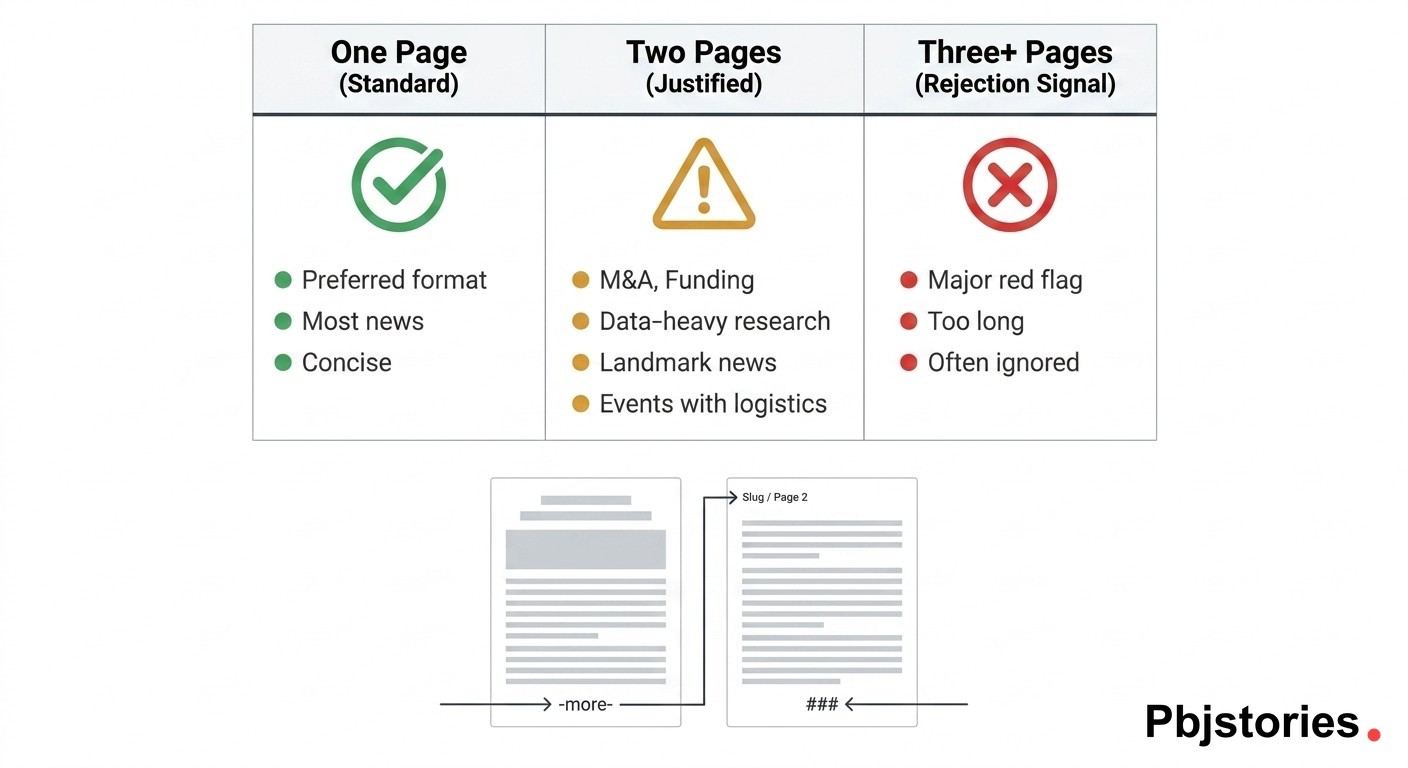
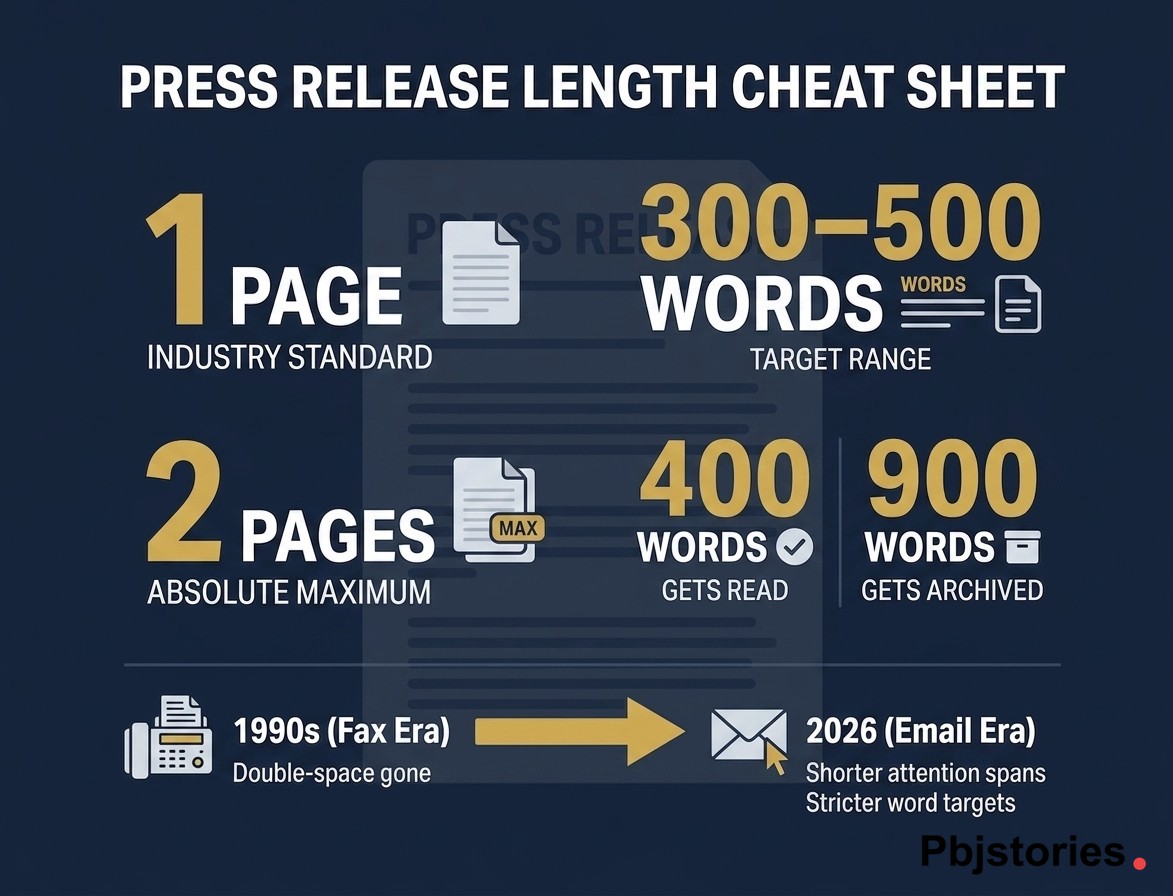
Yes. One page is the industry standard, and two pages is the absolute maximum that editors and wire services like AP, Reuters, and Business Wire will accept without cutting or ignoring the pitch.
In practical terms, a single page of letter-size paper with standard one-inch margins and a 12-point serif font holds roughly 300 to 500 words. That range covers the headline, dateline, lede, two or three body paragraphs, and one quote. Anything longer typically signals padding rather than added news value.
The rule exists because of how newsrooms actually work. A typical business or tech reporter skims hundreds of pitches a week, and editors allocate limited column inches to each story. Density matters more than comprehensiveness: a tight 400-word release gets read, while a 900-word release gets archived.
Think of the one-page norm as a journalist-empathy rule, not a bureaucratic checkbox. A merger announcement with mandatory legal disclosures can earn a second page; a product update cannot.
And the rule still holds in the email era. Faxing and double-spacing conventions are gone, but inbox attention spans are shorter than ever, so the 300–500 word target is arguably stricter today than it was in the 1990s.
How Long Should a Press Release Be? Word Count and Length Guidelines
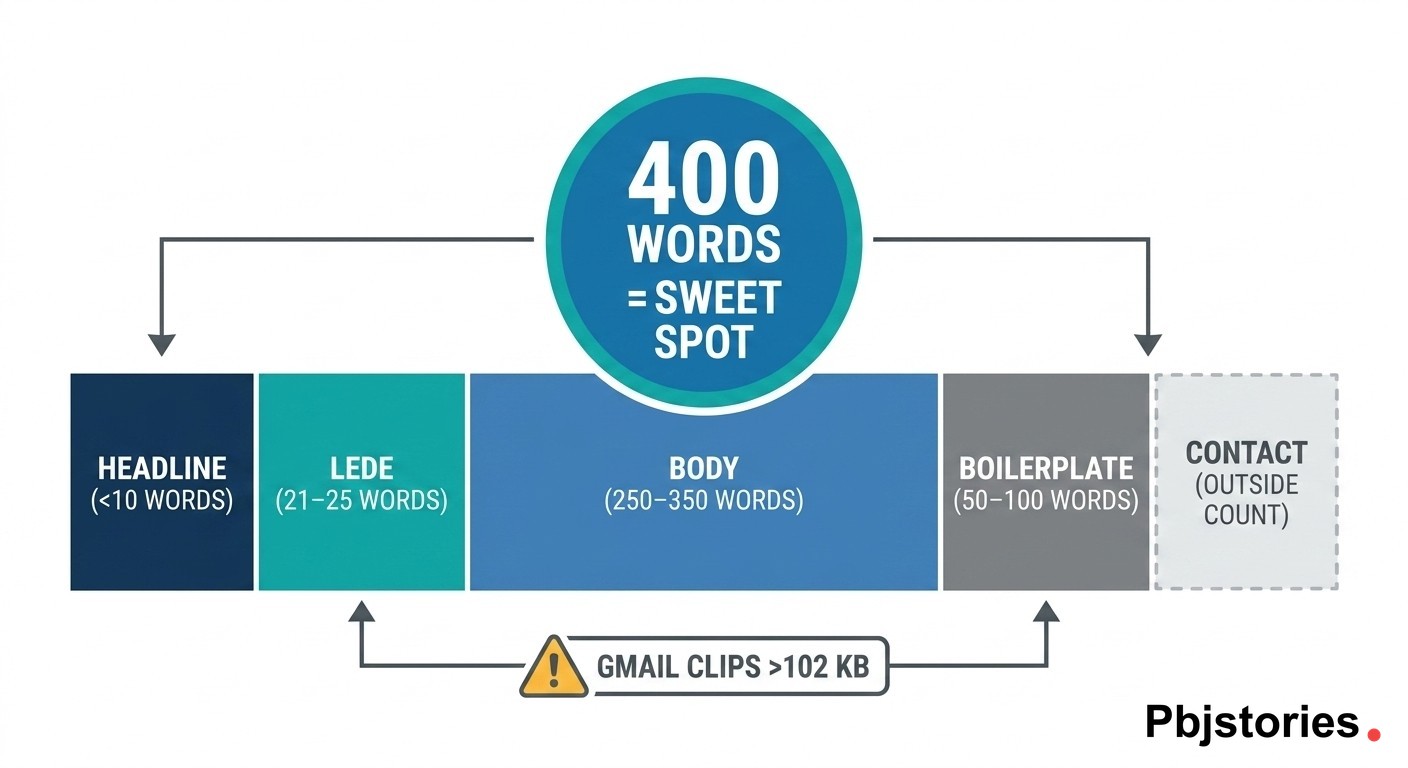
Aim for 300–500 words of body copy for a standard single-page release, with 400 words as the reliable sweet spot cited most often by newsroom editors and wire services.
That body includes your headline (under 10 words), optional subhead, dateline, lede, and three to four supporting paragraphs covering quotes, context, and data. Everything else is structural scaffolding.
The boilerplate (roughly 50–100 words), the media contact block, and the ### sign-off sit outside the 500-word body target. They still count toward the physical one-page limit on paper, so keep the boilerplate tight.
Your lede should land at 21–25 words and carry the full news value on its own. Editors often quote only the first sentence, so if it cannot stand alone with who, what, when, and where, the release will stall.
Digital delivery tightens the budget further. Gmail clips messages past roughly 102 KB, which truncates a long release mid-pitch, and Google News favors focused, scannable copy with a clear news hook over padded announcements.
Multimedia elements follow different rules:
-
Image and video embed links do not count toward the word budget
-
Logos and inline graphics still consume visual space on the page
-
Alt text and captions add perceived length even when word count stays low
A release packed with three hero images and a video may technically hit 380 words yet feel twice as long to a busy reporter.
Can a Press Release Be Two Pages? When It's Acceptable
Yes, a second page is acceptable, but only when the news itself demands the extra real estate. Padding never justifies page two; substance does.
Legitimate reasons to extend past one page include:
-
Major M&A or funding announcements that require mandatory legal disclosures, forward-looking statements, or SEC-referenced language
-
Data-heavy research releases where methodology, sample size, and key findings need to appear in the body
-
Landmark news with multi-executive quotes, such as a merger featuring statements from both CEOs
-
Event announcements bundling logistics, including speaker lists, session times, and venue details journalists will reference directly
Page-two formatting follows a strict convention. End page one with -more- centered at the bottom, and never split a paragraph across the page break because editors skim each page independently. At the top of page two, repeat a short slug (two or three keywords from the headline) followed by the page number, then continue the body. Close page two with ### centered below the boilerplate to mark the end.
The most common mistake is stretching to two pages to fit adjectives, background filler, or a duplicated boilerplate. If that is the only reason a release runs long, cut it instead.
Anything past two pages functions as a rejection signal. Wire distribution services flag overlong releases as poorly edited, and newsroom editors typically discard them before reaching the lede.
Standard Press Release Format and Structure That Keeps You on One Page
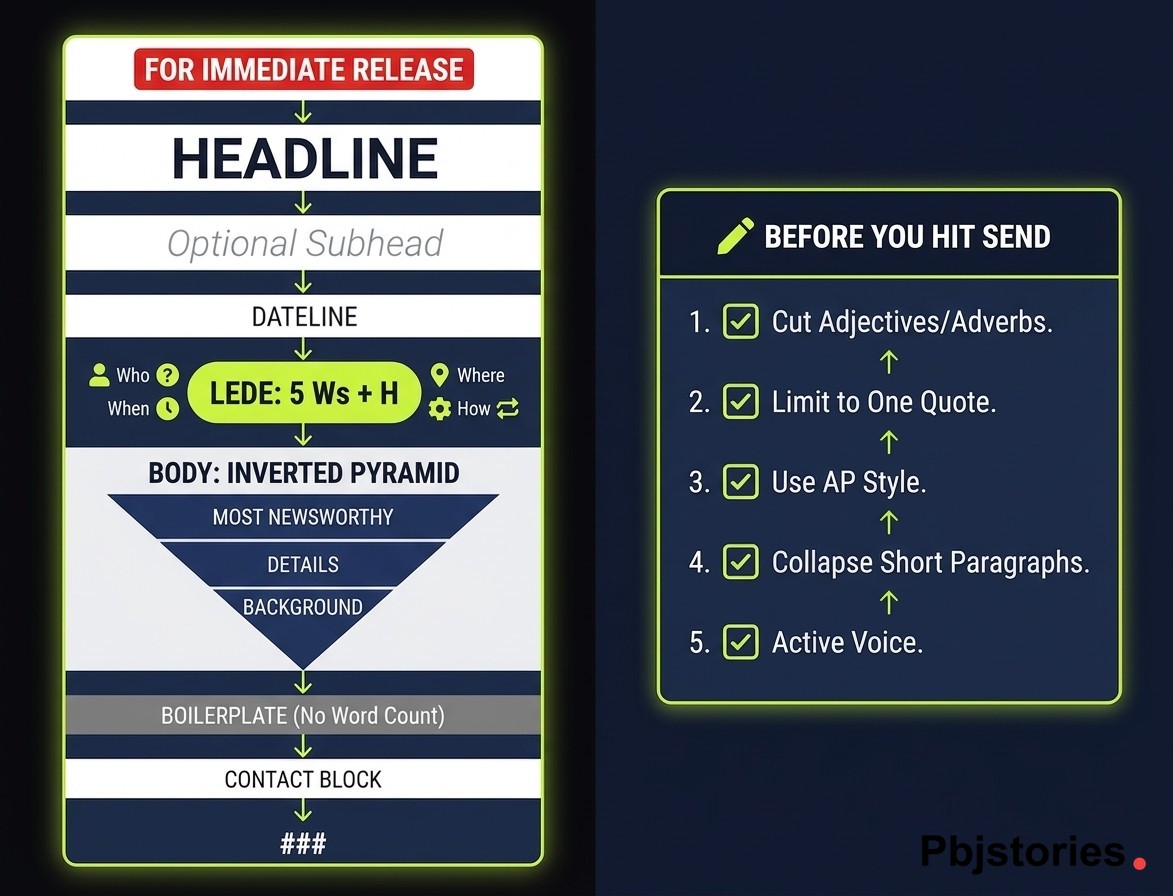
A single-page release follows a fixed order: FOR IMMEDIATE RELEASE tag, headline (under 10 words), optional subhead, dateline (CITY, State, Month Day, Year), lede, body in inverted pyramid, boilerplate, media contact block, and the ### sign-off.
The inverted pyramid does the heavy lifting. Your lede carries the who, what, when, where, why, and how; supporting quotes and context sit in the middle; background details go last so an editor can cut from the bottom without gutting the news.
Use this tightening checklist before sending:
-
Cut adjectives and adverbs that add no factual weight
-
Limit yourself to one quote unless the news truly requires two
-
Replace jargon with AP Style phrasing
-
Collapse two short paragraphs into one
-
Swap passive voice for active verbs
Start from a press release template rather than a blank page, and follow the full drafting workflow in this guide on how to write a press release.
AI-assisted drafting tools can auto-enforce AP Style and the 400-word target, which removes most of the manual tightening before distribution.
Press Release Length: FAQ
Does the Boilerplate Count Toward the One-Page Limit?
No. The boilerplate, media contact block, and ### sign-off are structural elements, not body copy, so they don't eat into the 300–500 word news target editors measure against.
They do, however, count toward the physical one-page limit on paper. Keep the boilerplate around 50–100 words so it doesn't push the release onto a second page unnecessarily.
How Many Words Should a Press Release Be?
A standard release runs 300–500 words, with 400 words as the sweet spot cited most often by newsroom editors and wire services. A two-page release caps near 700–800 words, and only when the news itself justifies the extra length.
For a deeper breakdown, see how long should a press release be.
What Qualifies as a Press Release?
A press release is a short, factual announcement of newsworthy information distributed to journalists and news outlets. It reports verifiable developments such as product launches, funding rounds, research findings, partnerships, or leadership changes.
Marketing copy does not qualify. A release must carry new, public-interest information written in a neutral, journalistic voice, not promotional language built around adjectives and calls to action.
Is a Press Release the Same as a News Release?
Yes. The two terms are used interchangeably in modern PR practice and refer to the same document format.
"News release" is the slightly more current preference among wire services like AP and Bloomberg because it emphasizes journalistic substance over the older print-press connotation. "Press release" remains the dominant search term and is still widely accepted across newsrooms.
Keeping a press release tight is easier when the writing, formatting, and distribution are handled in one place. PBJ Stories generates releases in AP style at the 300–500 word sweet spot, runs SERP-driven keyword research so the copy actually ranks, and pushes the final version to 500+ outlets including Google News and Yahoo Finance.
If you want a release that respects the one-page rule without sacrificing SEO value, let the platform handle the writing, optimization, and press release distribution from there.
Get PR tips delivered weekly
Join 3,200+ PR professionals getting actionable tips on press release writing, distribution, and media outreach.
No spam. Unsubscribe anytime.