
A press release dateline tells editors exactly where and when your news originates, and getting it wrong can undermine credibility before they even read your lead sentence. The format follows strict Associated Press Stylebook conventions for city names, state abbreviations, and dates, yet most formatting errors stem from confusing AP style with everyday writing habits like using postal codes or spelling out month names.
Whether you are issuing your first release or distributing dozens per quarter through a platform like PBJ Stories, the dateline is one of the smallest details that carries outsized weight. Journalists and wire editors scan it instantly to assess legitimacy. A malformed dateline signals inexperience.
What Is a Dateline in a Press Release?
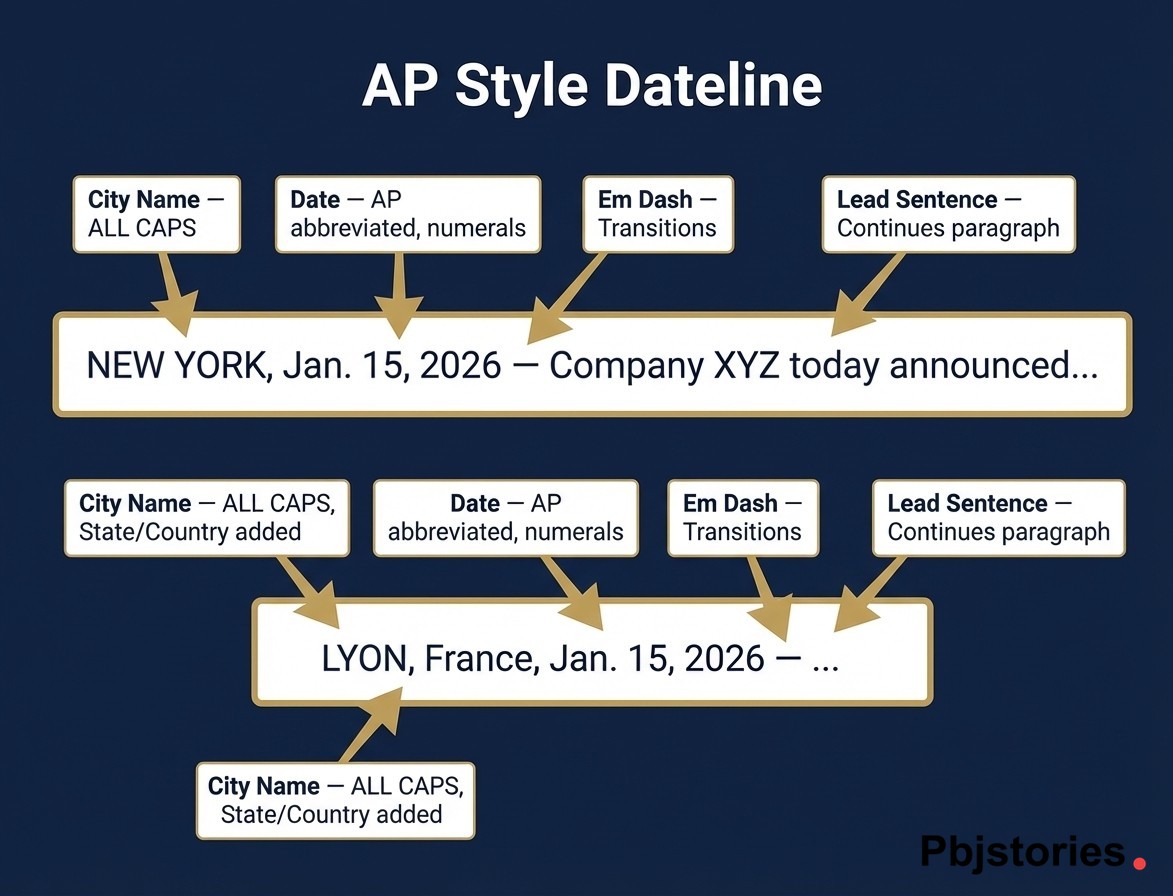
A press release dateline is the short line at the very beginning of the first body paragraph that states the originating city name (fully capitalized), a state abbreviation or country name if needed, and the distribution date. This line ends with a dash that transitions directly into the lead sentence. For example: NEW YORK, Jan. 15, 2026 followed by the opening of your story.
The dateline serves two functions. It tells journalists where the news originates, and it confirms when the release was issued. Reporters and editors rely on geographic and temporal context to evaluate newsworthiness, so a properly formatted dateline establishes trust before the reader finishes the first sentence.
This convention originated in newspaper reporting, where correspondents used datelines to indicate the city they filed from. Press releases adopted the same structure to mirror standard news article formatting.
Placement matters. The dateline sits inside the first paragraph of body text, below the headline and subheadline. It does not appear above the headline.
One persistent point of confusion: "FOR IMMEDIATE RELEASE" is a release designation, not a dateline. It appears above the headline to signal there is no embargo. The dateline is a completely separate element within the body copy, and these two are never interchangeable.
How to Format a Press Release Dateline in AP Style
The standard AP style press release dateline follows this structure: CITY, State Abbreviation, Month Day, Year, then a dash before your lead sentence. For a standalone city, the format is simply: NEW YORK, Jan. 15, 2026, followed by the opening line.
The city name is always fully capitalized. The state abbreviation appears in title case (Calif., not CALIF.), separated by commas. A space and dash connect the date to the lead sentence because the dateline and opening line form a single paragraph.
The Associated Press Stylebook serves as the industry-standard reference for this formatting. Distribution platforms like PR Newswire, Business Wire, and GlobeNewsWire enforce AP style dateline rules during submission. Formatting correctly before distribution avoids delays and editorial corrections. For broader guidance, see these press release formatting tips.
City Names That Stand Alone in AP Style Datelines
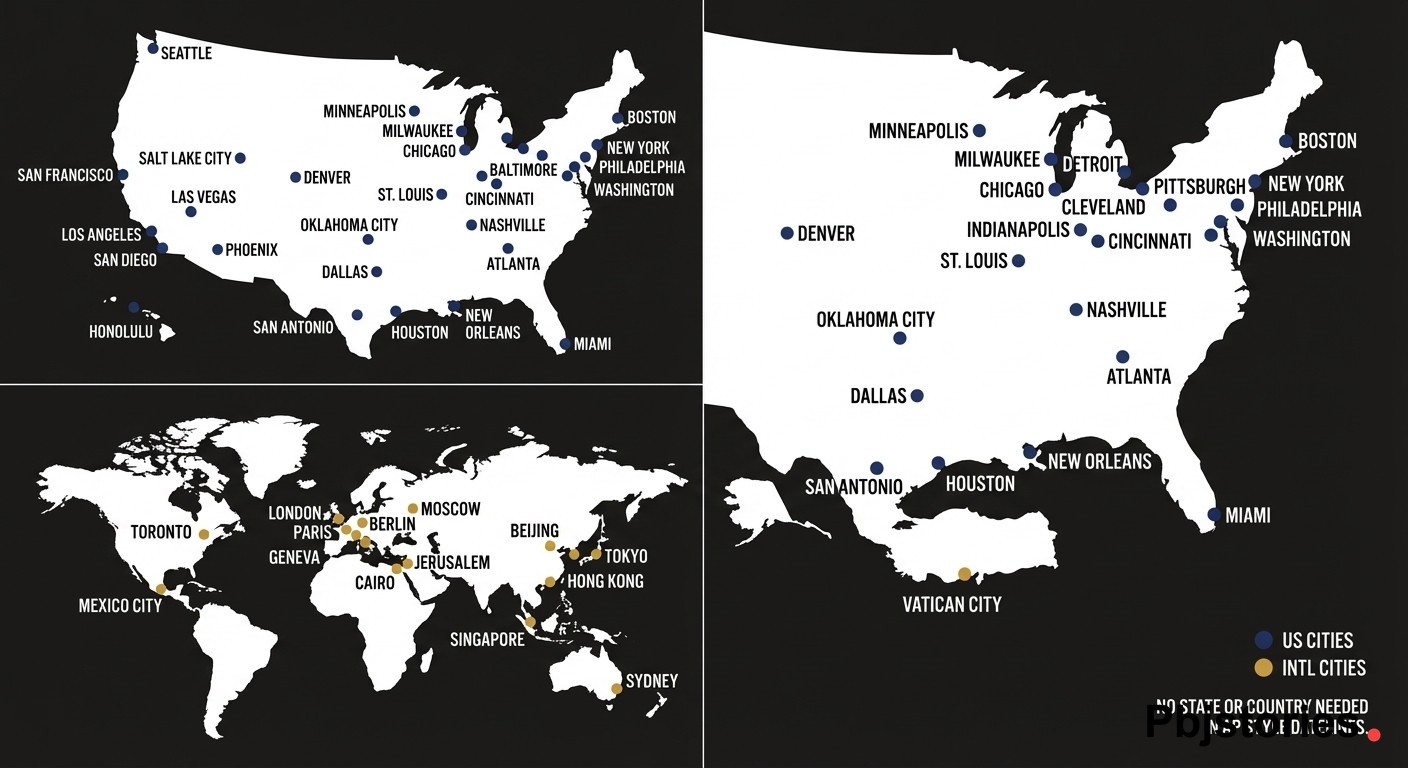
Certain major U.S. cities are so widely recognized that the AP Stylebook allows them to appear without a state name. Adding a state would be redundant.
Domestic standalone cities include: Atlanta, Baltimore, Boston, Chicago, Cincinnati, Cleveland, Dallas, Denver, Detroit, Honolulu, Houston, Indianapolis, Las Vegas, Los Angeles, Miami, Milwaukee, Minneapolis, Nashville, New Orleans, New York, Oklahoma City, Philadelphia, Phoenix, Pittsburgh, Salt Lake City, San Antonio, San Diego, San Francisco, Seattle, St. Louis, and Washington.
Similarly, roughly 50 international cities stand alone without a country name. Key examples: Beijing, Berlin, Cairo, Geneva, Hong Kong, Jerusalem, London, Mexico City, Moscow, Paris, Rome, Seoul, Singapore, Sydney, Tokyo, Toronto, and Vatican City.
For international cities not on the standalone list, the country name follows the city: LYON, France, Jan. 15, 2026. Country names use AP style English spelling, not ISO codes.
The Associated Press updates its standalone city list periodically, so check the current edition of the AP Stylebook before finalizing your dateline.
AP Style State Abbreviations vs. Postal Codes
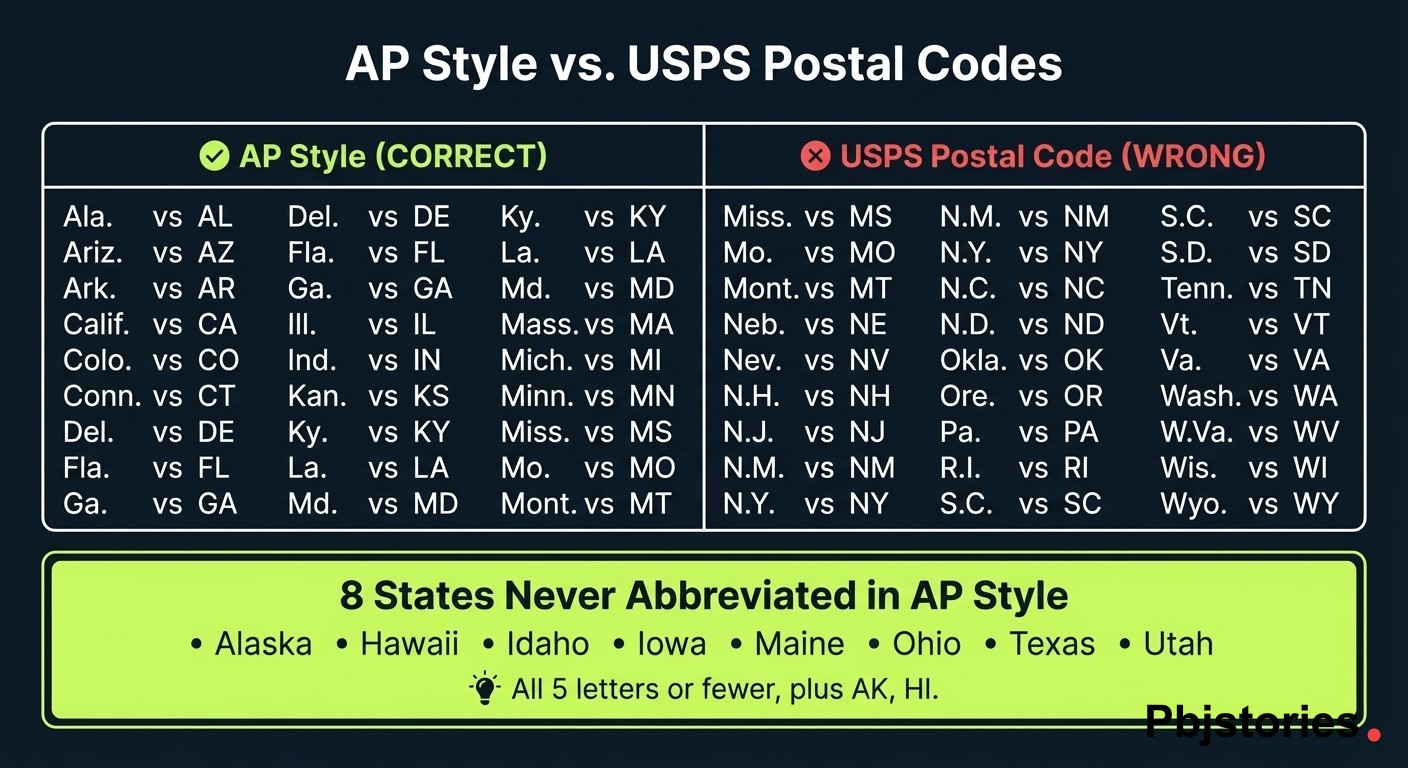
One of the most common dateline errors is substituting USPS two-letter postal codes for AP style state abbreviations. These are entirely different systems. Write Calif. not CA, Fla. not FL, Mass. not MA, Conn. not CT, and Mich. not MI. Postal codes exist for mail sorting, while AP abbreviations follow journalism conventions defined by the Associated Press Stylebook.
Eight states are never abbreviated in AP style: Alaska, Hawaii, Idaho, Iowa, Maine, Ohio, Texas, and Utah. A helpful mnemonic: all have five or fewer letters, plus Alaska and Hawaii.
For quick reference, here is the complete list of AP state abbreviations:
Ala., Ariz., Ark., Calif., Colo., Conn., Del., Fla., Ga., Ill., Ind., Kan., Ky., La., Md., Mass., Mich., Minn., Miss., Mo., Mont., Neb., Nev., N.H., N.J., N.M., N.Y., N.C., N.D., Okla., Ore., Pa., R.I., S.C., S.D., Tenn., Vt., Va., Wash., W.Va., Wis., Wyo.
Distribution platforms like PR Newswire and Business Wire expect AP abbreviations. Submitting postal codes often triggers reformatting delays, so getting this right in your press release template saves time.
Date and Time Formatting Rules
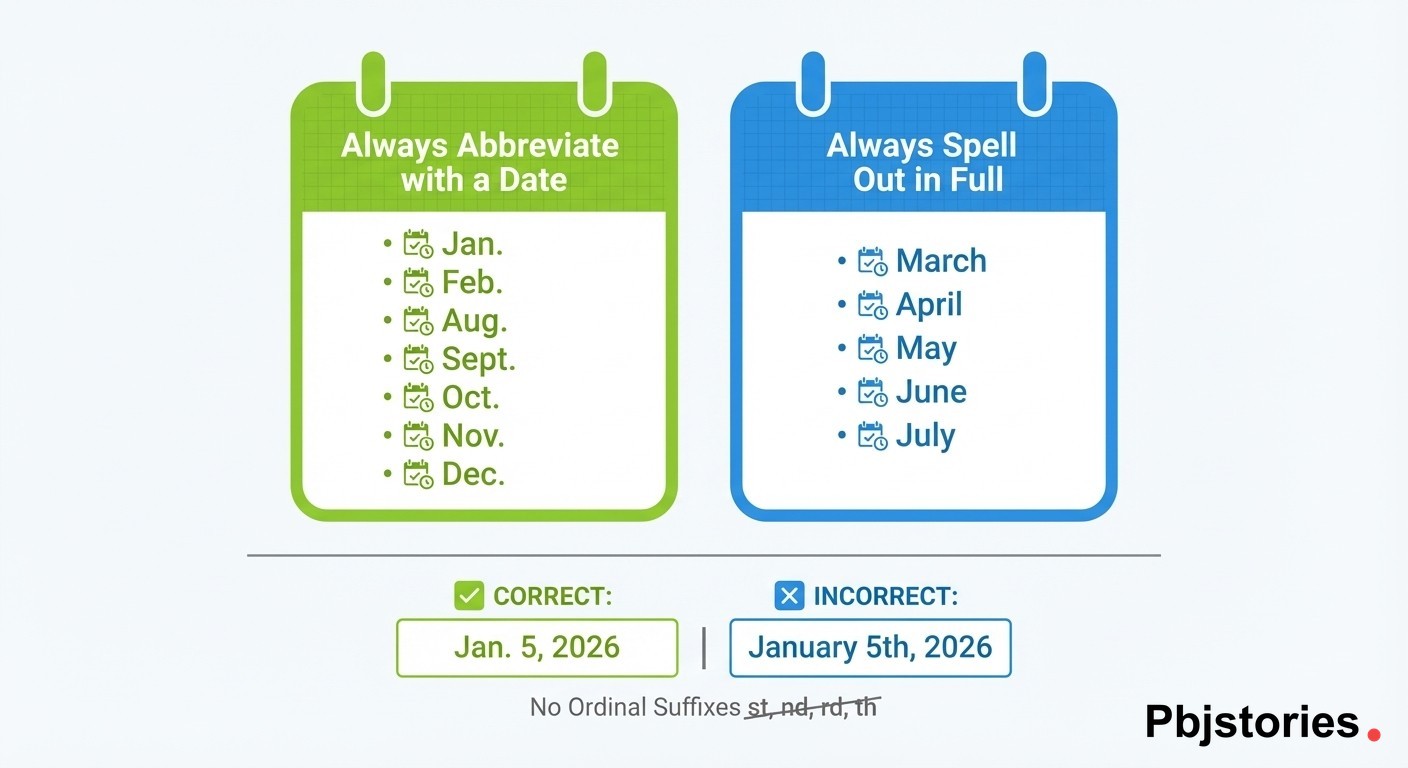
AP style dates use Arabic numerals without ordinal suffixes: write Jan. 5, not January 5th. Seven months are abbreviated when paired with a specific date: Jan., Feb., Aug., Sept., Oct., Nov., and Dec. The remaining five (March, April, May, June, and July) are always spelled out in full.
Always include the year in a press release dateline. While AP style sometimes omits the year for dates within the current year in news articles, press releases require it for archival clarity.
Time formatting follows lowercase with periods: 10 a.m., 3:30 p.m. Use "noon" and "midnight" instead of 12 p.m. or 12 a.m. Time is typically not part of the dateline itself, though embargoed or time-sensitive releases may include it.
One critical rule trips up first-time writers: the dateline date is always the distribution date, never the event date. If your product launches March 20 but the release goes out March 13, the dateline reads March 13. The launch date belongs in the body of your release.
Press Release Dateline Examples and Templates
Comparing correct and incorrect formatting side by side helps writers spot errors faster. Most dateline mistakes follow predictable patterns.
Correct vs. Incorrect Dateline Examples
Each pair below highlights a specific formatting error alongside its corrected AP style version.
Wrong: New York, NY, January 15th, 2026
Right: NEW YORK, Jan. 15, 2026
Four errors in one line: the city name lacks full capitalization, NY is a postal code instead of an AP abbreviation, "January" should be abbreviated with a date, and "15th" uses an ordinal suffix.
Wrong: SAN FRANCISCO, CA, 01/15/2026
Right: SAN FRANCISCO, Jan. 15, 2026
Numeric date formats belong on invoices, not press releases. San Francisco also stands alone, so the postal code CA is both wrong in style and unnecessary.
Wrong: AUSTIN, TX, Jan. 15, 2026
Right: AUSTIN, Texas, Jan. 15, 2026
Texas is one of the eight states never abbreviated in AP style, so TX is always incorrect here.
Wrong: LYON, Jan. 15, 2026
Right: LYON, France, Jan. 15, 2026
Lyon does not appear on the AP Stylebook's standalone city list, so the country name is required.
Ready-to-Use Dateline Templates
Copy and paste the template that matches your scenario, replacing the bracketed text with your lead sentence.
Major U.S. city (standalone): CHICAGO, Jan. 15, 2026, [Lead sentence begins here.]
Smaller U.S. city with state: BOULDER, Colo., Jan. 15, 2026, [Lead sentence begins here.]
International city (standalone): TOKYO, Jan. 15, 2026, [Lead sentence begins here.]
International city with country: MUNICH, Germany, Jan. 15, 2026, [Lead sentence begins here.]
Swap in the correct AP style month abbreviation and update the year to your actual distribution date. For smaller U.S. cities, confirm whether your state requires an AP abbreviation or is spelled out in full by checking against the eight never-abbreviated states listed above.
Common Press Release Dateline Mistakes and How to Avoid Them
Most dateline errors fall into a handful of recurring patterns:
Using USPS postal codes instead of AP abbreviations. Write Calif., not CA.
Forgetting to capitalize the city name. The city must be fully capitalized: DENVER, not Denver.
Adding ordinal suffixes to dates. Write Jan. 15, not Jan. 15th, because AP style uses plain Arabic numerals.
Using the event date instead of the distribution date. The dateline always reflects when the release goes out.
Abbreviating states that AP style spells out. Alaska, Hawaii, Idaho, Iowa, Maine, Ohio, Texas, and Utah are never abbreviated.
Confusing "FOR IMMEDIATE RELEASE" with the dateline. These are separate elements serving different functions.
Using numeric date formats like 01/15/2026 instead of Jan. 15, 2026.
Distribution platforms may auto-reformat datelines, but submitting correctly formatted copy from the start prevents delays and formatting conflicts.
When to Adjust Your Press Release Dateline
Fully remote companies without a physical headquarters should use the city where the business is legally incorporated. If no formal HQ exists, use the city most closely associated with the news or where the primary spokesperson is located.
Virtual events and online announcements do not change this rule. The dateline reflects who is issuing the release, not where an event takes place. A company headquartered in Denver that hosts a virtual conference still uses DENVER in its dateline.
For multi-location announcements like mergers or partnerships, the dateline carries the city of the company distributing the release. The second company's location belongs in the body copy.
Re-issued press releases require an updated dateline matching the new distribution date. Add "CORRECTED" or "UPDATED" before the headline so editors recognize the revision. And for embargoed releases, the dateline should reflect the intended publication date, not the date journalists first receive the document.
Press Release Dateline FAQ
What Date Goes in the Dateline: Release Date or Event Date?
The dateline always uses the date the press release is distributed to media, not the date of the event or product launch. If your product launches on February 20 but you distribute the release on February 18, the dateline reads Feb. 18. Place the event date in your lead sentence or second paragraph instead.
Which AP Style Cities Stand Alone Without a State or Country?
Approximately 30 U.S. cities and roughly 50 international cities require no state or country name in AP style datelines. The full domestic and international standalone lists appear in the city names section above. The AP Stylebook updates these lists periodically, so verify against the current edition.
What Does ### Mean at the End of a Press Release?
The symbol ### is a traditional end-of-release marker inherited from journalism. Centered at the very bottom of the release after the boilerplate, it signals to editors that no additional copy follows. This convention is entirely separate from the dateline and serves a different formatting function within press release structure.
How Do I Write a Dateline for an International Press Release?
For cities that do not stand alone, use the format: CITY, Country Name, Date. For example: MUNICH, Germany, Jan. 15, 2026. Major international cities like London, Paris, and Tokyo need no country name. Always use AP style country names (Germany, South Korea) rather than ISO codes (DEU, ROK), since distribution platforms like PR Newswire and Business Wire expect AP-compliant formatting.
Getting the dateline right is a small detail that signals professionalism to every journalist who reads your release. If you want to skip the manual formatting entirely, PBJ Stories generates press releases in proper AP style, from dateline to boilerplate, and distributes them to 500+ news outlets including Google News and Yahoo Finance. You can start with a ready-made template and have a polished, distribution-ready release in minutes.
Get PR tips delivered weekly
Join 3,200+ PR professionals getting actionable tips on press release writing, distribution, and media outreach.
No spam. Unsubscribe anytime.