
The seven types of PR are media relations, community relations, crisis communication, internal communications, public affairs and government relations, social media communications, and strategic communications. Each serves a different stakeholder, uses different tactics, and produces different deliverables — which is why treating PR as one service is how founders end up paying for a social media calendar when they wanted a Bloomberg feature.
The confusion is expensive. Marketing managers brief a "PR agency" expecting earned coverage and get LinkedIn posts instead. Crisis plans get drafted without internal communications support, and employee trust collapses before reporters even call. Meanwhile, agencies pitch everything as one package because it's easier to sell, and buyers don't know which discipline they actually need.
Below is what each of the seven disciplines actually does, who it talks to, and when to use it. You'll also see:
-
How the seven-type model compares to frameworks that swap in investor relations and CSR
-
Why public affairs and government relations are sometimes counted separately
-
Which discipline owns which deliverables, so briefs stop going to the wrong team
-
How strategic communications ties the other six together without duplicating their work
The 7 Main Types of PR
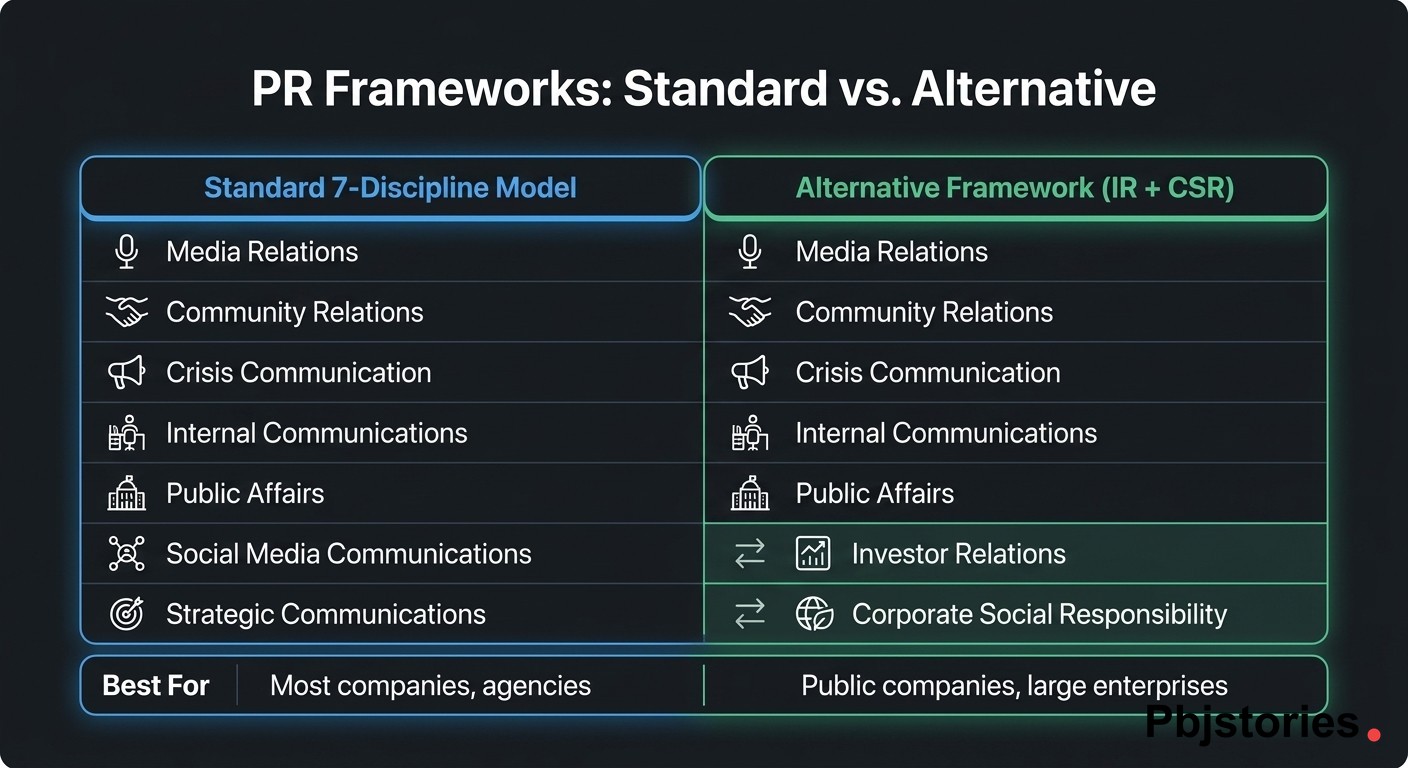
The seven-discipline model most agencies reference today covers media relations, community relations, crisis communication, internal communications, public affairs and government relations, social media communications, and strategic communications.
This list is a widely used reference, not a universal industry taxonomy. Some frameworks swap social media or strategic communications for investor relations or corporate social responsibility, depending on company size and ownership structure.
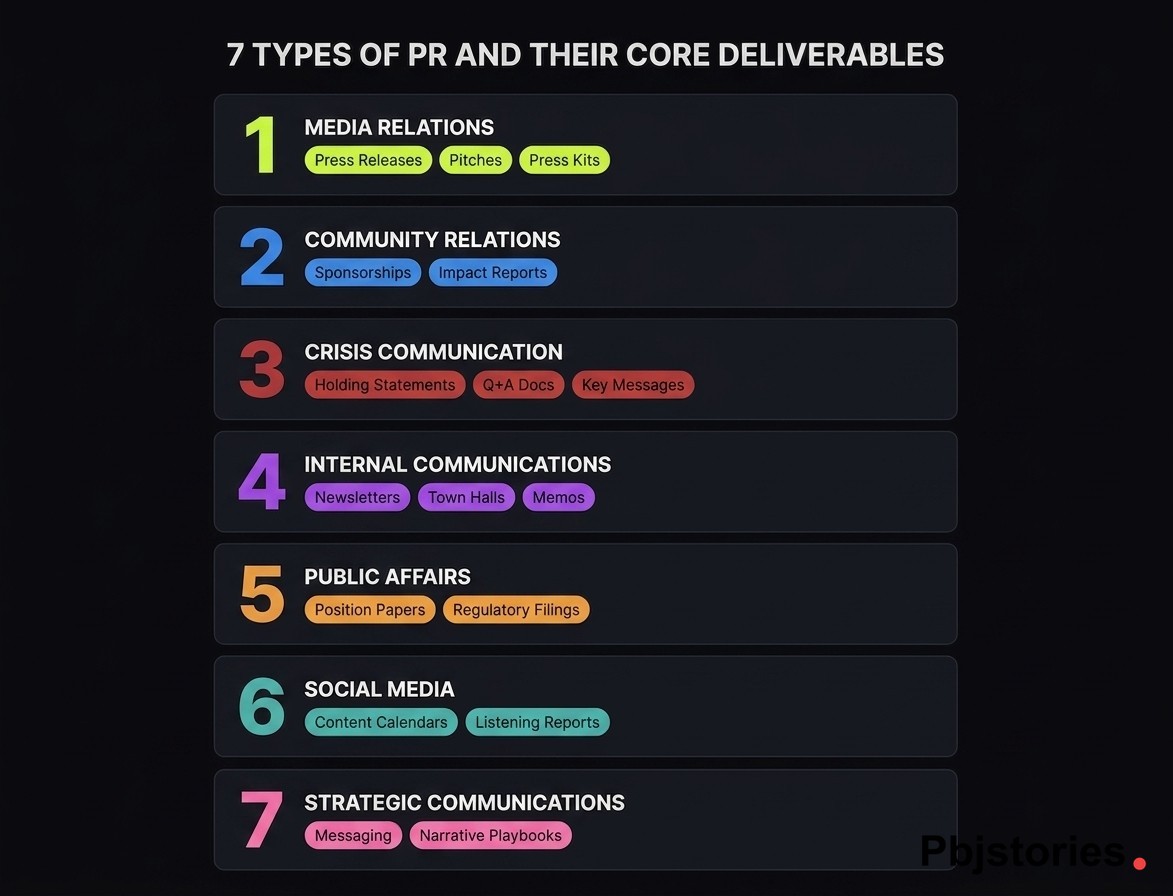
Each discipline produces its own deliverables:
-
Media relations press releases, pitches, press kits
-
Community relations sponsorship announcements, impact reports
-
Crisis communication holding statements, Q+A documents, key messages
-
Internal communications newsletters, town halls, leadership memos
-
Public affairs position papers, regulatory filings
-
Social media communications content calendars, listening reports
-
Strategic communications messaging architecture, narrative playbooks
1. Media Relations
Media relations is the discipline of building relationships with journalists, editors, and publications to earn unpaid coverage in outlets like Bloomberg, TechCrunch, or local dailies.
For example, a Series A startup pitches TechCrunch to secure a launch feature that drives signups and investor interest.
Typical deliverables include press releases, media pitches, press kits, and spokesperson bios. Media relations sits inside PR rather than replacing it, since PR also covers internal, crisis, and community functions that journalists never touch.
2. Community Relations
Community relations builds goodwill with local audiences around an organization's physical operations, stores, offices, or plants. A regional bank sponsoring a youth soccer league, or a grocery chain backing a food drive, are standard examples.
It overlaps with corporate social responsibility but stays geographically anchored to the neighborhoods a business actually serves. Typical outputs include sponsorship announcements, on-the-ground event participation, volunteer programs, and annual community impact reports shared with local media and residents.
3. Crisis Communication
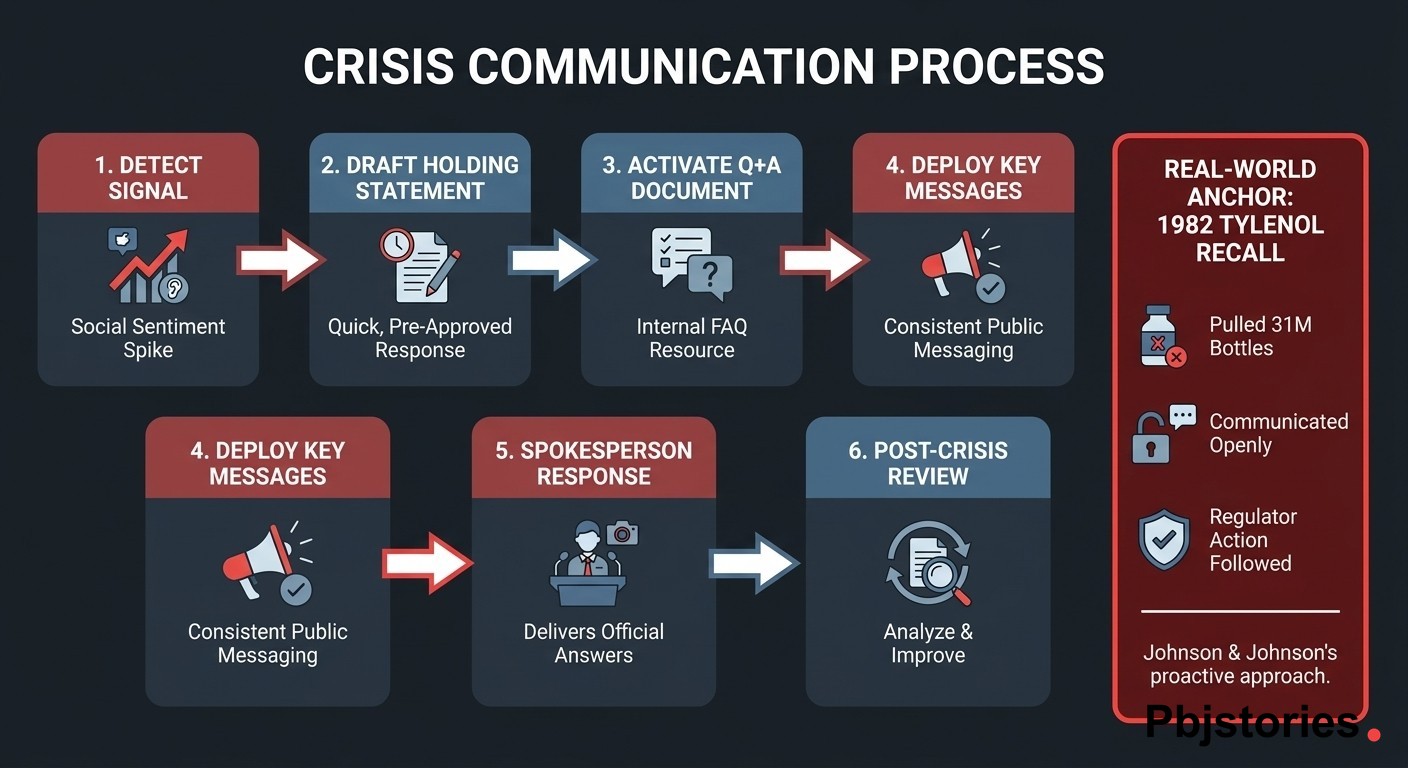
Crisis communication is the rapid-response discipline that protects reputation during emergencies, product recalls, executive controversies, or data breaches. The Johnson & Johnson Tylenol recall of 1982 remains the textbook case, because the company pulled 31 million bottles and communicated openly before regulators forced its hand.
Standard deliverables include hot issues briefs, holding statements, Q+A documents, and approved key messages. Prepared crisis plans shorten recovery time, since spokespeople deliver pre-approved answers instead of drafting them under pressure.
4. Internal and Employee Communications
Internal communications aligns employees with company strategy, culture, and change through channels like intranet updates, internal newsletters, town halls, and leadership memos.
A CEO's all-hands announcement before a merger is a classic example, since it sets the narrative before rumors fill the gap.
This discipline strengthens every other PR function. Engaged employees become external brand advocates on LinkedIn, at conferences, and in customer conversations.
5. Public Affairs and Government Relations
Public affairs and government relations manage relationships with legislators, regulators, and policy stakeholders who shape the rules a business operates under. A tech coalition lobbying on AI legislation, or a pharmaceutical firm engaging the FDA on drug approvals, both sit squarely in this discipline.
Typical deliverables include position papers, coalition briefs, regulatory filings, and testimony prep for executives appearing before committees.
Some frameworks split the two, treating public affairs as broader policy influence and government relations as direct agency contact. Others combine them.
6. Social Media Communications
Social media communications manages brand voice, engagement, and reputation across LinkedIn, X, Instagram, TikTok, and YouTube. Tone shifts by platform: LinkedIn skews professional, TikTok skews conversational.
Core deliverables include content calendars, community responses, influencer outreach, and social listening reports. The function amplifies media relations wins by reposting earned coverage, and surfaces early crisis signals through sentiment spikes, giving comms teams time to draft holding statements before a story escalates.
7. Strategic Communications
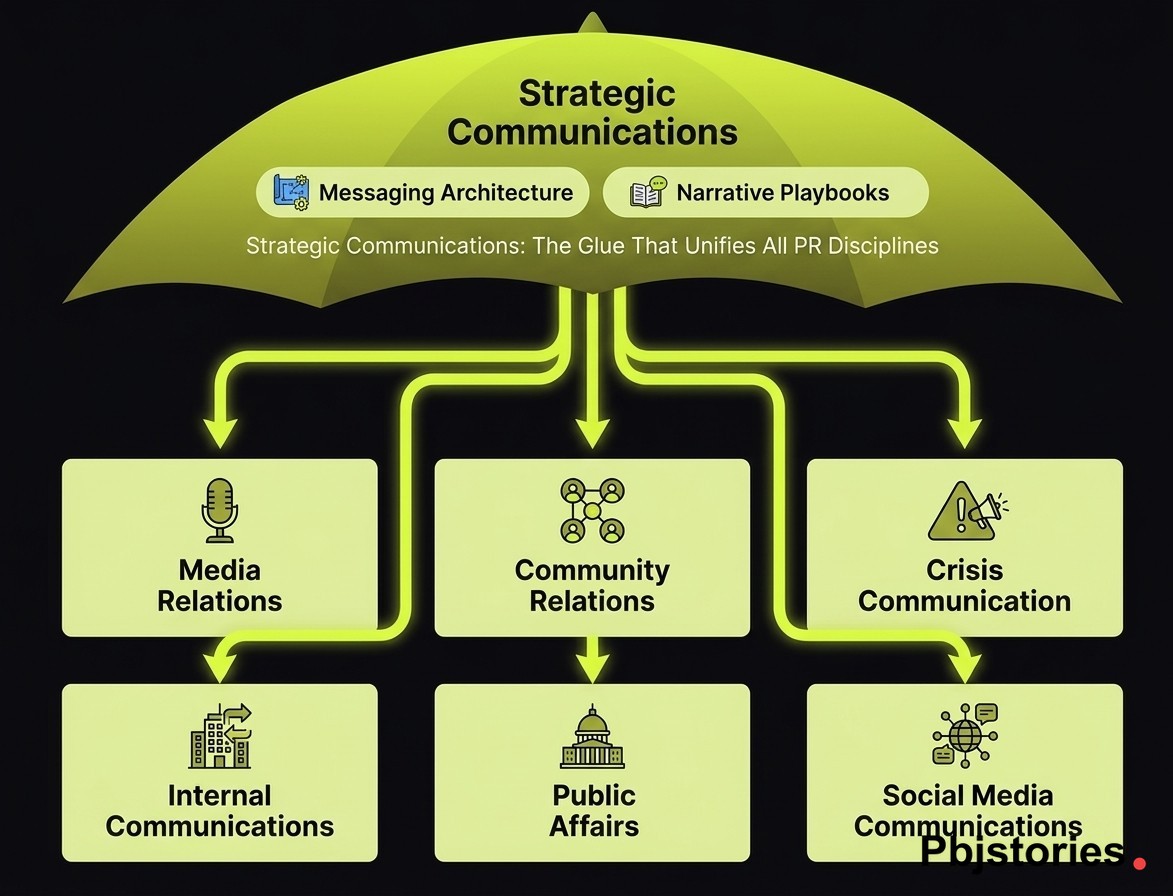
Strategic communications is the umbrella discipline that aligns every other PR type with long-term business goals. It acts as the glue that ties media, internal, crisis, and social efforts into a single narrative.
A company-wide messaging framework, for example, carries the same core story across earnings calls, press releases, and employee updates. Typical deliverables include messaging architecture, communications roadmaps, and narrative playbooks that keep spokespeople, departments, and campaigns on message over multi-year horizons.
Investor Relations and CSR: Alternative PR Types
Some frameworks, including Jody Fisher's, swap social media and strategic communications for investor relations (IR) and corporate social responsibility (CSR). The substitution reflects a different lens: instead of grouping PR by channel, it groups by stakeholder, which matters more for publicly traded and ESG-focused companies.
Investor relations covers communications with shareholders, analysts, and financial media. Quarterly earnings releases, 10-K filings, investor day decks, and analyst Q+A briefings all fall here. IR is tightly regulated by the SEC, therefore disclosure timing and wording carry legal weight that general PR does not.
Corporate social responsibility, by contrast, covers sustainability, ethics, diversity, and community impact. Annual sustainability reports, ESG scorecards, and social-impact announcements are standard CSR outputs. The discipline has grown because institutional investors increasingly weigh ESG metrics alongside financial results.
Which "7 types" framework fits depends on three factors: company stage, ownership structure, and audience. A private startup rarely needs IR, while a listed consumer brand may rank CSR above social media in strategic priority.
The 7 Types of Publics in PR (and Why They Differ from the 7 Types of PR)
Types of PR are disciplines (what PR teams do), while types of publics are audiences (who PR teams reach). Confusing the two leads to briefs that name a tactic without naming the stakeholder it serves.
The seven publics most practitioners recognize are:
-
Employees receive internal memos, town halls, and culture updates.
-
Investors receive earnings releases, analyst calls, and shareholder letters.
-
Customers receive product announcements, brand campaigns, and support messaging.
-
Media receive pitches, press kits, and embargoed briefings.
-
Government receives position papers, regulatory filings, and testimony.
-
Community receives sponsorships, local event coverage, and impact reports.
-
General public receives broad-reach content across news and social channels.
Each PR discipline targets a specific public, therefore understanding the audience determines which discipline to deploy. Crisis communication speaks to customers, media, and employees at once. Investor relations speaks almost exclusively to shareholders and financial media.
This distinction matters because every strong brief, strategy doc, or press release starts by naming the public first and the discipline second. Flip that order, and the message rarely lands.
How to Choose the Right Type of PR for Your Business
Match the PR discipline to the business goal. Awareness maps to media relations, trust to community relations, risk to crisis communication, policy to public affairs, and workforce alignment to internal communications.
Most businesses run two or three types simultaneously, not one in isolation. A Series A startup typically pairs media relations with social media communications, while a regional hospital combines public affairs, crisis planning, and community relations.
Company stage and regulation dictate the mix:
-
Startups and small businesses lean on media relations and social, since earned coverage builds credibility faster than paid ads.
-
Regulated industries (pharma, finance, energy) need public affairs and crisis communication on permanent standby.
-
Publicly traded companies must layer investor relations on top of everything else to meet SEC disclosure expectations.
A single well-optimized press release often serves media relations, SEO, and investor communications at once. If you are new to the format, start with press release fundamentals before drafting.
For common announcements, working templates speed up the process. Reference product launch press release examples when announcing a new feature or SKU, and new hire press release examples when introducing executives or board members who signal business momentum.
Why Understanding the Different Types of PR Matters
Taxonomy clarity translates directly into career growth and budget discipline. Even practitioners with two or more years of experience report confusion between corporate comms, strategic comms, and MarComms, which slows promotions and muddies briefs.
Businesses feel the same cost. A company that misclassifies its needs signs a $5,000+ monthly agency retainer for media relations when the real problem is internal alignment or crisis preparedness. As a result, spend goes to deliverables that never move the actual goal.
The confusion deepens when PR gets conflated with marketing and advertising. PR earns credibility through third-party channels like journalists and regulators. Marketing promotes directly to customers through owned channels, while advertising pays for guaranteed placement. Same content sometimes, but different intent and different measurement.
Nonprofits and community groups benefit most from this clarity, since framing a fundraiser announcement as community relations rather than marketing changes the channel, tone, and audience. The nonprofit press release guide shows how that framing plays out in practice.
Every PR type still needs a distribution channel, and a press release remains the most efficient one.
What Are the 7 Types of PR: FAQ
What Are the 7 Types of PR?
The seven types of PR are media relations, community relations, crisis communication, internal communications, public affairs and government relations, social media communications, and strategic communications.
Frameworks vary. Some sources, including Jody Fisher's, substitute investor relations and corporate social responsibility for social media and strategic comms, depending on whether the company is publicly traded or ESG-focused.
What Is the Difference Between the 7 Types of PR and the 7 Types of Publics?
Types of PR are disciplines (functions a team performs), while publics are audiences (stakeholders a team reaches). Crisis communication, for example, is a discipline. Customers, employees, and media are the publics it addresses during a recall.
Confusing the two produces briefs that name a tactic without naming the stakeholder, which weakens targeting.
Which Type of PR Is Most Important for a Small Business?
Media relations and community relations deliver the highest ROI for small businesses, since both earn third-party credibility without paid placement. A well-distributed press release covering a launch, hire, or milestone is often the most efficient first move.
That matters when a $5,000 per month agency retainer sits outside the budget. Platforms like PBJ Stories let founders write and distribute releases on a per-release basis instead.
How Is PR Different from Marketing?
PR earns credibility through third-party channels like journalists, editors, and analysts. Marketing promotes directly to customers through owned and paid channels.
Content and campaigns often overlap, yet intent and measurement differ. PR tracks reputation and earned reach, while marketing tracks revenue and conversion.
Are There More Than 7 Types of PR?
Yes. Practitioners list 10 or more sub-fields, including influencer PR, digital PR, product PR, event PR, and MarComms. Each produces its own deliverables, such as event press release examples for launches and conferences.
The "7 types" model groups these narrower sub-fields under broader disciplines, therefore it simplifies the landscape without excluding them.
Running seven disciplines in parallel is where most small teams hit the wall, especially when media relations alone can eat a full week of outreach per announcement. That is the gap PBJ Stories closes: AI drafts your release in AP style, SERP-driven keyword research targets terms you can actually rank for, and distribution pushes the story to 500+ outlets including Google News and Yahoo Finance.
If you want to see how a single announcement can cover media relations, investor communications, and digital PR at once, browse our press release examples or start writing your next release today. No retainer, no waiting on an account manager, just earned coverage on your timeline.
Get PR tips delivered weekly
Join 3,200+ PR professionals getting actionable tips on press release writing, distribution, and media outreach.
No spam. Unsubscribe anytime.