
Press releases are not outdated in 2026. The format has quietly become one of the few content types that journalists, search engines, and large language models all treat as a trusted primary source — which is a bigger moat than it was in 2019, not a smaller one. What is dying is the blast-and-pray wire model that sends one announcement to 200 clone sites and calls it distribution.
That gap is where most founders and marketers lose money in both directions. The dismissive camp ("releases are dead, just post on LinkedIn") misses the E-E-A-T signals, Knowledge Panel entries, and ChatGPT citations that only a release on a real news domain produces. The old-guard camp keeps paying $5,000-a-month retainers for duplicate wire blasts that Google deduplicates and LLMs deprioritize during retrieval. Both are judging the format by the wrong scoreboard — the first by lead volume, the second by raw placement count.
Below is the honest answer on what press releases still do, what they don't, and where they fit in a 2026 strategy:
-
The three forces keeping the format alive: journalist workflows, SEO and AI discoverability, and regulatory compliance
-
Why LLMs cite press releases on authoritative domains and how that feeds entity stacking
-
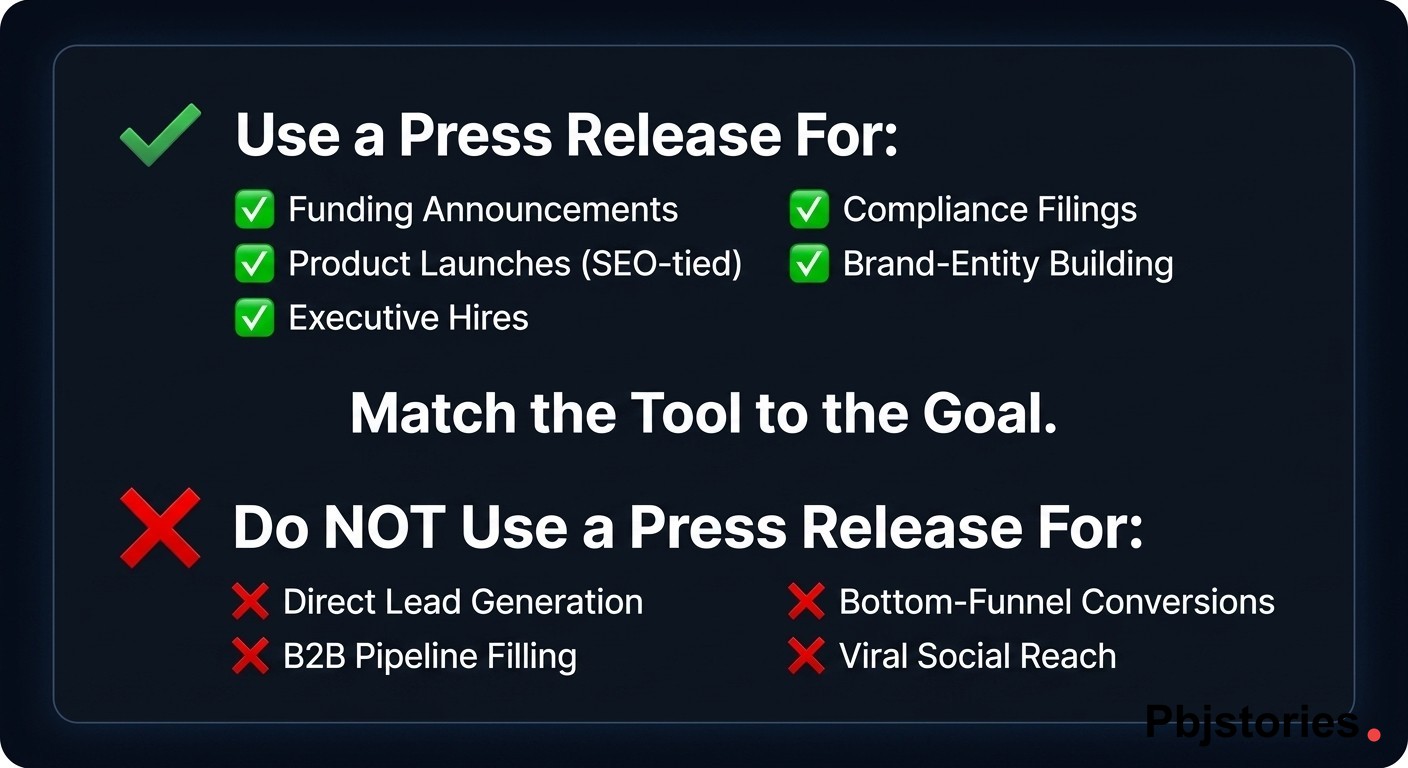
When a release is worth it (funding, launches, executive hires, compliance, brand entity building) and when it's the wrong tool (direct leads, B2B pipeline, viral reach)
-
What "public" actually means once a release is distributed, and why rewriting old releases breaks the archive
-
How press release SEO and the shift from blast wires to targeted distribution changes the ROI math
Are Press Releases Outdated? The Short Answer
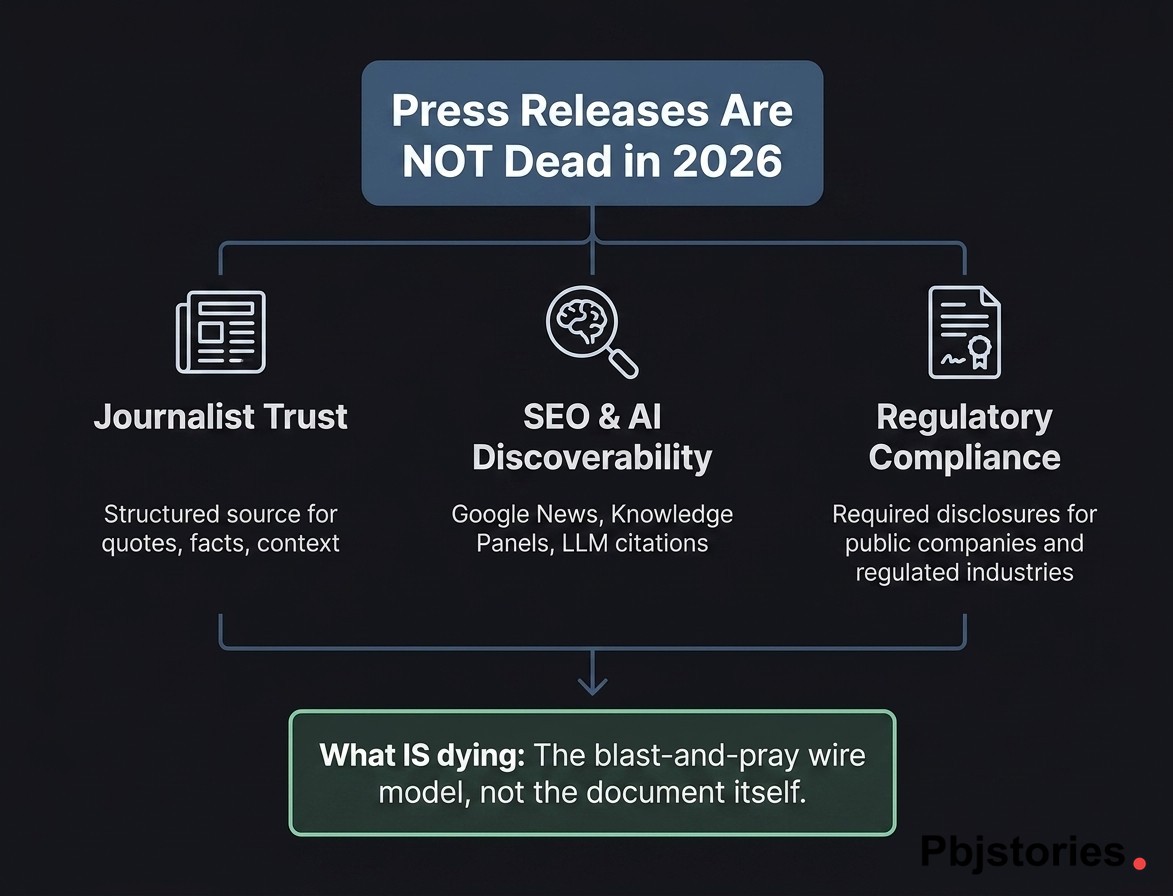
No. The format is evolving, not disappearing, and it still pulls real weight across PR, SEO, and AI visibility. What is fading is the blast-and-pray wire model, not the document itself.
The confusion comes from mixing two things. The press release as a document, an official, citable announcement, remains valuable to journalists, analysts, and large language models. The delivery method is what looks obsolete, since duplicate wire clones produce thin content that Google and LLMs deprioritize.
Three forces keep the format alive:
-
Journalist workflows, because reporters still rely on structured announcements for quotes, facts, and context.
-
SEO and AI discoverability, since releases on authoritative news domains feed Google News, Knowledge Panels, and LLM citations.
-
Regulatory compliance, because public companies and regulated industries must disclose material events through recognized channels.
Why Press Releases Still Matter: Trust, Legitimacy, and Third-Party Validation
A press release functions as a primary source document. Journalists quote from it, financial analysts pull figures from it, and AI models treat it as an official statement issued by the company itself. That status cannot be replicated by a LinkedIn post or a founder's tweet, since neither carries the structural authority of a dated, on-the-record announcement.
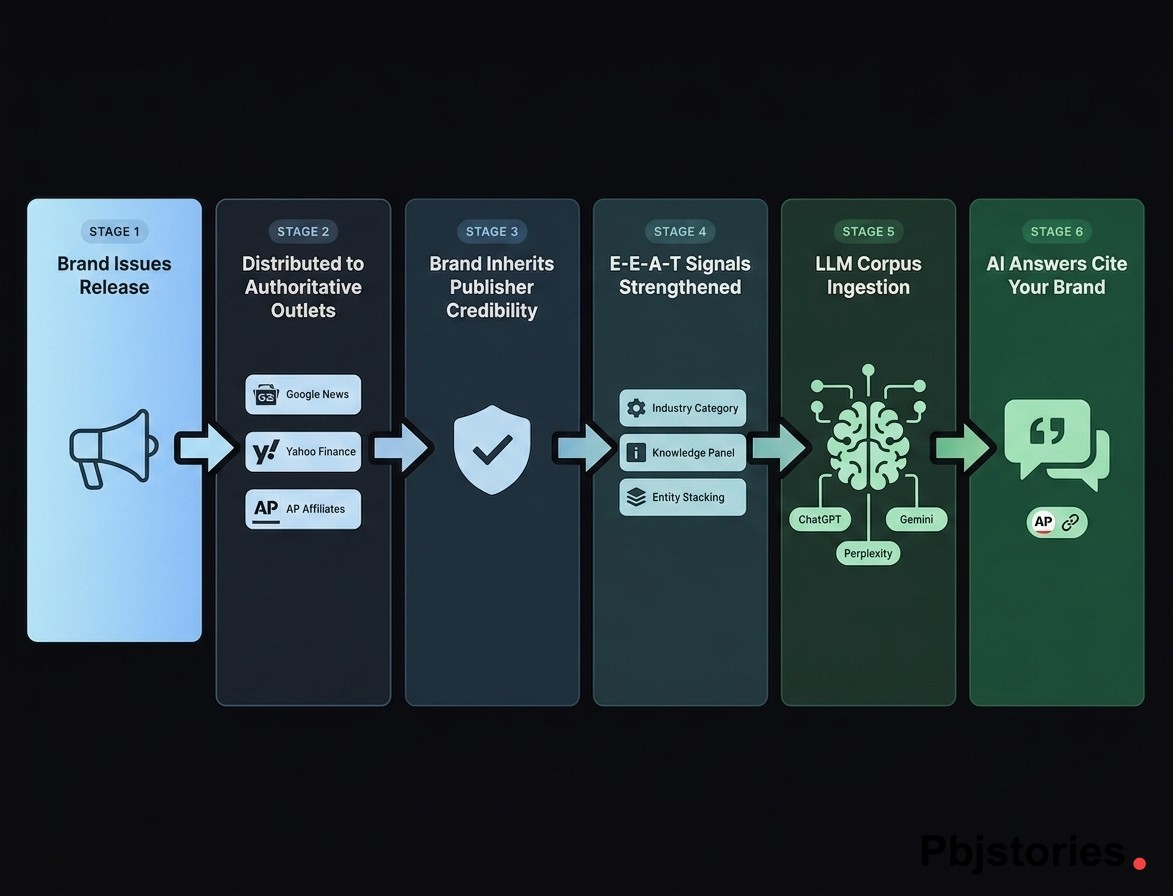
Third-party validation compounds the effect. When a release lands on Google News, Yahoo Finance, or an AP-affiliated outlet, the brand inherits the credibility of the publisher. The same announcement posted only to an owned blog stays within the brand's own echo chamber and earns no external trust signal.
This is where press releases feed E-E-A-T signals. Repeated mentions across authoritative news domains strengthen entity stacking, reinforce Knowledge Panel data, and help Google connect a brand to its founders, products, and industry category. Practitioners on Reddit describe this bluntly: press releases are a trust asset, not a lead magnet, and judging them by conversion rates misses the point.
The AI layer extends the same logic. ChatGPT, Gemini, and Perplexity cite news outlets as authoritative retrieval sources, so a release distributed to real publishers can surface inside AI answers months later. Duplicate wire clones rarely qualify, but unique releases on recognized domains enter the corpus that LLMs draw from when users ask about your company.
Are Press Releases Worth It? Cost vs. Return
It depends entirely on the goal. For direct leads or immediate sales, a press release is usually the wrong tool. For legitimacy, SEO longevity, AI citation, or regulatory compliance, the math works in your favor.
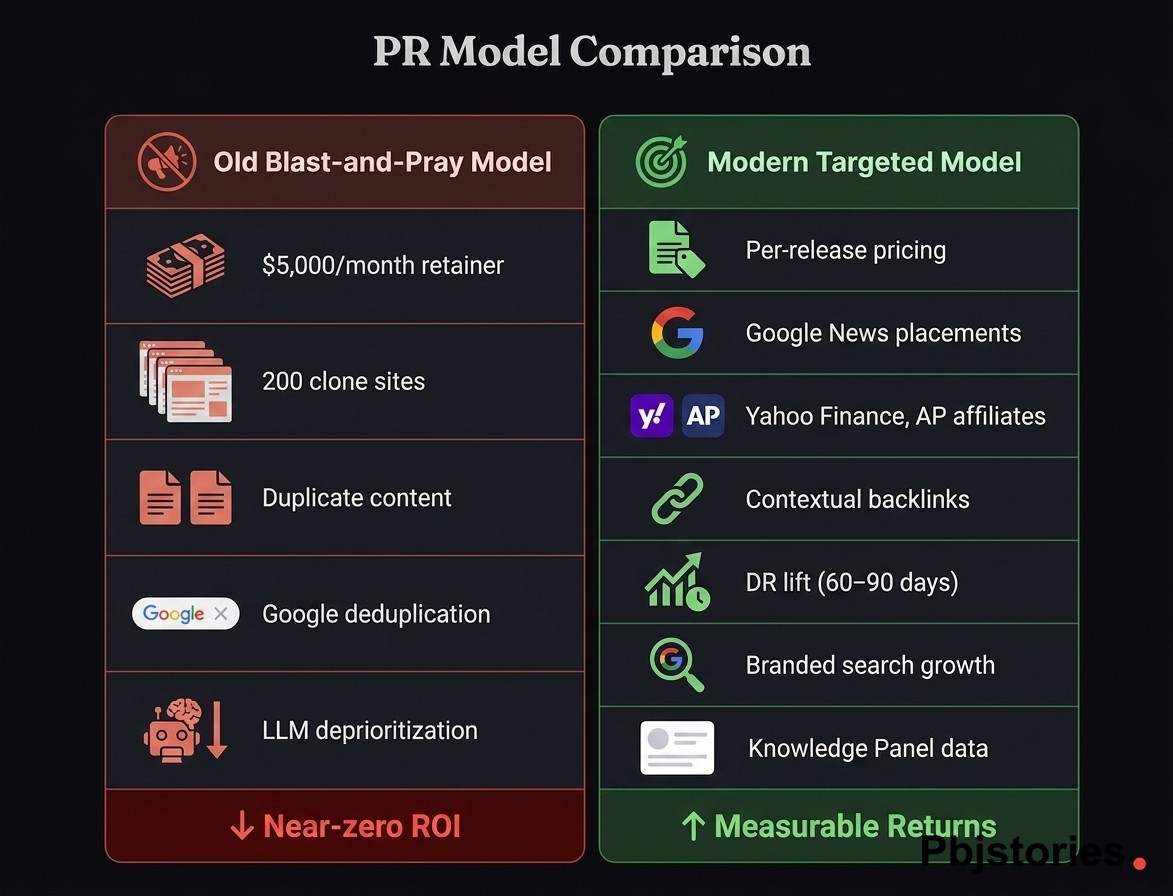
The Reddit critique is fair when aimed at the old model: a $5,000/month agency retainer blasting one announcement across 200 clone sites. That produces duplicate content, which Google deduplicates and LLMs deprioritize during retrieval. You pay for volume and get near-zero unique indexation.
Modern per-release pricing flips that equation. Distribution to real outlets like Google News, Yahoo Finance, AP affiliates, and Bloomberg syndication partners creates unique, crawlable placements instead of mirrored clones. The return becomes measurable rather than theoretical.
Typical returns from a well-targeted release include:
-
Contextual backlinks from news domains with real editorial authority
-
Referring domain growth and Domain Rating lift over 60–90 days
-
Branded search volume increases as entity mentions accumulate
-
Entity associations that feed Knowledge Panel and Knowledge Graph data
-
Long-tail keyword rankings on the release page itself
A quick decision framework:
-
Worth it: funding announcements, product launches tied to SEO, executive hires, compliance filings, brand-entity building
-
Not worth it: direct lead generation, B2B pipeline, bottom-funnel conversions, viral social reach
So the ROI question isn't whether press releases are worth it in the abstract. It's whether your goal matches what the format actually delivers.
Are Press Releases Public? Archiving and the Historical Record
Yes. Once distributed, a press release enters the public record and stays there. Google and Bing index it, news aggregators syndicate it, and LLM crawlers ingest it as structured, dated source material tied to the issuing brand.
That permanence is the archival value. Old releases remain searchable for years, forming a verifiable timeline of funding rounds, product launches, leadership changes, and milestones that reinforces brand authority whenever a journalist, investor, or AI model looks up the company.
A common question on Reddit is whether outdated releases should be rewritten. The practitioner consensus is no, because altering a dated announcement breaks the historical record. Instead, issue a new release referencing the update, so both versions coexist as accurate snapshots in time.
This archive also powers entity stacking. Repeated mentions of the same brand, executives, products, and locations across authoritative news domains strengthen the knowledge graph that Google's Knowledge Panel and LLMs rely on to identify and describe your company.
For a deeper breakdown of the format itself, see what is a press release. The short version: every published release becomes a permanent citation point working for your brand years later.
When Press Releases Are Still Required: Public Companies, Finance, and Healthcare
For publicly traded companies, press releases are not optional. The SEC requires disclosure of material events under Regulation FD, and those disclosures must reach all investors simultaneously through recognized channels. Earnings releases, IPO announcements, and merger notices typically move through wire services like Business Wire or PR Newswire, since regulators, stock exchanges, and institutional investors expect that distribution trail.
This is why wire services persist despite their SEO limitations. Regulated industries legally must file through channels with timestamped, auditable distribution, so compliance keeps the old infrastructure alive even as marketers move on.
Healthcare and pharmaceutical companies face similar rules. FDA approvals, clinical trial results, and recall notices require formal public announcements, and nonprofit grant disclosures often fall under semi-regulated reporting standards tied to funders or the IRS.
For unregulated brands, none of this applies. A SaaS startup or local business has no legal reason to use a wire. The motivation is SEO, legitimacy, and AI visibility, which is where choosing the right press release distribution service matters far more than compliance.
Press Releases in the Age of AI and LLM Discovery
LLMs like ChatGPT, Gemini, and Perplexity pull from indexed news content when generating answers, which means a release published on an authoritative domain can become both a training signal and a live retrieval source. Google News, Yahoo Finance, and AP-syndicated outlets sit high in that trust hierarchy.
The "95% invisible to AI" claim holds mostly for duplicate wire clones. LLMs deprioritize near-identical copies, so a release fanned out to 200 clone sites rarely surfaces. A unique release on a high-authority outlet behaves very differently and can be cited directly.
To improve AI pickup, write in AP style with clear entity mentions, factual structure, quotable statistics, and keywords that match how users phrase questions to LLMs. Name the company, product, location, and spokesperson consistently so the entity graph stays tight.
The compounding outcomes are contextual backlinks and entity stacking: repeated brand mentions across trusted domains strengthen the knowledge graph and make future AI citations more likely.
FAQ: Are Press Releases Outdated?
Is the Press Release Dead in 2026?
No. The format has evolved from mass-wire spam into a targeted trust and legitimacy tool that feeds journalist workflows, SEO, and AI citations. Practitioners in PR agencies and in-house comms teams still issue releases weekly, because nothing else matches their authority as a dated, on-record primary source.
Do People Still Use Press Releases?
Yes, and widely. PR teams, publicly traded companies, regulated industries, startup founders announcing funding rounds, and nonprofits all continue to issue them. The shift is tactical, not existential: distribution has moved from mass-wire blasts toward targeted placements on Google News, Yahoo Finance, and owned newsrooms that feed both journalist inboxes and AI retrieval.
Are Press Releases Worth the Cost?
It depends on the goal. For direct leads, usually no. For legitimacy, SEO longevity, AI citation, or regulatory compliance, yes.
Quick rule: if a LinkedIn post would do the job, skip the release. If you need a dated, on-record primary source, issue one.
Are Press Releases Public Information?
Yes. Once distributed, a release enters the public record, gets indexed by Google and Bing, and is ingested by AI models as dated source material. Older releases typically remain as archives rather than being rewritten, since each new announcement issues fresh, timestamped information instead of overwriting history.
Press releases aren't outdated, but the way they're written, optimized, and distributed has changed completely. Hitting a wire service and hoping for pickup no longer works; today's releases need AP-style writing, SERP-driven keyword targeting, and distribution across outlets that journalists and AI models actually read.
That's exactly what PBJ Stories is built for. Our platform handles the full workflow: AI drafts the release, SERP research identifies keywords you can realistically rank for, and we distribute to 500+ high-authority news sites including Google News and Yahoo Finance. If you're weighing the cost of an agency retainer against real SEO and citation outcomes, see how AI-powered press release distribution stacks up per release.
Get PR tips delivered weekly
Join 3,200+ PR professionals getting actionable tips on press release writing, distribution, and media outreach.
No spam. Unsubscribe anytime.