
Press release backlinks generated through syndication services look impressive in backlink reports, but most pass zero ranking value. Google classifies them as paid placements rather than editorial endorsements. The distinction between a link that appears automatically on 400 outlet websites and one that a journalist at a major publication places deliberately is enormous, and it determines whether your PR investment actually moves search rankings.
Most businesses discover this the hard way. They pay for distribution, see hundreds of new links in Ahrefs or Semrush, and then wonder why organic traffic stays flat. The real SEO value from press releases comes not from syndication itself, but from the editorial coverage that a genuinely newsworthy announcement can trigger.
The difference between wasting budget on ignored links and earning high-authority backlinks from real news coverage comes down to strategy and sequence. Understanding how Google actually treats syndicated press release links, when distribution still makes sense, and proven methods for earning PR backlinks with genuine ranking power is what separates effective campaigns from expensive dead ends.
What Are Press Release Backlinks (and How They Differ from PR Backlinks)
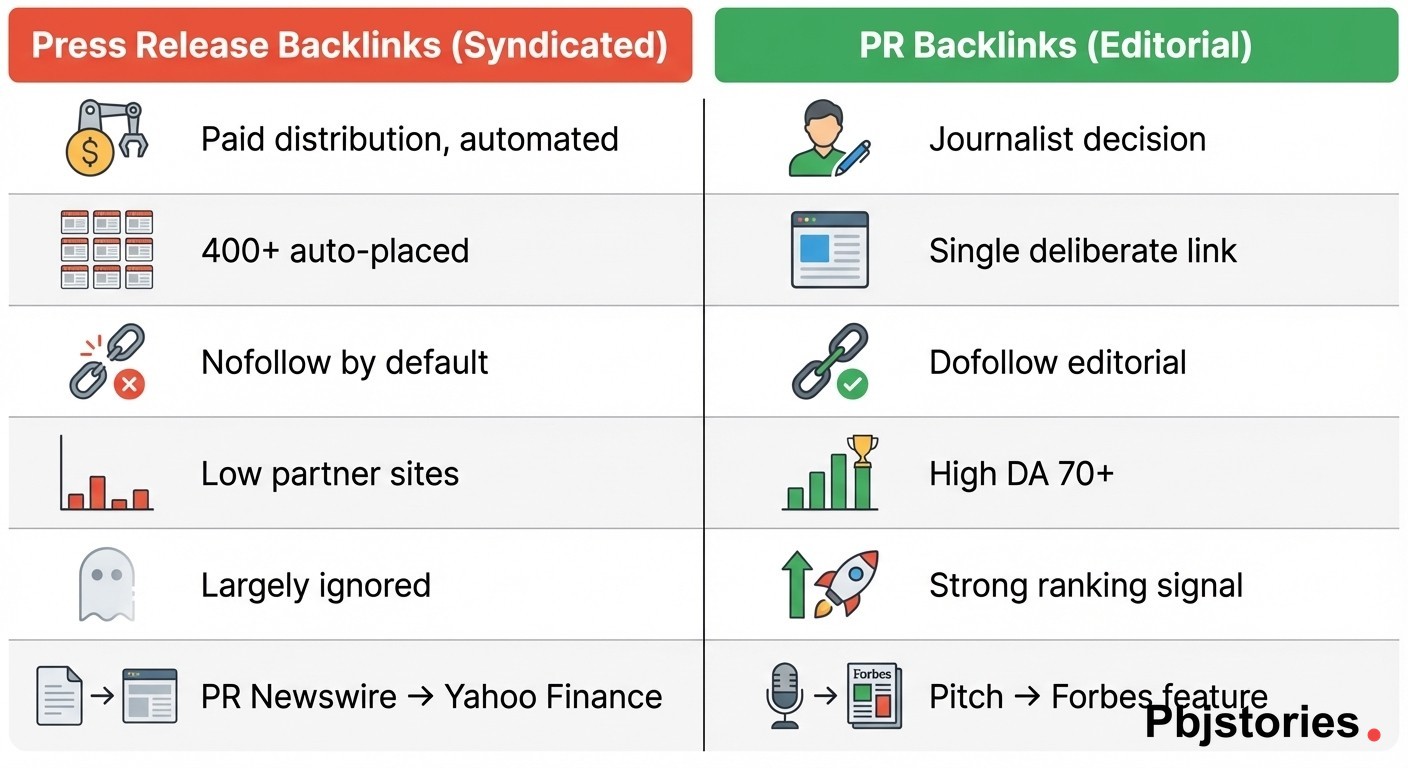
Press release backlinks are links created when a syndication service automatically publishes your release across hundreds of news outlet partner sites. You submit a release to a newswire, and that release appears on partner sites carrying your embedded links. These links result from paid distribution, not editorial judgment.
PR backlinks, by contrast, are editorially earned. A journalist reads your story, decides it deserves coverage, and links to your site within their own original article. Google treats editorial endorsements and automated placements as fundamentally different signals, which is why this distinction matters for SEO.
Consider the difference in practice. A press release distributed through PR Newswire might appear on Yahoo Finance with a link back to your site. That link exists because your newswire paid for placement. Now compare that to a Forbes journalist who receives your pitch, investigates your company, and writes an independent feature linking to your product page. The Forbes link carries genuine editorial weight. The Yahoo Finance syndication does not.
This gap extends to link attributes. Major newswires like PR Newswire and Business Wire default to nofollow on links within distributed releases, signaling to Google that these are not organic endorsements. Smaller outlets and free distribution sites sometimes produce dofollow links, but those domains typically have low authority, limiting any ranking benefit.
The terminology confusion causes real frustration. People search "press release backlinks" and "PR backlinks" expecting identical results, yet the SEO value is vastly different. Syndicated press release links are automated placements Google largely ignores. PR backlinks earned through journalist coverage on high-authority news sites remain among the strongest link types available. Conflating the two leads to misallocated budgets and disappointing results.
Do Press Release Backlinks Help SEO? What Google Actually Says
Syndicated press release links carry minimal direct ranking value. Genuine PR backlinks earned through journalist coverage, however, remain among the strongest link types for SEO, thanks to their inherent trust signals and editorial authority.
Google's Stance on Syndicated Press Release Links
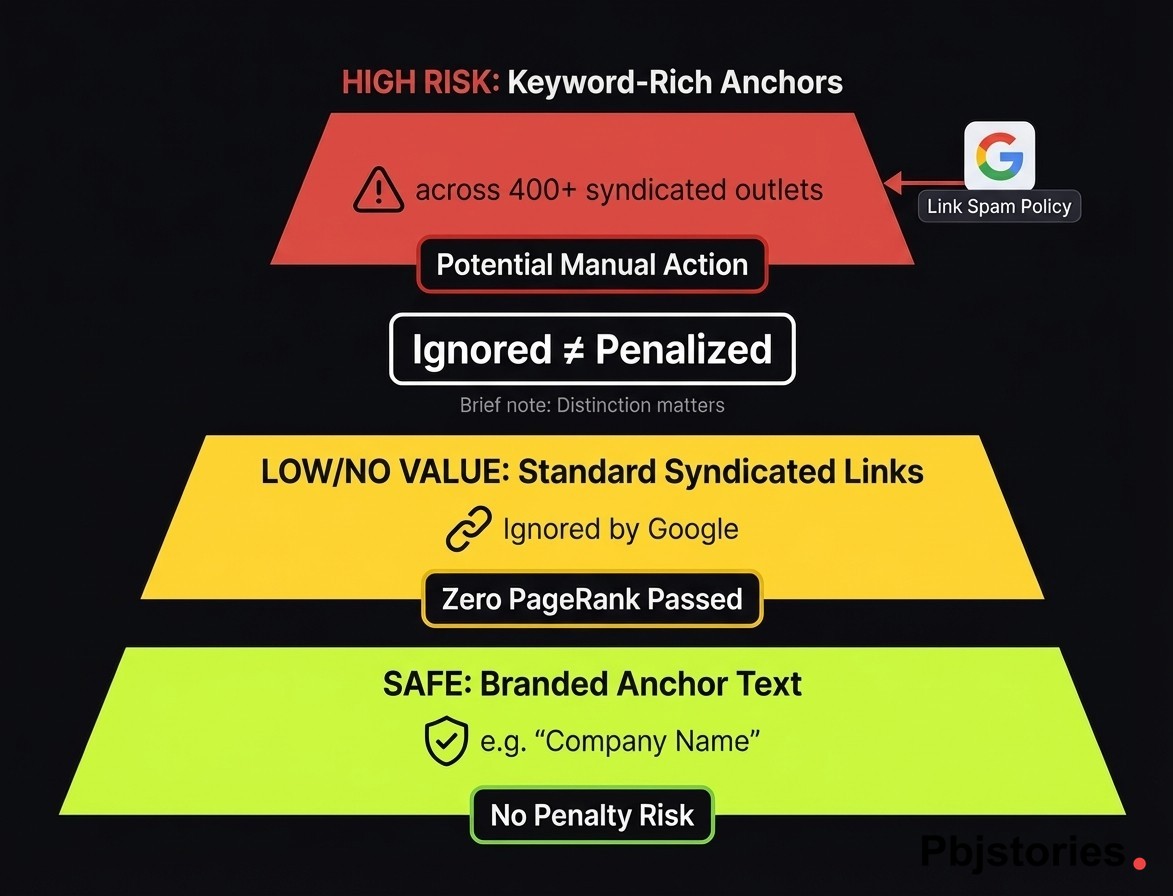
Google's link spam documentation explicitly lists links in press releases with optimized anchor text as an example of a link scheme. This classification places syndicated press release links alongside paid links and large-scale article marketing campaigns.
John Mueller has addressed this topic publicly on multiple occasions, confirming that Google largely ignores syndicated press release links for ranking purposes. The reasoning is straightforward: these links are paid placements distributed automatically, not editorial endorsements from journalists who evaluated the content.
However, "ignored" and "penalized" are two very different outcomes. Google typically does not issue manual actions against sites simply for having press release backlinks in their profile. Those links just pass no PageRank, making them a zero-sum investment from a pure link building perspective.
The exception involves manipulative patterns. Distributing hundreds of releases loaded with keyword-rich anchor text, such as "best personal injury lawyer Chicago" repeated across 400 syndicated outlets, could trigger a manual action under Google's link spam policies. Branded anchor text ("Company Name") carries far less risk. Keeping press release links branded and minimal is the safest approach for any press release SEO strategy.
Why Genuine PR Backlinks Still Move Rankings
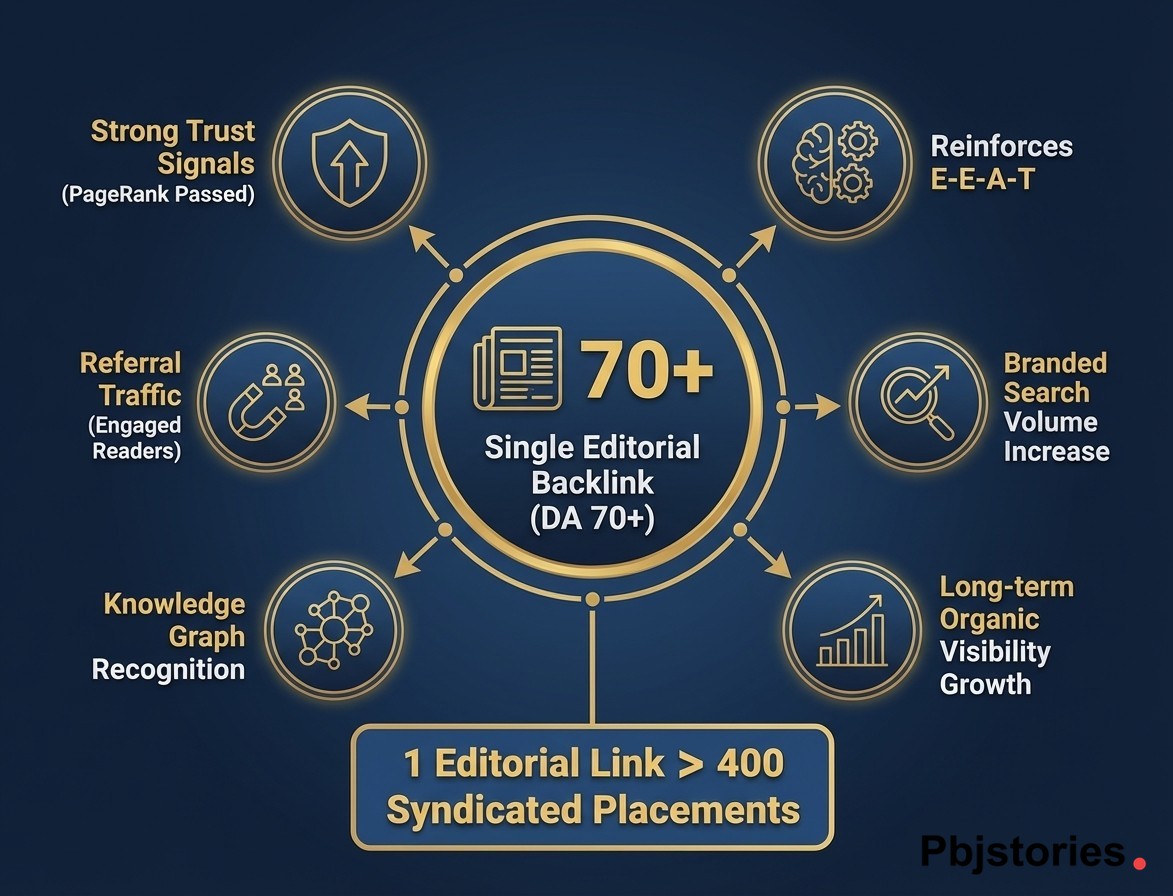
Editorially placed links from high-authority news sites (DA 70+) carry strong trust signals. A reporter at Forbes or Reuters choosing to link to your company is fundamentally different from automated syndication placing your URL across 400 outlets. Google's algorithms recognize that distinction.
These editorial links directly reinforce E-E-A-T signals. Coverage on recognized news outlets tells Google's quality raters that your brand demonstrates expertise, authority, and trustworthiness within its industry. Consequently, a single editorial backlink from a major publication can outweigh hundreds of syndicated placements in ranking impact.
The benefits compound beyond raw link juice. Editorial coverage drives referral traffic from engaged readers, increases branded search volume, and strengthens entity recognition in Google's Knowledge Graph. Each of these factors feeds back into improved organic visibility over time.
The Reddit skeptics are partly right: syndicated press release links alone won't move rankings. But dismissing all press-related links as worthless confuses two entirely different mechanisms. Syndicated links are distributed. Editorial links are earned. One is a paid placement Google ignores. The other is a trust signal Google actively rewards.
When Press Release Backlinks Actually Make Sense
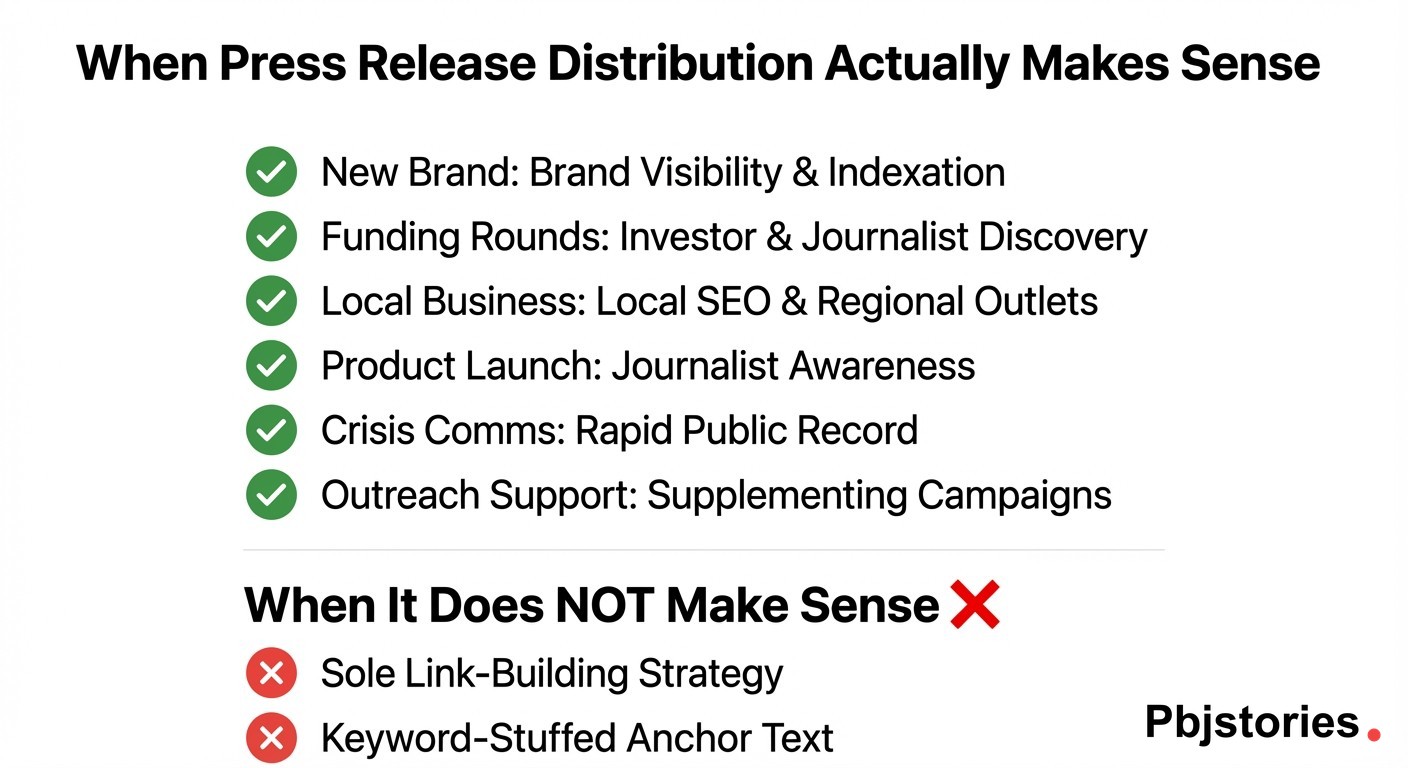
Even though syndicated links carry minimal direct ranking power, press release distribution delivers legitimate value in several specific scenarios. The key is matching the tactic to the right business objective.
New business or product launches benefit most. A startup with no web presence needs Google to discover and associate its brand entity with relevant topics. Syndicated press releases create that initial footprint by generating brand mentions across hundreds of indexable pages, accelerating entity recognition in Google's systems.
Funding announcements and major milestones also represent strong use cases. Journalists actively monitor newswires like PR Newswire and Business Wire for stories. A genuinely newsworthy event, such as a Series A raise or a major partnership, has a real chance of earning editorial pickup beyond the syndicated placements.
For local businesses, press releases distributed to regional news outlets generate local citations, consistent NAP mentions, and geographic brand signals. These elements support local pack visibility, as Google uses entity and location data from multiple sources to validate local business relevance.
Press release links also serve as backlink profile diversification. If your link profile relies heavily on guest posts or niche edits, a small number of branded anchor links from syndicated outlets adds natural variety. An overly uniform link profile can appear manipulative to Google's algorithms.
Some businesses pursue press release placements on Yahoo Finance or Google News purely for social proof. "As Seen On" badges on a homepage build credibility with potential customers, regardless of SEO impact. That is a perfectly valid goal if expectations are realistic.
The honest answer about when press releases waste money: if your sole objective is ranking improvement through link juice, syndicated distribution will disappoint. The budget is better spent on digital PR outreach or creating content that earns editorial coverage organically.
How to Earn High-Quality PR Backlinks from Journalists and News Sites
The strongest press-related backlinks come from editorial coverage, not syndication. A press release is simply the vehicle. The newsworthy event is the engine that drives journalist interest and produces links with real ranking power.
Create Something Genuinely Newsworthy First
Small businesses often feel they have nothing "exciting" to announce. The fix is reframing what counts as news. Original research, industry survey data, provocative founder stories, local community impact, and contrarian takes on trending topics all generate journalist interest. They offer something a reporter can build a story around.
Consider the bulletproof suit example that circulated on Reddit: a $20,000 product with an inherently dramatic concept earned coverage from GQ. No aggressive pitching or expensive newswire made that happen. The product itself was the story, combining an unusual price point, a physical danger element, and a visual hook that practically wrote the headline.
Before spending money on distribution, apply a simple mental test: would a journalist write about this even without being asked? If the answer is no, invest time in making the story more compelling first. Add a data point, sharpen the angle, or tie the announcement to a larger cultural or industry trend.
Even modest stories benefit from keyword-optimized press releases that build topical authority around your brand through entity stacking. Repeated association between your brand name, industry terms, and geographic signals helps Google recognize your entity over time.
Pitch Journalists Directly with Digital PR Outreach
Digital PR outreach involves identifying reporters who cover your industry, studying their recent work, and sending personalized pitches with a clear news hook. Journalists receive hundreds of generic emails daily, so personalization is the single biggest factor separating pitches that get opened from those that get deleted.
A successful pitch includes five core elements:
- Subject line with the news hook, not the words "Press Release"
- Personalization referencing the journalist's recent article or beat
- The story angle in two to three sentences
- A clear data point, unique element, or exclusive offer
- Direct contact information for follow-up
The subject line does the heaviest lifting. Journalists at outlets like TechCrunch or Business Insider scan subject lines in seconds, so leading with the most compelling fact or angle increases open rates significantly.
For finding journalist contacts, practitioners rely on media databases that aggregate reporter profiles by beat and outlet, along with platforms connecting sources to journalists actively seeking expert commentary. These tools reduce guesswork and let you target reporters who already write about your niche.
A well-executed digital PR campaign typically yields 5-20 editorial backlinks from DA 50-90+ sites per campaign. That volume seems small compared to 400 syndicated links, yet the ranking impact is far greater. Each link carries genuine editorial authority. To maximize pickup rates, ensure every release follows press release SEO best practices before pitching.
Use Press Release Distribution as a Supplement, Not a Strategy
Syndicated distribution works best as step three in a sequence: create genuine news first, pitch journalists directly second, then distribute through a newswire to amplify reach and establish a public record. This order matters. Editorial pickups carry real SEO weight, while syndication alone produces links Google largely ignores.
Distribution through quality newswires ensures your release appears in Google News, which accelerates indexing and strengthens brand entity recognition across Google's systems. PBJ Stories distributes to 500+ outlets including Google News and Yahoo Finance, pairing AI-powered writing with SERP-driven keyword optimization to maximize each release's independent search visibility.
Distribution is not a link building strategy on its own. The real value is supplementary: brand signals, entity stacking, topical association, and faster crawling. The most effective approach layers distribution beneath direct journalist outreach and genuinely newsworthy content.
Best Press Release Distribution Sites for Backlinks
Choosing the right distribution platform depends on your budget, target audience, and whether you expect syndicated links or genuine journalist pickup.
Paid platforms:
PR Newswire: The industry standard at $500-$1,500+ per release. Distributes to thousands of outlets including major financial and trade publications. Links are mostly nofollow. Best for large-scale corporate announcements.
Business Wire: Similar pricing and tier, with particularly strong distribution across financial and investor news outlets. Links default to nofollow. Best for funding rounds and publicly traded company news.
EIN Presswire: A solid mid-tier option at $99-$499 per release. Smaller reach than premium newswires but sufficient for targeted industry distribution.
eReleases: Priced at $399+ per release, positioned for small businesses and startups. Bundles writing assistance with distribution.
Free platforms:
PRLog: Basic free plan with limited reach and low domain authority. Useful primarily for indexing new brand entities.
OpenPR: Similar scope to PRLog. Free distribution creates a public record, though backlink value is negligible.
For a deeper comparison, see our breakdown of the best distribution services.
Here is the honest reality: the difference between a $50 release and a $500 release is outlet quality and reach, not necessarily SEO impact from the links themselves. A premium newswire gets your release onto recognizable sites, but ranking impact still depends on whether real journalists find your story compelling enough to cover independently.
Press Release Backlinks vs. Other Link Building Methods
No single link building method covers every SEO need. Understanding the trade-offs helps allocate budget effectively across channels.
Press release distribution costs $50-$1,500 per release and generates 100-400+ syndicated links. Most carry nofollow attributes, and Google largely ignores them. The real value lies in brand signals, entity stacking, and keyword-optimized visibility. Time to results is fast, typically within 48-72 hours.
Digital PR campaigns range from $2,000 to $10,000+ and yield 5-20 editorial backlinks from DA 50-90+ news sites. These links represent genuine journalist endorsements, so they carry significant PageRank and E-E-A-T trust signals. Turnaround is slower, often 4-8 weeks, but a single editorial placement from a major outlet can outweigh hundreds of syndicated links.
Guest posting runs $100-$500 per placement and produces one contextual dofollow link per post. Domain authority varies widely (DA 30-70), and quality depends heavily on the host site. Guest posts work best for building niche relevance around specific keywords.
Niche edits cost $100-$300 per link and offer the fastest turnaround since the link is inserted into existing, already-indexed content. The risk is higher, though. Low-quality sites selling niche edit placements often host hundreds of outbound links, which dilutes value and raises red flags for Google's spam algorithms.
The most effective backlink strategy in 2025 combines multiple methods. Press releases build brand recognition and entity associations. Digital PR secures high-authority editorial links. Guest posts and niche edits fill gaps with niche-relevant contextual links. Relying on any single channel leaves vulnerabilities competitors will exploit.
Common Mistakes That Waste Your Press Release Budget
The most expensive error is treating syndicated distribution as a standalone link building strategy. Press release links work as a supplement to digital PR outreach and content marketing, not a replacement. Businesses that rely solely on distribution end up with hundreds of links Google ignores and zero editorial coverage.
Keyword-stuffed anchor text is the second most common budget killer. Google's link spam documentation explicitly classifies optimized anchor text in press releases as a link scheme. Flooding syndicated links with exact-match keywords like "best accounting software" instead of branded anchors risks triggering a manual action for no ranking benefit.
Distributing a release with no genuine news produces predictable results: zero journalist pickup. Reporters monitoring newswires skip promotional content that reads like a sales page. The real waste is never the distribution fee. It is distributing something that was never newsworthy to begin with.
Choosing free distribution sites solely to save money backfires for a different reason. These platforms typically carry domain authority under 30 and display competitor press releases alongside yours, diluting whatever brand signal you hoped to gain.
Finally, ignoring on-page SEO within the release itself means missing the one outcome syndication can deliver independently: ranking the press release in search results. Headline structure, keyword targeting, and entity mentions determine whether your release surfaces for branded and topical queries. A well-optimized release can rank on its own, even if the links it generates carry no PageRank. Learn more about optimizing a press release for search visibility before spending on distribution.
Press Release Backlinks FAQ
Does Google Penalize Press Release Backlinks?
Google does not penalize press release backlinks outright but treats most syndicated links as paid placements and ignores them for ranking purposes. A manual action actively reduces your rankings, while devalued links are quietly not counted. Most press release links fall into the second category.
However, aggressive patterns of keyword-optimized anchor text across hundreds of syndicated releases could trigger a manual action under Google's link spam policies. Branded anchors in moderation carry far less risk.
Are Press Release Backlinks Dofollow or Nofollow?
Most major newswires, including PR Newswire and Business Wire, apply nofollow attributes to links within distributed releases. Smaller outlets and free submission sites sometimes produce dofollow links, but these typically come from low-authority domains with minimal ranking influence.
The follow status matters far less than editorial placement. A nofollow link from a journalist's original article on a DA 80+ news site carries more SEO weight than a dofollow link from a free distribution page with a DA under 30.
How Much Do Press Release Backlinks Cost?
Prices range from free to $10,000+ depending on the service tier. Free sites like PRLog and OpenPR cost nothing but deliver low-authority links. Mid-tier services such as EIN Presswire run $99 to $499 per release. Premium newswires like PR Newswire and Business Wire charge $500 to $1,500+. Full-service digital PR agencies typically cost $2,000 to $10,000+ per campaign.
Cost does not always correlate with SEO value. A $500 newswire release may produce mostly nofollow links, while a well-crafted $200 release with a genuinely newsworthy angle might earn editorial pickup. Compare distribution platforms before committing budget.
Can Press Release Backlinks Help Local SEO?
Press releases distributed to local and regional news outlets generate local citations, NAP consistency signals, and geographic brand mentions that support local pack visibility. The SEO impact for local businesses comes more from brand signals and local entity recognition than from direct link authority.
Earned coverage in a local newspaper carries significantly more weight for local pack rankings than syndicated distribution. Google treats editorial mentions from trusted local sources as genuine relevance signals for geographic queries, something automated syndication across national outlets cannot replicate.
How Many Backlinks Can You Get from a Single Press Release?
Syndicated distribution typically produces 100-400+ links across outlet websites, but Google likely ignores most of them. These links register in backlink tools yet pass virtually no PageRank.
A genuinely newsworthy release picked up by real journalists might earn 5-20 high-quality editorial links from DA 70+ news sites. Those few editorial links carry far more ranking power than hundreds of syndicated ones. Quality outperforms quantity every time.
Should Press Release Backlinks Be Part of My SEO Strategy?
Press releases belong in your SEO strategy as one component of a diversified backlink and brand-building approach, not as a standalone tactic. Syndicated links carry minimal ranking power on their own, so they deliver the best results when paired with digital PR outreach, guest posting, and content marketing.
Distribution is most effective when the release serves a genuine business purpose, such as a product launch, funding round, or original data release, and is supplemented by direct journalist outreach targeting editorial coverage. That combination turns a single announcement into both brand signals and high-authority backlinks.
Press releases work best when writing, keyword targeting, and distribution all reinforce each other. PBJ Stories brings that full workflow together on one platform, using AI to draft AP-style releases, SERP-driven research to find keywords your release can actually rank for, and distribution to 500+ outlets including Google News and Yahoo Finance.
If you want press release backlinks that contribute real brand signals and entity recognition rather than just inflating a number in your backlink tool, explore PBJ Stories and see how a single release can support your broader SEO strategy from day one.
Get PR tips delivered weekly
Join 3,200+ PR professionals getting actionable tips on press release writing, distribution, and media outreach.
No spam. Unsubscribe anytime.