
A boilerplate press release is the short, standardized paragraph at the bottom of every press release that tells journalists exactly who your company is and why it matters. Most companies treat it as an afterthought, copying a few generic sentences and never updating them. The result? Editors skip it, reporters misidentify the brand, and a consistent media presence becomes harder to build.
The boilerplate is one of the few pieces of text that appears in every single release a company sends. Journalists frequently paste it directly into their coverage, so a weak or outdated boilerplate can quietly undermine months of PR effort.
The sections below break down exactly what belongs in a boilerplate, how to match its tone and structure to your industry, and where most companies go wrong. You will also find real examples from corporations, nonprofits, and universities, plus a ready-to-use template.
What Is a Boilerplate in a Press Release?
A press release boilerplate is a standardized paragraph, typically 3-5 sentences and roughly 100 words, placed at the end of every press release to summarize who the company is, what it does, and how to reach it. The term originates from the thick steel plates used in 19th-century printing presses, later adopted in legal and media contexts to describe reusable text.
Its primary purpose is practical: give journalists a ready-to-use company description they can copy directly into their coverage without additional research. Reporters work under tight deadlines, so a well-crafted boilerplate removes friction between your announcement and published coverage.
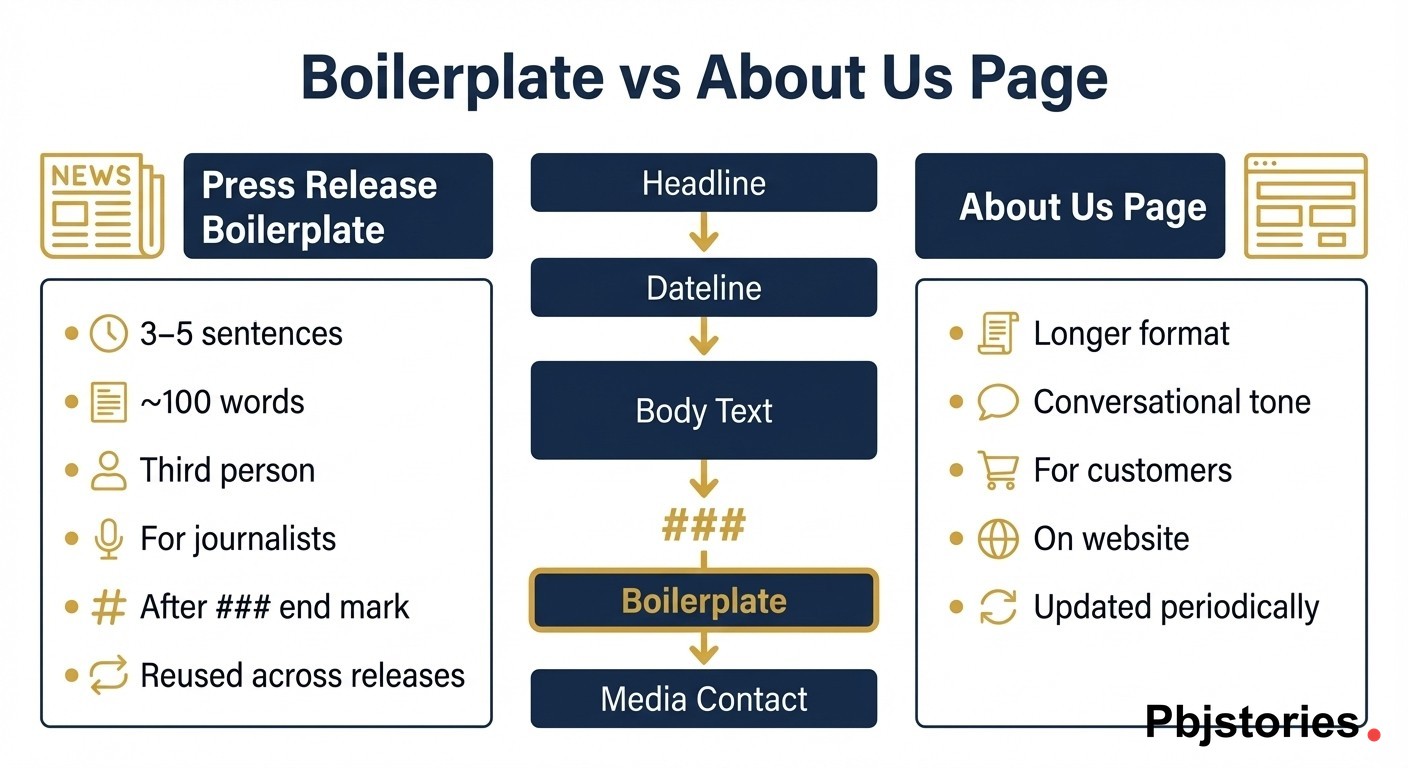
A common point of confusion is the difference between a boilerplate and an About Us page. Both describe the company, but they serve different audiences. A boilerplate is concise, written in third person, and tailored for press use. An About Us page is longer, more conversational, and designed for customers browsing a website.
Where does the boilerplate go? According to AP-style formatting, the industry standard for press release structure, it appears after the body text, following the "###" end mark, and directly before or alongside media contact information.
The same standardized company description also appears in media kits, pitch decks, and investor materials. Maintaining one consistent paragraph across all these channels reinforces brand identity and prevents conflicting descriptions from circulating among reporters, analysts, and stakeholders.
What to Include in a Press Release Boilerplate
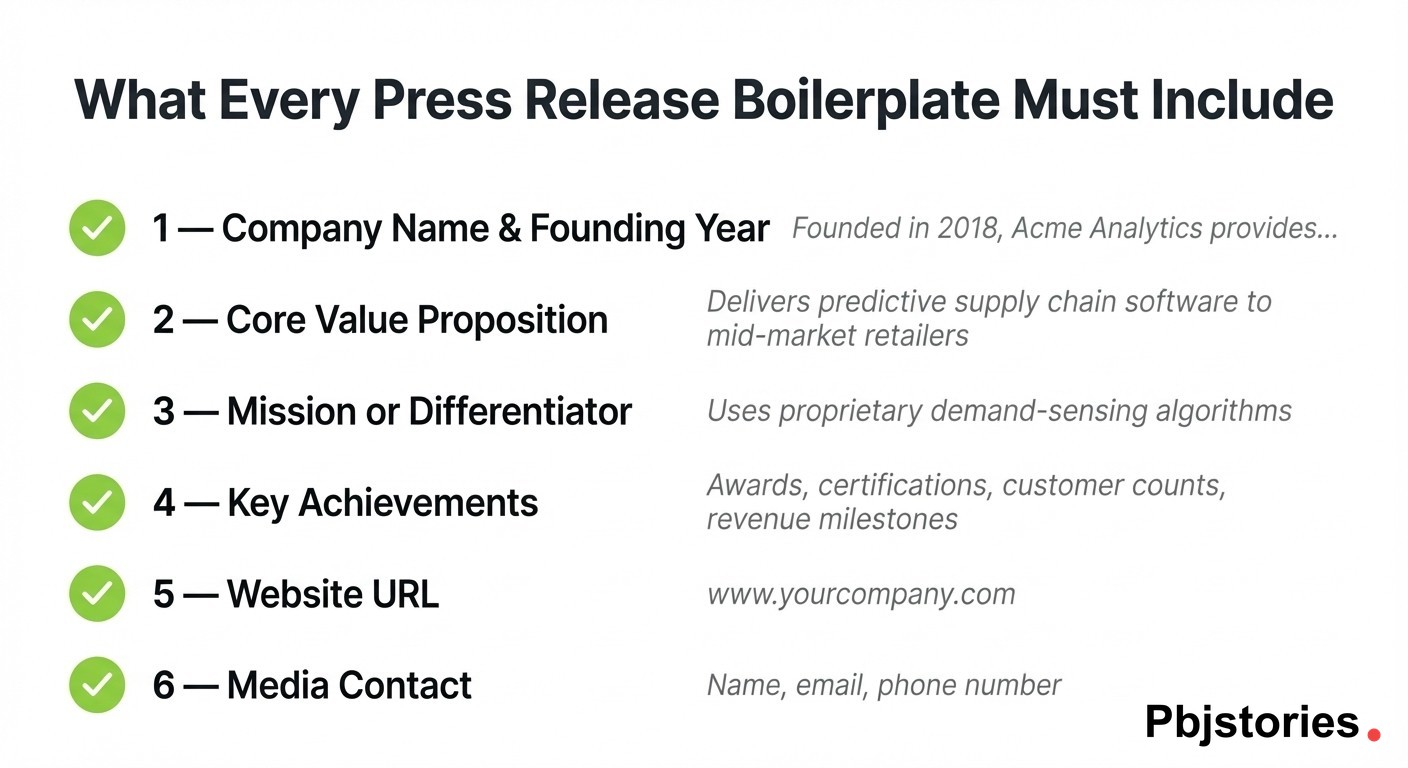
Every boilerplate should contain these core elements:
- Company name and founding year
- Core value proposition (what you do and who you serve)
- Mission statement or unique differentiator
- Key achievements, awards, or milestones
- Website URL
- Media contact information
Company Overview, Mission, and Key Achievements
Start with the company name and founding year. These two details immediately establish credibility and history. A sentence like "Founded in 2018, Acme Analytics provides..." tells journalists exactly who they are writing about.
Follow with a single sentence that captures the core value proposition: what the company does and who it serves. This sentence should read like an elevator pitch, not a mission essay. For example, "Acme Analytics delivers predictive supply chain software to mid-market retailers."
Next, add a mission statement or unique positioning that separates the company from competitors. Frame this factually. "The company's platform uses proprietary demand-sensing algorithms" carries more weight than "We are the best analytics provider."
Even one or two concrete achievements add measurable credibility. Awards, certifications, notable partnerships, customer counts, or revenue milestones all work. According to AP-style press release conventions, specific data points outperform vague claims every time.
New companies without a track record should focus on the founding story, the specific problem being solved, and the target market. A compelling vision paired with a clearly defined audience replaces achievements in early-stage boilerplates.
Keywords, Website URL, and Contact Information
Always include the company website URL so journalists and readers can access additional information without searching. A direct link removes friction and increases the chance of accurate coverage.
Naturally integrate 1-2 target keywords that describe your industry or core offering. For example, "AI-powered press release platform" works because it reads as a genuine descriptor. Stuffing multiple keyword variations into a single sentence signals spam to both editors and search engines.
Consistent keyword association across dozens of press releases can reinforce entity signals for search engines, though the direct press release SEO impact of a boilerplate alone remains modest. The headline and body text carry far more ranking weight.
Contact information, including a media contact name, email, and phone number, typically sits directly after or beside the boilerplate. Together, these elements complete the standard AP-style format and give journalists everything they need in one place.
How to Write a Press Release Boilerplate
Two core steps, tone and mistake-proofing, separate a boilerplate journalists will use from one they ignore.
Choose the Right Tone, Point of View, and Length
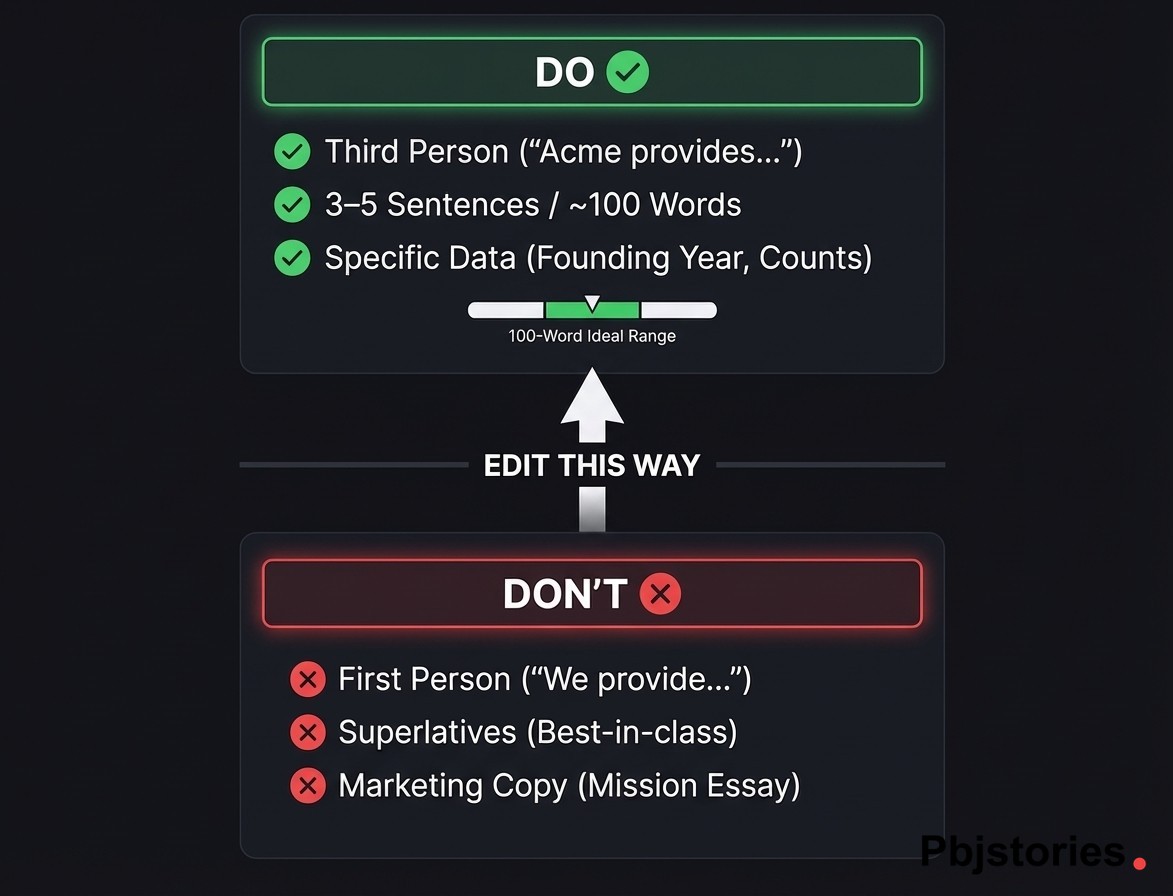
Always write in third person. Journalists copy boilerplates directly into their articles, so "Acme Analytics provides..." works. "We provide..." forces every editor to rewrite your paragraph before publishing.
Keep the tone factual, professional, and confident. Superlatives like "best-in-class" or "world-leading" get cut by editors who need verifiable descriptions, not marketing copy. Replace vague claims with specific data points: customer counts, founding year, or industry served.
Target roughly 100 words or 3-5 sentences. Boilerplates exceeding 150 words risk being skipped entirely by journalists working under deadline pressure.
One practical test: read your boilerplate aloud as an elevator pitch. If it takes longer than 30 seconds, trim it. Brevity signals that a company knows exactly what it does. For formatting guidance on the full release, see this press release template.
Common Boilerplate Mistakes to Avoid
These errors reduce your boilerplate's effectiveness with journalists and editors:
Overly promotional language. Puffery like "industry-leading" erodes credibility. Reporters need factual descriptions, not marketing copy.
Outdated information. Listing a previous CEO or discontinued products signals neglect and undermines trust.
Missing contact details or broken URLs. Without a working link and media contact, the boilerplate becomes useless for outreach.
First-person writing. Using "we" or "our" forces journalists to rewrite the entire paragraph before publishing.
Excessive length. Anything over 150 words competes with the press release body for attention and risks being cut entirely.
Before-and-After Boilerplate Comparison
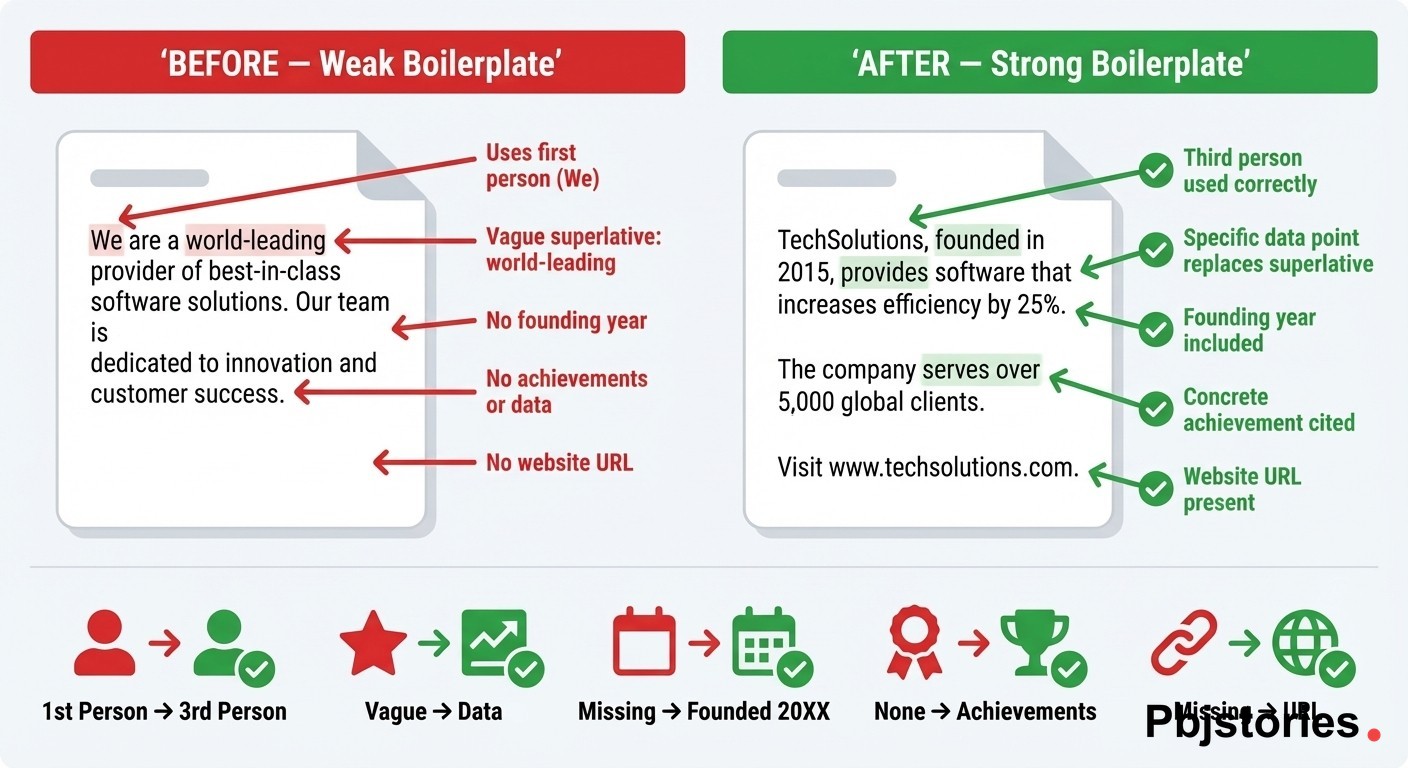
Weak example:
"We are the best and most innovative solutions company in the world. Our team is passionate about delivering cutting-edge, world-class services to our amazing clients. We are truly revolutionizing the industry. Contact us to learn more!"
This version uses first person, relies on empty superlatives, names no specific achievements, and omits a URL.
Improved version:
"Founded in 2019, Apex Digital Solutions provides cloud migration services for mid-market healthcare companies across North America. The company has completed over 200 migrations with a 99.6% uptime record and serves 45 hospital networks. Apex is headquartered in Austin, Texas. Learn more at apexdigital.com."
The revision switches to third person so journalists can paste it directly. Vague claims become verifiable metrics. Industry keywords like "cloud migration" and "healthcare" replace generic language, reinforcing the company's identity across coverage. And the URL gives reporters immediate access to additional sources.
Press Release Boilerplate Examples by Industry
Different industries emphasize different credibility signals, so boilerplate structure shifts depending on whether the organization leads with revenue data, mission impact, or academic reputation.
Corporate and Technology Boilerplate Examples
Large corporations structure their boilerplates around specific data points: founding year, customer count, revenue figures, stock ticker symbol, and headquarters city. Concrete numbers replace the need for subjective claims.
Sample corporate boilerplate: "GlobalTech Industries (NYSE: GTI), founded in 1987, delivers enterprise supply chain solutions to more than 2,000 clients across 40 countries. Headquartered in Chicago, Illinois, GlobalTech generated $4.2 billion in annual revenue. Learn more at www.globaltech.com."
A technology startup boilerplate shifts emphasis toward the problem solved and investor backing rather than revenue history.
Sample startup boilerplate: "Founded in 2022, NovaBridge automates contract compliance for mid-market SaaS companies using natural language processing. Backed by $12M in Series A funding, NovaBridge serves 300 customers across North America. Visit www.novabridge.io."
Both formats avoid vague descriptors and lead with verifiable facts that journalists can quote directly.
Nonprofit, Law Firm, and University Boilerplate Examples
Nonprofits lead with mission because their credibility comes from impact, not revenue. A strong nonprofit boilerplate opens with the problem the organization addresses, names the communities served, and includes measurable outcomes.
"Founded in 2003, Harbor Hope serves homeless veterans across Southern California through transitional housing, job training, and mental health services. Since its founding, the organization has helped more than 12,000 veterans secure stable housing. Learn more at harborhope.org."
Law firms shift emphasis toward practice areas and peer-recognized accolades. Mentioning rankings from Chambers, Best Lawyers, or Super Lawyers carries more weight than self-described expertise. Include attorney count, founding year, and headquarters city.
Universities follow a similar model: founding year, student enrollment, national rankings, and signature research strengths. Location anchors the description geographically, while ranking data establishes academic reputation over promotional language.
Press Release Boilerplate Template (Copy and Customize)
Copy the template below and replace each placeholder with your company's details:
[Company Name], founded in [Year], [what the company does] for [who it serves]. [Key achievement or metric]. Unlike [competitors or alternative approaches], [Company Name] [unique differentiator]. Headquartered in [City, State/Country], the company [additional credibility signal]. For more information, visit [website URL].
Swap credibility signals based on your organization type. Startups emphasize funding raised or the problem solved. Enterprises reference revenue or customer count. Nonprofits lead with impact metrics, and professional firms highlight rankings or practice areas.
When to Update Your Press Release Boilerplate
Review your boilerplate quarterly or immediately after any major company change: a new funding round, leadership transition, acquisition, rebrand, product launch, or significant milestone. Journalists often reference the most recent press release and assume the boilerplate reflects current company information, so stale details erode credibility fast.
Should old press releases be retroactively updated? No. Press releases are historical records that capture the company at a specific moment. Altering them creates confusion for reporters who already cited the original version.
Instead, add a brief note to archived releases: "This press release was originally published on [date]. For current company information, visit [URL]." This preserves accuracy without misleading readers.
Boilerplates in Mergers and Acquisitions Press Releases
During the M&A announcement phase, include separate boilerplates for both companies so journalists and regulators can clearly identify each entity. This dual-boilerplate format appears in virtually every major acquisition press release.
Between announcement and deal closing, both companies must maintain independent boilerplates. They remain legally separate entities until regulatory approval is finalized, and merging descriptions prematurely can create compliance issues with the SEC or antitrust authorities.
After the deal officially closes, transition to a single unified boilerplate for the surviving or newly formed entity. Update the founding narrative, combined metrics, and headquarters details to reflect the merged organization accurately.
Boilerplate Press Release FAQ
How Long Should a Press Release Boilerplate Be?
Approximately 100 words or 3-5 sentences. Journalists working under tight deadlines will skip boilerplates that run longer than 150 words. Brevity forces clarity about what matters most, so treat every sentence as essential real estate.
Where Does the Boilerplate Go on a Press Release?
The boilerplate sits at the very end of the press release body, after the "###" end symbol and before or alongside media contact information. This placement follows standard AP-style press release formatting and ensures journalists see it as a reference block, not part of the news story.
What Is the Difference Between a Boilerplate and an About Us Page?
A boilerplate is a concise, third-person paragraph written for journalists and media use. An About Us page is a longer, conversational web page written for customers and prospects. Both describe the company, but editors need copy they can paste directly into articles, while website visitors expect a narrative that builds brand affinity.
Can a Press Release Boilerplate Help With SEO?
The direct SEO impact is modest, but consistently pairing your company name with target keywords across many press releases reinforces entity signals for search engines. Include your website URL and one or two natural keywords describing your industry or offering. However, press release SEO depends more on distribution reach, headline keyword targeting, and body content than on the boilerplate alone.
How Do I Write a Boilerplate for a New Company With No Track Record?
Focus on your mission, founding story, the specific problem the company solves, and the target market. A clear value proposition and compelling vision replace achievements in early-stage boilerplates. Add milestones, customer counts, or funding details as the company grows.
How Do I Handle Boilerplates During a Merger or Acquisition?
Include separate boilerplates for both companies during the announcement phase. Maintain those separate descriptions until the deal officially closes, since the entities remain legally independent until regulatory approval is finalized. After closing, consolidate into a single boilerplate for the merged entity that reflects the combined organization's scope and positioning.
A well-crafted boilerplate turns every press release into a branding opportunity, reinforcing your company's identity across hundreds of media placements. But writing the boilerplate is only one piece of the puzzle. Getting your release in front of the right audience matters just as much.
PBJ Stories helps you handle the full workflow, from AI-powered writing in AP style to distribution across 500+ news outlets including Google News and Yahoo Finance. If you want to pair a polished boilerplate with real reach, explore PBJ Stories press release tools and start turning company news into measurable visibility.
Get PR tips delivered weekly
Join 3,200+ PR professionals getting actionable tips on press release writing, distribution, and media outreach.
No spam. Unsubscribe anytime.