
Crisis public relations is how a company protects its reputation, revenue, and stakeholder trust when something goes wrong in public view. The first two hours decide the narrative that every follow-up article, analyst note, and AI answer will inherit for years, which is why the discipline is measured in minutes rather than press cycles.
Most "crisis PR" content sells the same seven-step plan without admitting the thing every experienced practitioner knows: communication doesn't save a company if operational reality contradicts the message. Johnson & Johnson pulled 31 million bottles before the statement went out. Uber replaced the CEO before the apology landed. Boards and spokespeople who try to talk their way out without moving the underlying pieces watch the story compound instead of closing. The first judgment call in a crisis isn't what to say — it's whether the company has actually done enough for a statement to land.
Below is how crisis PR actually works in 2026, and how to build a response system before you need one:
-
The three categories of crisis (operational, reputational, digital) and why most real incidents cross category lines
-
A seven-stage plan from pre-drafted holding statements through post-crisis audit
-
The three frameworks practitioners rely on — SCCT, Image Repair Theory, contingency continuum — and when each applies
-
Real examples of brands that recovered and brands that didn't, including J&J, Uber, United, Pepsi, and the 2024–2025 deepfake incidents that rewrote the digital-threat playbook
-
When to bring in outside crisis counsel, and the KPIs that separate a response that worked from one that only looked busy
What Is Crisis Public Relations and Why It Matters
Crisis PR sits at the intersection of media relations, legal counsel, and executive decision-making, and its purpose is to shape the narrative before others shape it for you. The work begins the moment an incident threatens a company's standing with the public.
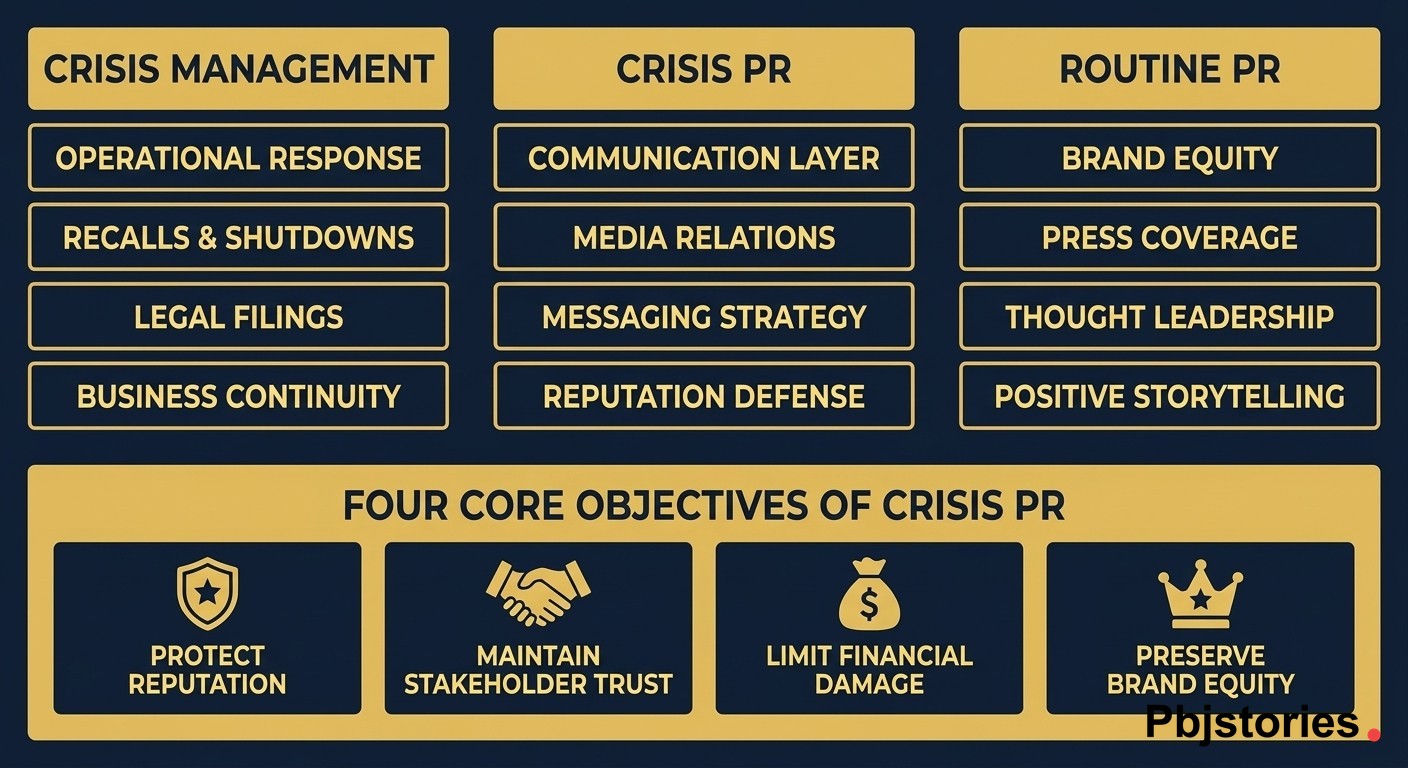
The term is often confused with two related disciplines. Crisis management is the operational response: product recalls, system shutdowns, personnel decisions, regulatory filings. Crisis PR is the communication layer that explains those actions to employees, customers, investors, regulators, and journalists. Routine PR, by contrast, builds brand equity during normal business conditions through press coverage, thought leadership, and product announcements.
These three disciplines must work in tandem, because words without operational action destroy credibility, and action without clear communication invites speculation.
Crisis exposure has become a baseline cost of operating at scale. Industry research cited in this rundown of reasons online reputation management is important finds that companies with 5,000-plus employees absorb roughly five major crises every five years — about one per year — making preparedness a recurring investment rather than a one-off project.
Preparation outweighs reaction for a simple reason: the first 1 to 2 hours of a crisis set the narrative frame that media and the public will carry forward. Once a reporter publishes a story without your voice in it, every follow-up article cites that initial framing. Companies that pre-draft holding statements and rehearse escalation paths respond in minutes rather than days. The compression from days to hours has been documented across two decades of practice, as outlined in this retrospective on twenty years of crisis communications shifting from traditional to real-time response.
Three established frameworks shape how practitioners think about response. Situational Crisis Communication Theory (SCCT), developed by W. Timothy Coombs, matches response strategies (deny, diminish, rebuild) to the level of organizational responsibility the public assigns to the event. William Benoit's Image Repair Theory catalogs tactics such as denial, evasion of responsibility, corrective action, and mortification. The contingency theory continuum plots responses along a spectrum from pure advocacy (defensive) to full accommodation (apology and correction), depending on stakeholder power and legal exposure.
Crisis PR pursues four core objectives at once:
-
Protect reputation by controlling the narrative through accurate, timely information
-
Maintain stakeholder trust across employees, customers, investors, and regulators
-
Limit financial damage from stock drops, boycotts, churn, and litigation exposure
-
Preserve long-term brand equity so the crisis becomes an episode, not a defining chapter
When these objectives align with operational reality, a well-managed crisis can even strengthen a brand. When they diverge, a minor incident can become a multi-year reputational drag.
Types of PR Crises: From Product Failures to AI-Generated Misinformation
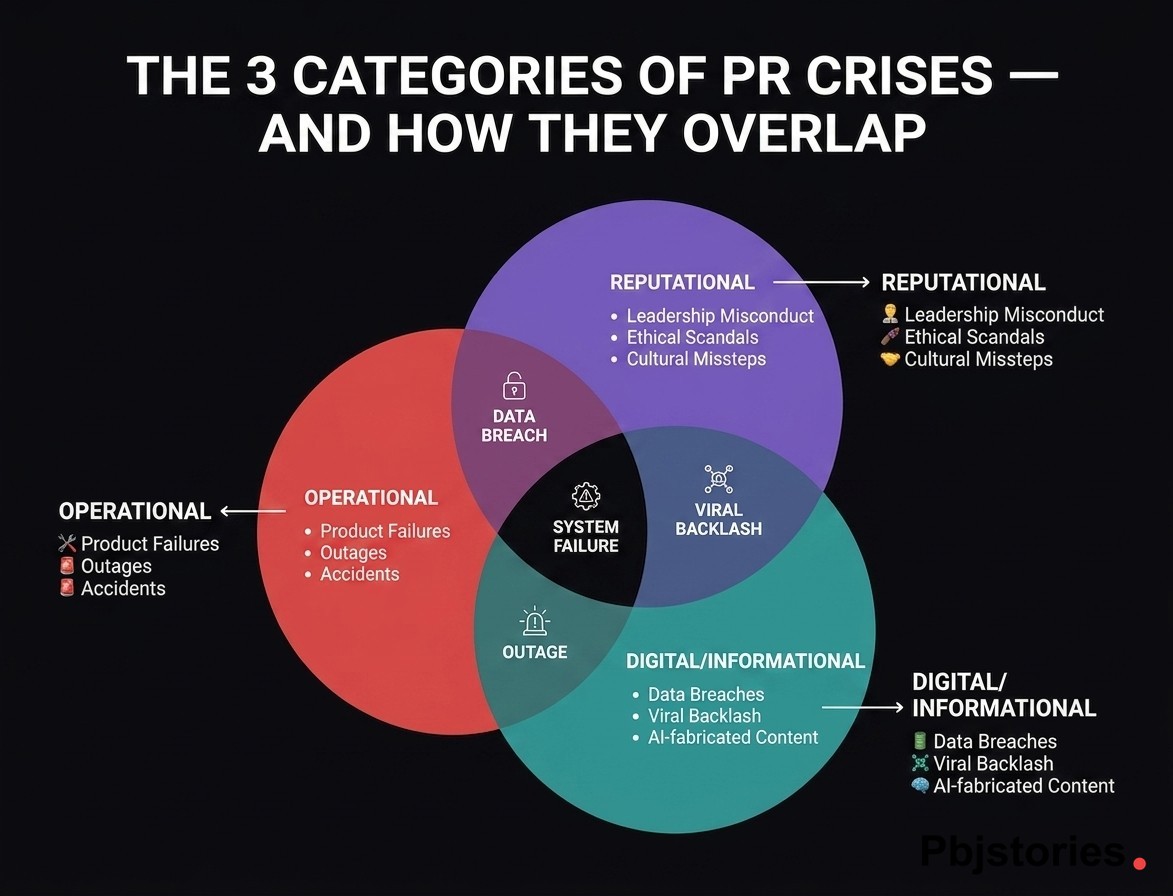
PR crises fall into three broad categories: operational (product failures, outages, accidents), reputational (leadership misconduct, ethical scandals, cultural missteps), and digital/informational (data breaches, viral backlash, AI-fabricated content).
Most real incidents cross category lines. A data breach, for example, starts as an operational failure, triggers regulatory scrutiny, and often ends as a reputational crisis depending on how leadership communicates.
Understanding which category a crisis belongs to shapes the response team, the legal exposure, and the messaging priority. The four scenarios below cover the situations communications teams face most often in 2026, from tangible product failures to synthetic media attacks that did not exist a decade ago.
Product and Service Failures
Operational crises cover product recalls, contamination events, safety incidents, and service outages, and they usually carry direct legal exposure alongside reputational risk. The communication challenge is acknowledging harm quickly without admitting liability in ways that complicate future litigation.
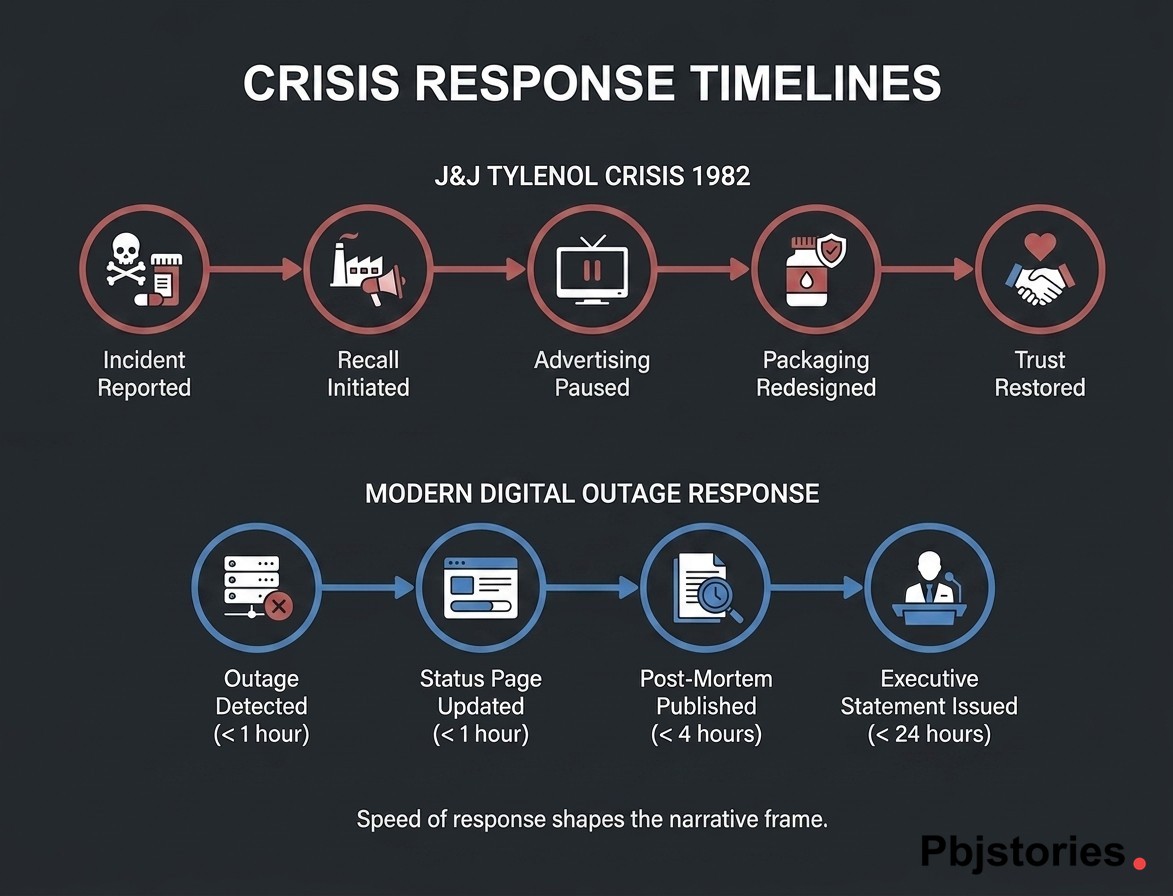
The Johnson & Johnson Tylenol recall of 1982 remains the benchmark. After cyanide-laced capsules caused seven deaths in the Chicago area, J&J pulled 31 million bottles, paused advertising, and redesigned packaging with tamper-evident seals. Speed and transparency turned a potentially brand-ending event into a trust-building moment.
Digital service outages follow the same logic on a compressed timeline. When major platforms like AWS, Cloudflare, or Meta go down, status pages, post-mortems, and executive statements appear within hours because enterprise customers and regulators expect real-time accountability. Rapid acknowledgment limits the narrative vacuum that fuels speculation on X and in trade press.
Product crises trigger regulatory attention from bodies like the FDA, CPSC, or NHTSA, so communication must be coordinated with legal counsel from the first hour. Statements should confirm facts already known, describe corrective action, and express concern for affected users, without speculating on cause.
A well-structured holding statement, distributed through wire services and the newsroom, buys time for the investigation. Pair it with direct customer notifications so affected parties hear from the company before they hear from reporters.
Cybercrime, Data Breaches, and AI-Generated Threats
Digital crises now move faster than any other category because an attacker, a leaked database, or a fabricated video can reach millions before the communications team finishes its first draft.
Data breaches, ransomware attacks, and stolen customer records trigger both reputational damage and strict legal obligations. Under the GDPR, organizations must notify the relevant supervisory authority within 72 hours of discovering a breach involving EU residents. California's CCPA and similar state laws in New York, Texas, and Colorado require consumer notification without unreasonable delay, and disclosure timing itself becomes part of the story if regulators find it slow.
Communications during a breach move in lockstep with legal and IT forensics: what is confirmed, what is still being investigated, and what affected customers should do today. Vague statements erode trust, while premature technical details can mislead if the forensic picture changes.
The 2026 threat layer adds synthetic media. Deepfake videos of CEOs announcing fake acquisitions, AI-generated press releases spoofed on lookalike newsrooms, and LLM-hallucinated claims repeated in social posts can all move markets before the real company responds. A fabricated earnings statement circulating on X or LinkedIn can trigger a stock reaction in minutes.
Defense requires continuous social listening, executive-image monitoring, domain watch for spoofed newsrooms, and a verification protocol that tells journalists exactly where official statements live. Publishing through recognized wire channels and pinning authoritative announcements on your owned newsroom gives reporters a single source of truth to check against suspect content. Where the breach also creates litigation risk, the communications response has to align with a parallel strategy for managing high-profile legal battles so that public statements do not contradict court filings.
Leadership Misconduct and Ethical Scandals
Reputational crises tied to leadership include CEO misconduct, financial fraud, insider trading, discrimination claims, harassment allegations, and broader workplace culture scandals. These cases differ from operational failures because the person creating the crisis is often the same person expected to speak for the company, which forces an immediate question of who holds the microphone.
Communication alone cannot resolve a leadership crisis. Statements about "values" and "accountability" ring hollow if the implicated executive remains in place, so personnel action (suspension, independent investigation, board oversight, resignation) usually has to precede or accompany the public response. Stakeholders read the action, not the adjective.
Uber's 2017 crisis illustrates the point. After reports of systemic harassment, the Holder Report, and a string of viral incidents, the board replaced CEO Travis Kalanick with Dara Khosrowshahi, restructured leadership, and published cultural reforms. The combination of structural change and consistent messaging rebuilt enough stakeholder trust for the company to proceed to its 2019 IPO, something a press release alone could never have achieved.
Financial fraud cases follow the same pattern. Regulators, auditors, and institutional investors expect governance changes, clawbacks, and disclosures aligned with SEC or equivalent rules. Coordinated sequencing matters: legal action first, then controlled disclosure, then a public statement that matches what the company has actually done.
Social Media Crises and Viral Backlash
A single tweet, TikTok, or employee post can trigger a full crisis within hours because social platforms compress the traditional news cycle into real-time reactions. Screenshots outlive deleted posts, and algorithmic amplification pushes outrage into feeds that would never have encountered the original content.
The first judgment call is whether a situation is an actual crisis or background noise. Not every negative comment warrants a statement, and overreacting to an isolated complaint often signals to other users that the issue is worth rallying around. Responding at the wrong altitude turns a small spat into a press story.
Practitioners typically watch four escalation thresholds before activating the crisis playbook:
-
Volume: a sharp spike in mentions beyond normal baseline, often 5-10x typical daily volume
-
Sentiment shift: net sentiment flipping negative and holding for more than a few hours
-
Tier-1 media pickup: coverage by outlets like Reuters, the BBC, or major trade publications
-
Stakeholder-specific outrage: employees posting internally, investors emailing IR, or regulators signaling interest
Any two of these crossing at once usually justifies escalation. Tier-1 pickup alone almost always does, because mainstream coverage carries the story to audiences who never saw the original post.
The response pattern matters as much as the timing. Acknowledge the specific concern, avoid corporate boilerplate, and route substantive replies through the principal spokesperson so the company speaks with one voice across channels.
How to Build a Crisis Public Relations Plan in 7 Steps
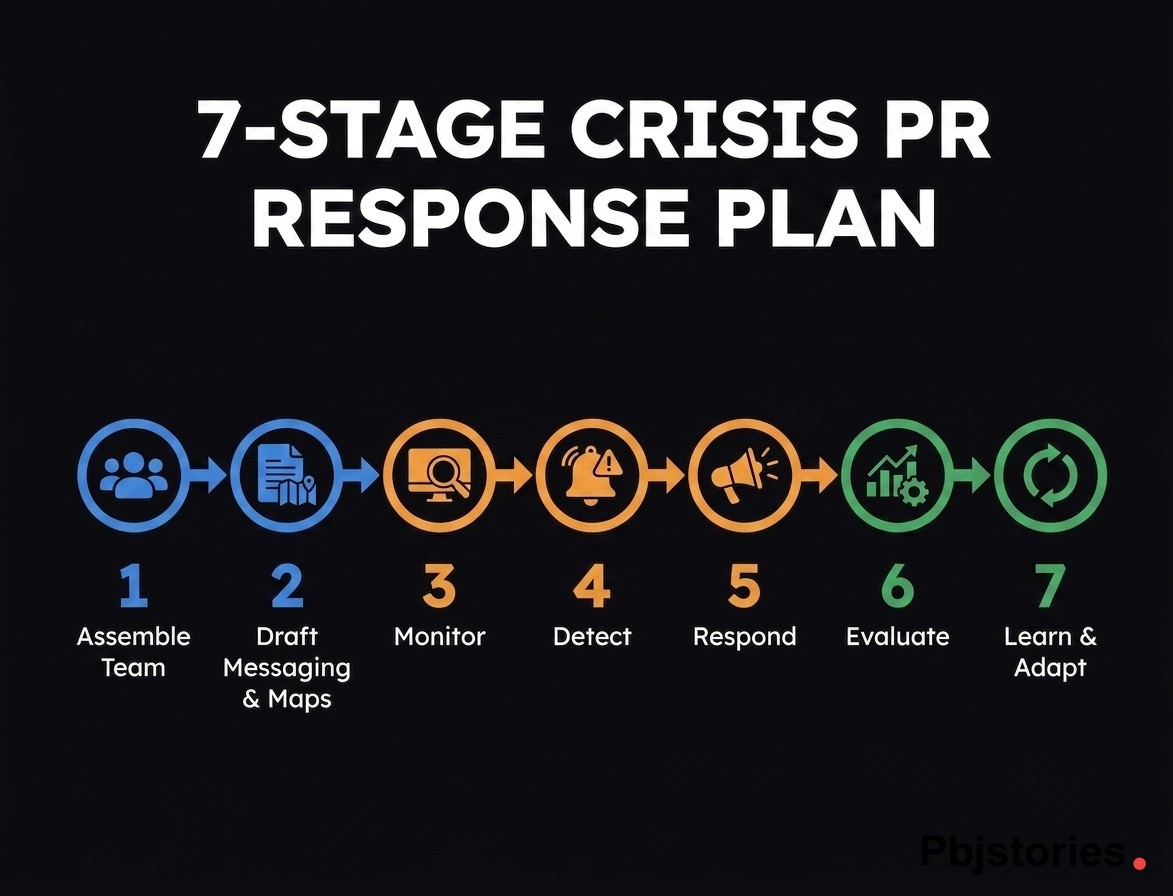
A working crisis PR plan follows seven stages: assess risk, assemble the team, draft messaging, set monitoring, respond, communicate internally and externally, and evaluate.
Practitioner consensus holds that roughly 90% of effective crisis response happens before anything goes wrong, because playbooks, spokesperson training, and pre-approved holding statements cannot be produced under pressure in the first hour.
The three subsections below unpack the operational core of the framework: building the response team, preparing messaging and stakeholder maps in advance, and running the monitor-respond-evaluate loop once a situation breaks.
Assemble and Train a Crisis Response Team
A functional crisis response team includes seven core roles, each with a defined lane and backup. The CEO or senior spokesperson delivers high-stakes statements, legal counsel reviews every word for liability, and the head of communications owns strategy and media relationships.
Alongside them, the HR lead handles employee messaging and personnel matters, the operations lead translates what is actually happening on the ground, the social media manager monitors and responds in real time, and IT or security takes the lead on breaches, deepfakes, and system outages.
One name, one voice.
The principal spokesperson principle means a single designated person delivers public statements across outlets, because contradictory quotes from two executives become the second-day story. Backup spokespeople are pre-approved and briefed, but they speak only when the primary is unavailable or the crisis type demands specialized authority, such as a CISO for a data breach.
Training matters more than org charts. Quarterly tabletop exercises walk the team through realistic scenarios, such as a product recall, a CEO scandal, or a ransomware leak, with live press calls, mock social feeds, and a running clock.
Crisis simulation practice consistently shows that rehearsed teams respond 40-60% faster than untrained ones, because muscle memory replaces improvisation when the first media call arrives. Rotate scenarios, debrief honestly after each drill, and update the playbook based on where the team hesitated or contradicted itself.
Develop Pre-Drafted Messaging and Stakeholder Maps
Pre-drafted messaging shortens the time between incident and response because writing under pressure produces errors, and errors become the story. Three assets form the foundation: holding statements, dark site pages, and pre-approved social media responses.
A holding statement is a short, scenario-agnostic acknowledgment confirming that the company is aware of the situation, treating it seriously, and will share updates within a defined window. Dark site pages are unpublished web pages, already drafted and legal-reviewed, that go live the moment a specific crisis breaks, covering recalls, breaches, or safety incidents. Pre-approved social responses cover the first 30 minutes of platform engagement, so community managers are not inventing language while mentions spike.
Stakeholder mapping assigns message priorities to each audience, since a single corporate statement cannot serve everyone:
-
Employees need direction, reassurance, and talking points before the public does
-
Customers need clarity on impact, remedy, and next steps
-
Investors need material facts and financial exposure
-
Regulators need compliance evidence and notification within statutory deadlines
-
Media need a named spokesperson, facts, and access
-
Partners and suppliers need continuity information and coordination guidance
Each message should be drafted once, legal-reviewed, and stored where the response team can retrieve it in under a minute.
Standardizing the external statement format also matters. Using a consistent press release template locks in tone, structure, and approval workflow before adrenaline takes over.
Monitor, Detect, Respond, and Evaluate
Detection begins long before the crisis peaks. Social listening tools track brand mentions, keyword spikes, and sentiment shifts across X, TikTok, Reddit, and Facebook, while media monitoring platforms flag tier-1 pickup from outlets like Reuters, Bloomberg, or the BBC.
Sentiment tracking matters most because volume alone does not distinguish a trending meme from a reputational threat. A 10% spike in mentions with sharply negative sentiment signals escalation, whereas the same spike with neutral sentiment often reflects routine news cycles.
The golden hour sets the response cadence. Acknowledge the situation publicly within 1–2 hours with a short holding statement naming the issue and promising updates, and release a full statement within 24 hours once facts are verified with legal, operations, and leadership.
Speed without accuracy backfires, so the initial acknowledgment should confirm awareness and care, not assign cause. The complete statement follows press release best practices: clear headline, factual lede, named spokesperson, corrective actions, and a media contact.
Distribute that statement through the same channels the crisis inhabits. If the story broke on X, respond there first; if it hit Google News, push a wire release so accurate coverage outranks speculation.
Post-crisis evaluation closes the loop. Review four dimensions:
-
Media cycle shape: peak volume, duration, and which outlets drove coverage
-
Sentiment recovery: days until net sentiment returned to baseline
-
Process failures: what internal gap allowed the crisis to form or escalate
-
Playbook updates: revised holding statements, new monitoring keywords, added spokespersons
Run the debrief within two weeks while memories are fresh, because insights lost to time rarely make it into the next version of the plan.
Crisis Public Relations Examples: Brands That Got It Right and Wrong
The clearest way to understand crisis PR is to compare responses side by side. Two companies can face similar incidents, and the one that leads with accountability often recovers within weeks, while the defensive responder spends months repairing trust.
The cases below show why tone, speed, and corrective action decide outcomes. Patterns repeat across industries, so the lessons transfer directly to any communications playbook.
Best-Managed PR Crises
Three cases show how speed, accountability, and visible action shorten recovery time and, in some situations, strengthen the brand.
KFC's 2018 UK chicken shortage began when a logistics switch to DHL left hundreds of restaurants without their core product. Rather than deflecting, KFC ran a full-page print ad rearranging its logo to read "FCK," paired with a plain-spoken apology and a live tracker showing which stores had reopened. The humor worked because it followed accountability, not the other way around, and the campaign is still taught as a template for small-brand tone under pressure.
Starbucks' 2018 racial bias incident in Philadelphia, where two Black men were arrested while waiting for a meeting, escalated on social media within hours. CEO Kevin Johnson issued a direct apology, met with the men personally, and closed roughly 8,000 U.S. stores for an afternoon of anti-bias training involving about 175,000 employees. Critics debated the training's depth, but the decision to absorb a day of lost revenue signaled that the company treated the incident as systemic rather than isolated.
Johnson & Johnson's 1982 Tylenol recall remains the reference case for product crises. After cyanide-laced capsules killed seven people in Chicago, the company pulled roughly 31 million bottles nationwide, cooperated openly with the FBI and FDA, and reintroduced the product in tamper-evident packaging that later became an industry standard. The case is documented as a defining entry in this PR history timeline, and its sequencing principles still anchor most modern crisis curricula.
The common thread is sequencing. Each company acted before explaining, and each explanation centered on affected people rather than corporate reputation. That order, action first and defense never, is what separates a managed crisis from a prolonged one.
Worst Crisis Responses and Lessons Learned
Three cases show how the wrong words, spoken in the wrong tone, extend a crisis well beyond the original incident.
United Airlines (2017) faced global backlash after security officers dragged Dr. David Dao off an overbooked flight. CEO Oscar Munoz's first statement called the passenger "disruptive and belligerent" and praised employees for following procedure, which created a second crisis on top of the first. By the time a genuine apology arrived, video of the incident had already circled the world, and United's market value dropped by an estimated $1 billion before recovering.
BP's Deepwater Horizon spill (2010) became the textbook example of tone-deaf executive communication. Eleven workers died, millions of barrels of oil reached the Gulf of Mexico, and CEO Tony Hayward told cameras, "I'd like my life back." The comment positioned the company as the victim and erased any empathy the earlier statements had built, accelerating his removal as spokesperson and eventually as CEO.
Pepsi's 2017 Kendall Jenner ad showed that a planned campaign can become a crisis without cultural sensitivity review. The spot trivialized Black Lives Matter protest imagery by suggesting a soda could resolve tension between demonstrators and police. Pepsi pulled the ad within 24 hours, but the internal creative process, which had bypassed external review, drew sharper criticism than the ad itself.
The common lessons are consistent. Lead with empathy for the affected parties, not a defense of the company or its employees. Avoid defensiveness in the first statement because it locks the brand into a position that later facts usually contradict. Never frame the organization as the victim when customers, workers, or communities carry the real harm. And subject every high-stakes campaign or statement to a review that asks how the most skeptical audience will read it. For more case studies along the same arc, this catalog of lessons from public relations disasters collects the recurring failure patterns side by side.
When to Hire a Crisis PR Firm vs. Managing In-House
Hire an external crisis PR firm when any of four triggers apply: active legal liability, national or international media attention, the crisis implicates a founder or C-suite executive, or the company has no one on staff with prior crisis experience. Outside these triggers, a trained in-house team can usually manage the response faster and at lower cost, because they already understand the product, culture, and stakeholders.
The decision also depends on bandwidth. Even experienced communications leads cannot run a 24-hour media cycle, brief legal counsel, and draft statements simultaneously, so firms earn their fee primarily by absorbing operational load during the first 72 hours.
What to Look for in a Crisis PR Firm
-
Industry experience in your specific sector (fintech, healthcare, consumer, energy), because regulatory language and reporter contacts differ sharply between verticals
-
24/7 availability with a named partner, not a rotating account team
-
Tier-1 media relationships at outlets that actually cover your industry, verified by recent bylines and placements
-
Transparent retainer structure with clear scope, hourly overage rates, and defined deliverables
-
Crisis simulation capability, because firms that only react during incidents rarely produce strong playbooks
Typical Costs
Preparedness retainers at mid-tier firms run $5,000–$25,000 per month and cover monitoring, playbook maintenance, media training, and tabletop exercises. Active crisis engagement at top firms ranges from $25,000 to $100,000+ per incident, scaling with duration, media intensity, and executive coaching hours.
Prevention costs a fraction of reaction. A year of preparedness retainer often equals a single week of active crisis work, so the financial argument aligns with the reputational one.
The Middle Path for Startups and Small Teams
Small companies rarely need a full agency for routine reputation issues. A lean in-house approach, combined with AI-powered distribution tools to push official statements to major outlets including Google News and Yahoo Finance, covers most operational and minor reputational events.
Escalate to a firm only when severity crosses the four triggers above. For the statement itself, keep tone consistent with your prepared messaging and route approvals through the same sign-off chain your playbook already defines.
Crisis PR Metrics: How to Measure the Effectiveness of Your Response
Measurement separates a crisis response that worked from one that only felt busy. Five core KPIs anchor the evaluation: share of voice, sentiment recovery time, media mention trajectory, message pull-through, and stakeholder trust surveys.
Share of voice tracks how much of the conversation in your category mentions your brand versus competitors, and a sharp spike during a crisis followed by steady decline is the expected curve. Media mention trajectory plots volume over time, showing when the story peaks and when it fades below baseline.
Message pull-through is the percentage of coverage that carries your approved key messages rather than critics' framing, and it reveals whether your spokespeople broke through or got rewritten. Stakeholder trust surveys close the loop by asking employees, customers, and investors directly whether confidence held, dropped, or recovered.
Digital metrics add a second layer. Social mention volume, sentiment shift measured at 7, 30, and 90 days, search interest trends on Google Trends, and branded search recovery together show how the public conversation moves across platforms. Branded search volume returning to normal often signals the story has left active memory.
Sentiment recovery time is frequently the single most telling metric because it compresses everything into one number: the days required for net sentiment to return to its pre-crisis baseline. A four-week recovery suggests the response worked. A six-month flat line suggests structural damage.
None of these metrics function without a baseline. Measure share of voice, sentiment, and branded search before anything goes wrong, because recovery is meaningless without a pre-crisis benchmark to recover to. Teams that monitor continuously catch early warning signals and hold the evidence needed to prove the response worked.
Crisis Public Relations: FAQ
Five questions come up repeatedly from founders, communications leads, and students researching the field, covering response speed, terminology, cost, recovery odds, and career entry points.
How Quickly Should a Company Respond to a PR Crisis?
Acknowledge the incident within 1-2 hours and publish a full statement within 24 hours. The initial acknowledgment does not need to explain what happened or assign cause; it only needs to confirm the company is aware, is investigating, and will share more soon.
That short window matters because silence invites speculation, and once media and social users fill the gap, the replacement narrative is difficult to dislodge. A brief holding statement buys time to verify facts with legal, operations, and affected stakeholders before committing to specifics.
Speed applies to distribution as well. The best time to send a press release influences whether journalists pick it up the same day, so crisis statements released off-hours often lose the news cycle they were meant to shape.
What Is the Difference Between Crisis Communication and Crisis Management?
Crisis communication is what you say: the holding statement, the press conference, the stakeholder email, the social post, the investor call. Crisis management is what you do: recalling the product, firing the executive, patching the breach, compensating affected customers, changing the policy that caused the incident.
The two functions run in parallel and depend on each other. A well-crafted statement loses credibility within hours if operational decisions contradict it, since journalists and customers compare words against actions in real time.
Effective crisis PR requires both working in tandem. Communications teams draft the narrative, operations and leadership produce the substance behind it, and legal counsel keeps both aligned. Words without action destroy trust faster than silence.
How Much Does Crisis Public Relations Cost?
Costs fall into three tiers. Preparedness retainers run $5,000 to $25,000 per month and cover ongoing media monitoring, playbook maintenance, spokesperson training, and quarterly tabletop exercises.
Active crisis engagement jumps to $25,000 to $100,000+ per incident at mid-to-top-tier firms, and high-stakes cases involving litigation, congressional attention, or international media can exceed that range because senior partners, crisis counsel, and 24/7 war-room staffing bill concurrently.
DIY distribution sits at the opposite end. Publishing an official statement through a press release platform costs from the low hundreds per release, which makes baseline announcement reach, including Google News and Yahoo Finance, accessible to startups without agency retainers.
Preparation consistently costs a fraction of reactive engagement, so companies that invest in a retainer and playbook rarely pay the six-figure fees associated with unmanaged crises.
Can a Company Recover From a PR Crisis?
Yes. Recovery is achievable with accountability, transparency, corrective action, and consistent follow-through sustained over 6 to 18 months. The timeline reflects how long media cycles, search results, and stakeholder memory take to reset around a new, positive narrative.
KFC rebuilt trust within weeks of the 2018 UK chicken shortage because the "FCK" apology paired humor with direct ownership of the failure. Starbucks moved faster still, closing 8,000 stores for bias training after the 2018 Philadelphia incident and signaling that policy, not just messaging, had changed.
Some brands actually emerge stronger when the response exceeds expectations, since a well-handled crisis becomes evidence of integrity under pressure. The decisive factor is whether actions match words, because stakeholders forgive mistakes far more readily than they forgive evasion.
How Do You Get Started in a Crisis PR Career?
Start in general public relations or journalism, because both paths build the two skills crisis work demands most: fast, accurate writing under deadline pressure and real relationships with reporters at tier-1 outlets.
After two to four years, move into agency work with a dedicated crisis practice group, or take an in-house communications role at a regulated industry like finance, healthcare, or energy, where incident response is part of the weekly rhythm rather than a rare event.
Seniority matters more here than in most PR specialties. Advising a CEO during a live crisis requires credibility that usually takes 7 to 10 years to build, since executives will not follow counsel from someone who has never sat through a tier-1 media storm.
Practitioners consistently describe crisis PR as the most rewarding part of the profession despite real burnout risk, because the work is intense, high-stakes, and directly visible to the people making the largest decisions in the company.
Once the immediate crisis passes, the recovery phase depends on flooding search results and news feeds with accurate, forward-looking stories that rebuild trust. That's where distribution scale matters: a single statement on your own blog rarely reaches the stakeholders who saw the original headlines, so earned placement across tier-1 outlets becomes essential to reset the narrative.
PBJ Stories helps brands move fast when minutes count, generating AP-style statements and distributing them to 500+ news sites including Google News and Yahoo Finance, with SERP-driven keyword targeting so your corrective messaging actually ranks against the crisis coverage. If you want a head start before the next incident, grab our crisis playbook starter kit and keep it alongside your holding statements.
Get PR tips delivered weekly
Join 3,200+ PR professionals getting actionable tips on press release writing, distribution, and media outreach.
No spam. Unsubscribe anytime.