
Press release quotes are the most copied, pasted, and published element of any media announcement, yet most read like they were written by committee and approved by legal. Journalists scan dozens of releases per day, and the quote is often the only section they lift verbatim into their story. A flat, generic quote kills an otherwise newsworthy release before it reaches a single reader.
The problem is straightforward: PR teams spend hours perfecting the headline and lead paragraph, then rush the quote at the last minute. The result is a forgettable line stuffed with corporate enthusiasm and zero substance. Editors cut these quotes because they add nothing a reader couldn't guess on their own.
What follows is a practical breakdown of formatting rules, a proven three-sentence structure for writing quotable material, and over 15 real examples organized by announcement type. Whether you are ghostwriting for a CEO or drafting your own founder quote for a press release, every section below is built around one goal: producing quotes that journalists actually keep in the final story.
What Is a Press Release Quote and Why Does It Matter?
A press release quote is a direct statement attributed to a named spokesperson that adds a human perspective to an otherwise factual announcement. It typically includes the person's full name, job title, and company, making it the one element that carries personal authority.
Journalists value these quotes because they function as ready-made soundbites. Many outlets, especially digital publications working under tight deadlines, will run a well-crafted quote verbatim without requesting an additional interview. This saves reporters time and gives your spokesperson direct access to the published story.
Quotes also build credibility by attaching a real person's opinion to the news. For both traditional media and search engines, a named attribution strengthens E-E-A-T signals, linking expertise and experience directly to the announcement.
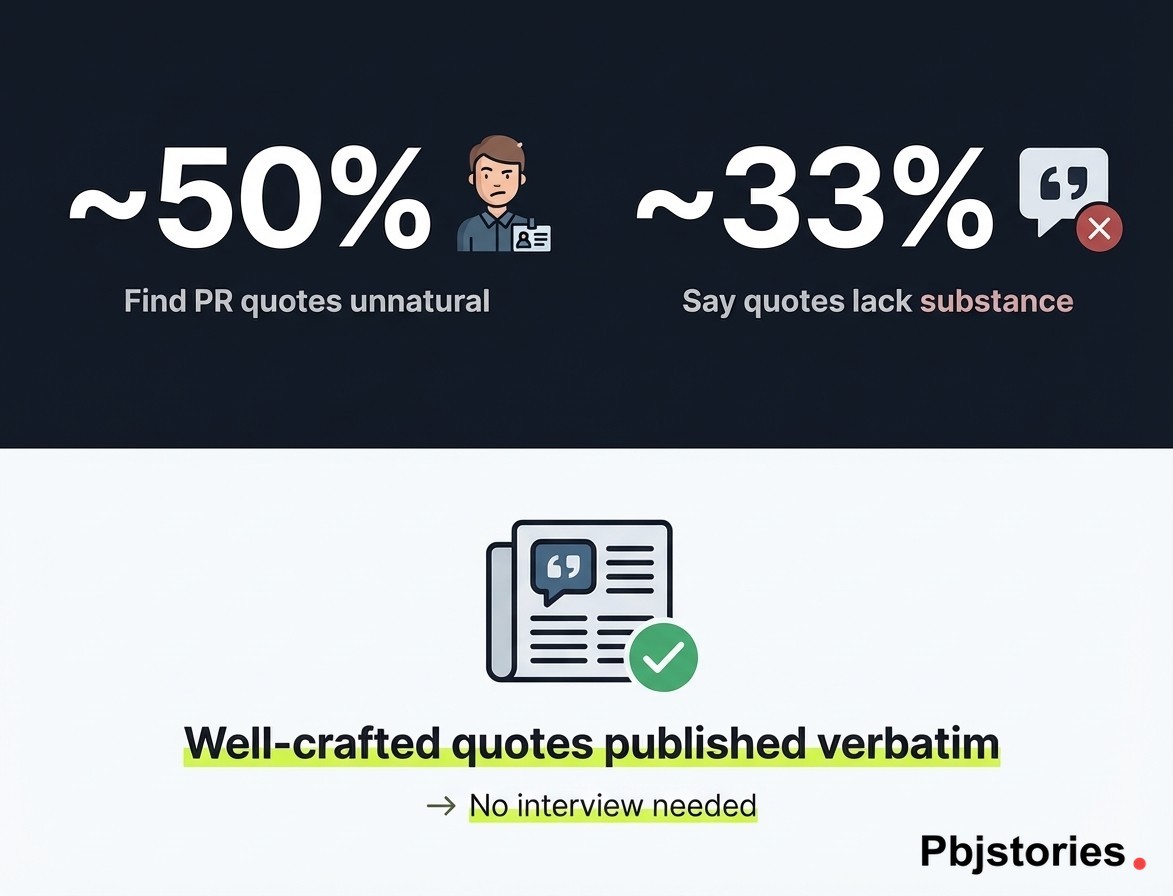
But poorly written quotes do the opposite. Surveys of journalists consistently show that roughly half find PR quotes unnatural, and about a third consider them not substantive enough to include. Generic language actively reduces your chances of media pickup.
One clarification worth making: press release quotes differ from pull quotes and cross-heads. Pull quotes are design elements editors select from existing article text for visual emphasis. Cross-heads are subheadings breaking up long editorial copy. Neither involves original attributed statements from a spokesperson.
How to Format Press Release Quotes (AP Style, Attribution & Punctuation)
Incorrect formatting signals amateur work to editors before they even read your message. Mechanical errors in attribution, punctuation, or tense can cost you media pickup entirely. The rules below follow AP Style, the standard for newsrooms and wire services across North America.
Quotation Marks, Attribution, and Tense Rules
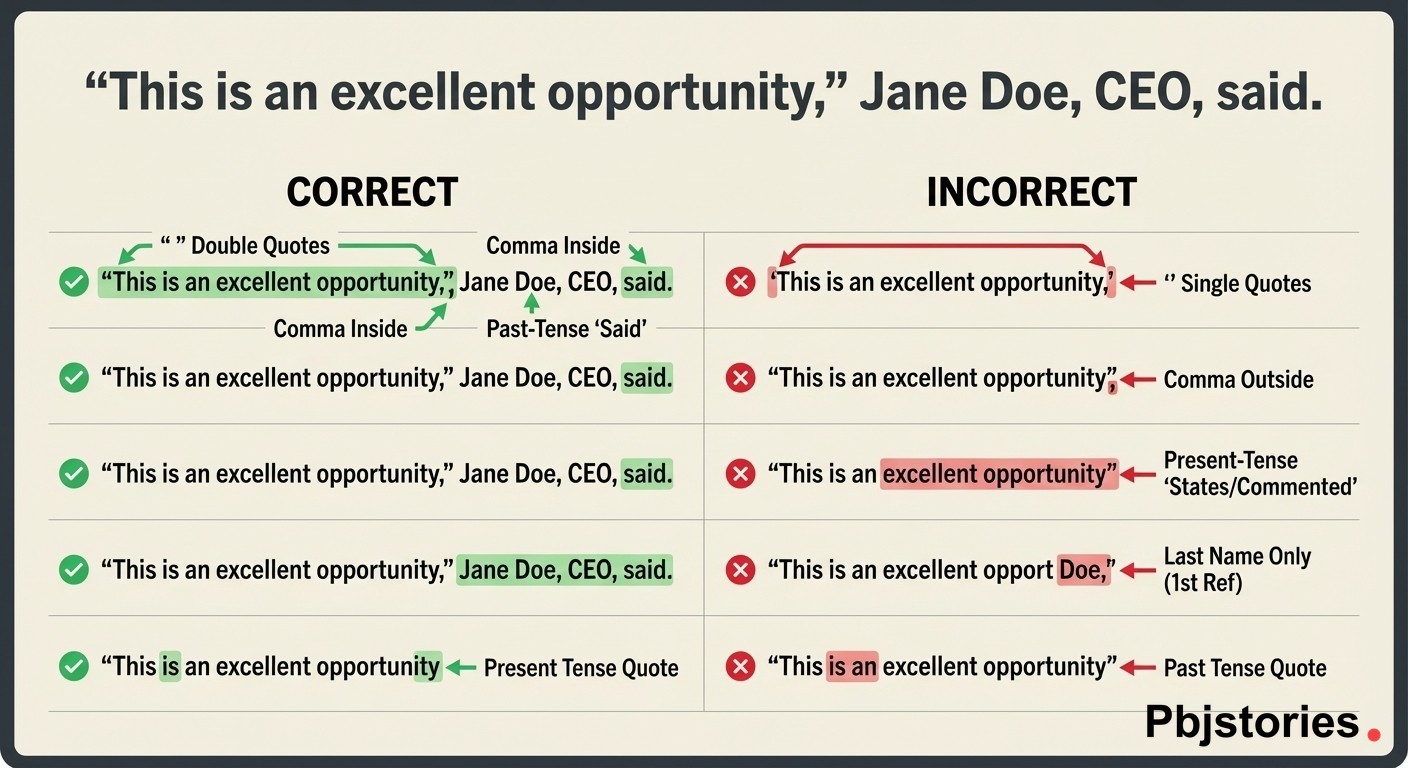
AP Style requires double quotation marks around every direct quote, a comma before the attribution, and the past-tense verb "said" for the attribution tag. Avoid "says," "states," or "commented," because newsrooms treat "said" as the neutral standard.
Here is the correct format:
"We designed this product to reduce onboarding time by 40 percent," said Jane Doe, Chief Product Officer at Acme Corp.
Notice the comma sits inside the closing quotation mark, and "said" follows immediately. The quote content uses present or future tense because the speaker's opinion remains current, while the attribution verb stays in past tense. This contrast trips up many writers, but the rule is consistent across AP guidelines.
On first reference, use the speaker's full name and title. Subsequent references use last name only: Doe added that the feature would ship in Q3.
One more distinction: "according to" works for paraphrased statements but should never introduce a direct quote. If the words appear inside quotation marks, attribution must use "said." Following these conventions signals to editors that your release meets professional newsroom standards.
Formatting Single vs. Multiple Quotes in One Press Release
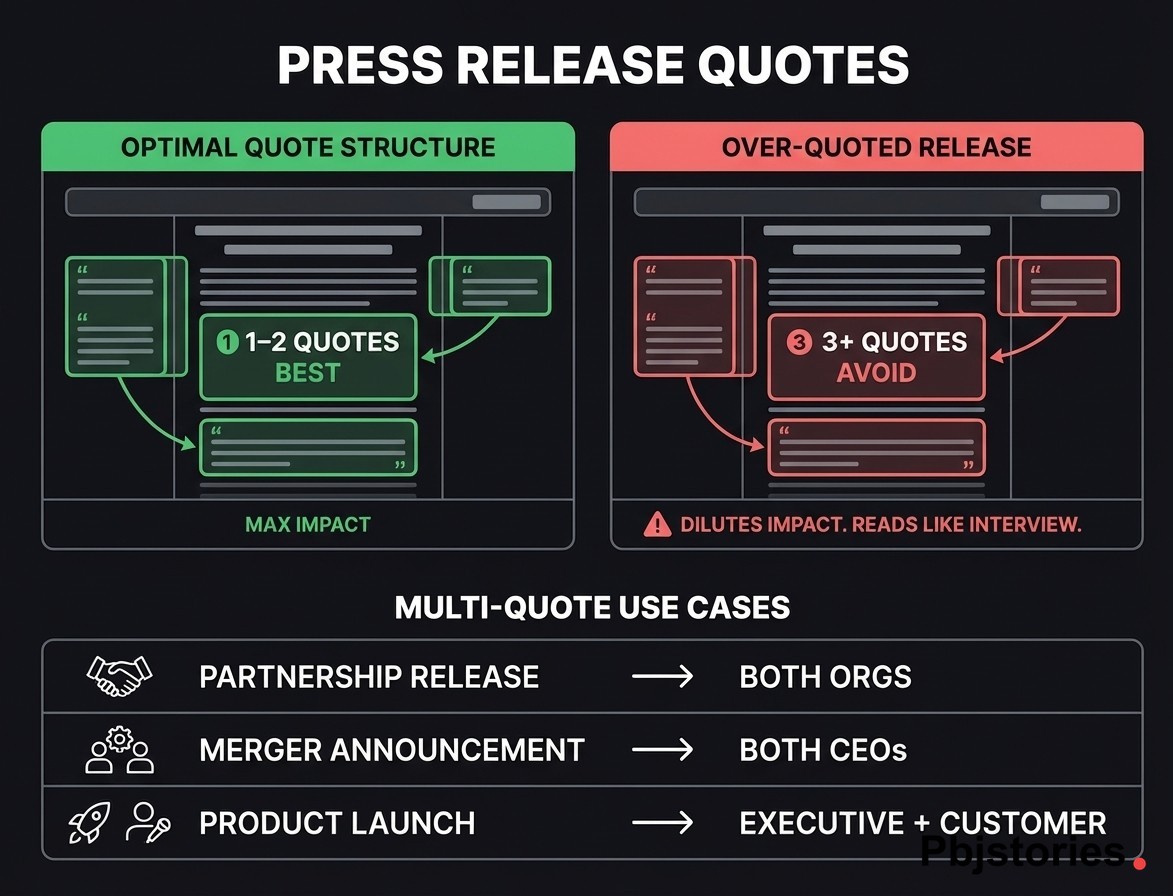
Most press releases perform best with 1-2 quotes. More than three makes the release read like an interview transcript, diluting each speaker's impact and giving editors more reasons to cut content.
When quoting multiple speakers, give each person a new paragraph with full name, title, and company on first mention. Each quote should offer a distinct perspective rather than echo the same message.
A frequently missed AP Style rule applies to multi-paragraph quotes from a single speaker: opening quotation marks appear at the start of every paragraph, but closing quotation marks appear only at the end of the final paragraph. This signals to the reader that the same person is still speaking.
Multiple quotes are appropriate when the announcement genuinely involves more than one party. Partnership releases benefit from quoting both organizations, and merger announcements where both CEOs speak address stakeholder concerns from two sides. Product launches can pair an executive quote with a customer testimonial, giving journalists an independent voice alongside the company's own.
How to Write Press Release Quotes That Journalists Actually Use
Proper formatting gets your release past the gate. The content of the quote, however, determines whether a journalist copies it into their story or deletes it during editing. What separates quotable material from filler comes down to specificity, structure, and voice.
The 3-Sentence Quote Formula: News, Insight, Future
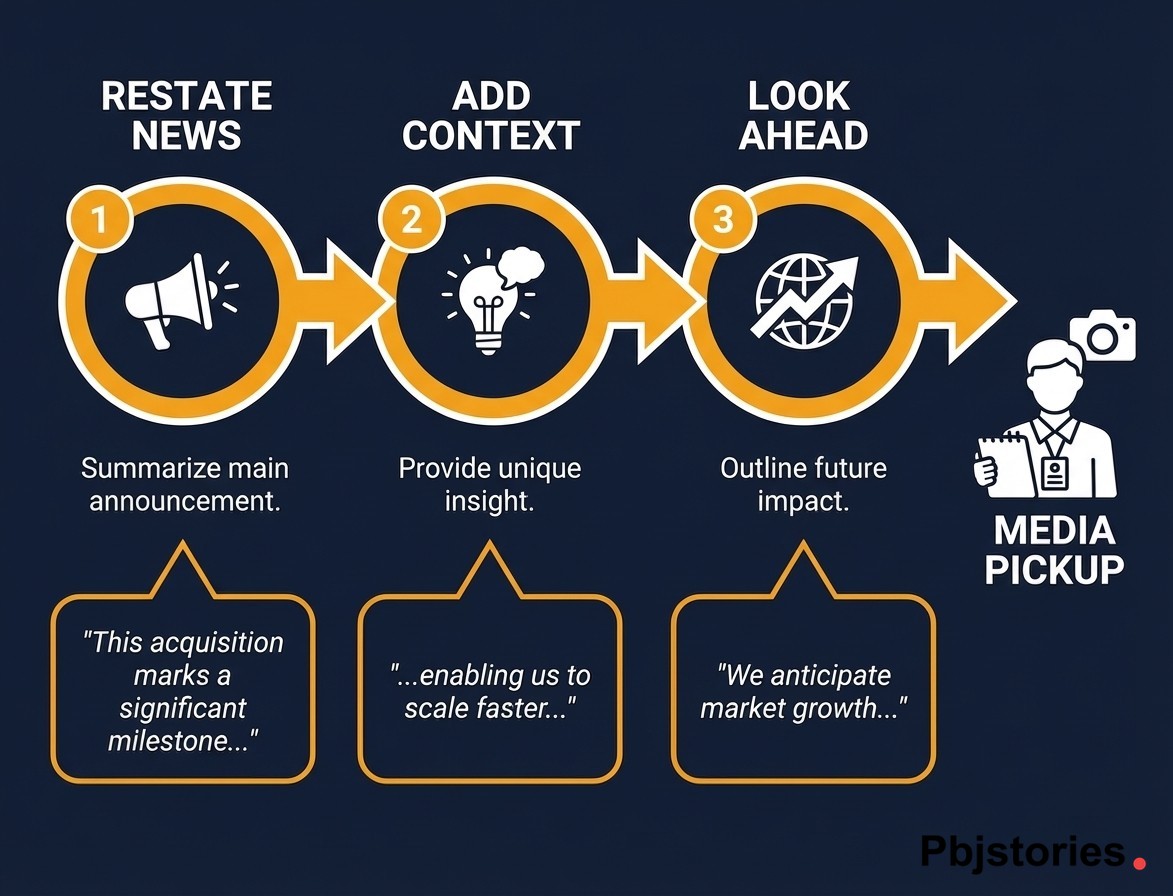
The most effective press release quotes follow a three-part structure drawn from PR practitioner experience: restate the news, add new context, then look ahead. Each sentence serves a distinct purpose for journalists scanning the release.
Sentence 1 restates the announcement in the speaker's own words, giving the journalist a quotable summary. Sentence 2 introduces a new piece of information or context not found anywhere else in the release body. Sentence 3 points toward the future, expressing vision or next steps.
Here is the difference in practice. A weak quote: "We are thrilled to announce this partnership. It will be great for our customers. We look forward to working together." And a strong one: "This partnership gives our 50,000 users direct access to real-time analytics. Until now, teams had to export data manually, which cost an average of three hours per week. By Q3, we plan to integrate predictive modeling into the shared platform."
The second version works because each sentence earns its place. The first sentence gives editors a self-contained summary they can pull into a headline. The second provides original data, giving journalists a reason to include the quote rather than paraphrase around it. The third offers a forward-looking hook that makes the story feel ongoing.
Without that middle sentence carrying fresh information, most editors will cut the quote entirely. Specificity is what separates a quote journalists copy from one they delete. For more structural guidance, see these press release tips.
Ghostwriting Quotes for CEOs and Executives
PR teams draft the vast majority of executive quotes. The executive reviews and approves them, sometimes without a single edit. This is standard industry practice, not deception, and every communications professional should treat it as a core skill.
The practical workflow starts with a 10-15 minute interview to capture the executive's natural voice. Record the conversation if possible, then draft 2-3 quote options with different tones: formal, conversational, and enthusiastic. Send all options with a clear approval deadline so the release stays on schedule.
Voice-matching separates forgettable quotes from believable ones. Read the executive's previous interviews, conference talks, and internal memos. Mirror their sentence length, vocabulary level, and speech patterns. A CEO who speaks in short, blunt sentences should not suddenly sound like a policy paper.
One common pain point: the executive won't provide input or approve on time. The fix is proactive. Get standing approval for a pre-agreed quote style during onboarding, or designate a backup spokesperson authorized to be quoted when the primary contact is unavailable.
AI tools can generate initial quote drafts quickly, and the final version must sound like the specific human being attributed, not a generic corporate voice pulled from a template. For help with the broader workflow, see this guide on writing a press release.
Common Mistakes: Cliches, Filler, and Generic Language
The single most overused phrase in press release quotes is "We are thrilled to announce." Variations like "delighted," "excited," and "proud" appear in thousands of releases each year, yet they tell journalists nothing specific. Editors delete these openers on sight.
Beyond empty enthusiasm, several other mistakes weaken otherwise solid quotes:
Repeating the lead paragraph inside the quote, giving journalists redundant text instead of new detail
Keyword stuffing the quote with unnatural phrasing no real person would say out loud
Running longer than 2-4 sentences, making the quote harder for editors to excerpt cleanly
Omitting any forward-looking statement, leaving the journalist without a narrative hook
Compare these two versions for a new hire announcement:
BAD: "We are excited to welcome John to our team. He brings a wealth of experience and we look forward to his contributions."
GOOD: "John led the infrastructure rebuild at CloudBase that cut downtime by 60 percent. That operational discipline is exactly what we need as we scale from 200 to 1,000 enterprise accounts this year."
The second version gives a journalist quotable material because it contains a concrete achievement, a named company, and a measurable goal. Generic enthusiasm gets cut during editing. Specific claims and numbers survive.
Press Release Quote Examples and Templates by Scenario
The strongest quote depends on the type of announcement, because each scenario demands a different tone, speaker, and level of detail. The examples and templates below cover the most common PR situations with fill-in-the-blank structures you can adapt immediately.
New Hire and CEO Appointment Quote Examples
The strongest new hire announcements include two quotes: one from the hiring executive explaining why this person was chosen, and one from the new hire expressing their vision. This two-quote structure gives journalists two distinct angles.
Hiring executive example (using the 3-sentence formula):
"After a six-month search, we needed a leader who had scaled enterprise sales beyond $100M ARR. Maria's track record at Orion Systems, where she grew the sales org from 15 to 120 reps, made her the clear choice. She will lead our expansion into the European market, with a target of 40 new enterprise accounts by year-end," said David Chen, CEO of NovaTech.
New hire example:
"NovaTech's product already has strong traction with mid-market buyers, which is exactly where I've spent the last decade building repeatable sales motions. My first priority is hiring three regional directors across London, Berlin, and Amsterdam. I plan to have our EMEA pipeline generating qualified revenue within two quarters," said Maria Lopez, VP of Sales at NovaTech.
Fill-in template for hiring executives:
"[New hire name]'s experience in [specific domain] at [previous company] makes them the right leader for [specific challenge]. [He/She/They] will oversee [specific scope] as we [specific company goal]. We expect [measurable outcome] within [timeframe]," said [Executive name], [Title] at [Company].
Each quote carries unique information, so journalists can use either or both without redundancy.
Product Launch and Partnership Announcement Quotes
A product launch quote should center on the customer problem being solved, not internal celebration. The strongest quotes name the pain point and quantify the improvement.
Example: "Our customers told us manual reporting consumed 12 hours per sprint. This release automates 80 percent of that workflow, freeing engineering teams to ship features instead of spreadsheets."
Partnership quotes require a different structure. Each organization's spokesperson should explain what their side contributes and what the end user gains. This dual-quote format signals mutual commitment and gives journalists two distinct sources.
Partner A template: "[Partner B]'s [specific capability] combined with our [specific asset] gives [target users] [specific benefit]. [Forward-looking statement about timeline or rollout]," said [Name], [Title] at [Company A].
Partner B template: "[Specific user group] has needed [solution] for [context]. Together with [Partner A], we're delivering [measurable outcome] starting [timeframe]," said [Name], [Title] at [Company B].
Using a press release template helps structure these dual quotes consistently across announcements.
Merger, Acquisition, and Funding Press Release Quotes
Merger and acquisition quotes must address stakeholder concerns directly: what happens to employees, customers, and the product roadmap. Vague optimism reads as evasive, so specificity builds trust.
Acquiring company template: "[Acquired company]'s [specific capability] strengthens our ability to [concrete objective]. All [number] employees will join our [department/division], and existing customers will retain access to [product/service] through [transition plan]," said [Name], [Title] at [Acquiring company].
Acquired company template: "Joining [Acquiring company] gives our team the resources to [specific goal] while continuing to serve [customer base]. Our [product] roadmap remains on track, with [feature/milestone] launching in [timeframe]," said [Name], [Title] at [Acquired company].
Funding announcement quotes should specify what the capital will fund, not just celebrate raising money. For example: "This Series B allows us to expand our engineering team from 30 to 75 and open our first APAC office in Singapore by Q2."
Including a quote from the lead investor adds third-party credibility no internal spokesperson can replicate. The investor quote should explain why they backed the company, referencing market opportunity, traction metrics, or team strength. Journalists treat investor quotes as independent validation, making them far more likely to include the release in coverage.
Awards, Milestones, and Crisis Communication Quotes
Award and milestone quotes should credit the team and connect the achievement to a larger mission rather than self-congratulation. Journalists cut lines like "We're honored to receive this recognition" because they carry no new information.
Template: "[Award name] reflects [team/department]'s work on [specific project or initiative]. [Specific result that earned the recognition]. This validates our approach to [broader company mission or industry challenge]," said [Name], [Title] at [Company].
Crisis communication quotes require a fundamentally different approach. The tone must be calm, factual, and empathetic, never defensive. Each crisis quote should accomplish three things: acknowledge the situation directly, state what corrective action is underway, and express commitment to resolution.
Placement also changes. Crisis quotes often belong near the end of the release, after facts and context have been established. Leading with an executive statement before the reader understands the situation can appear reactive. Let the factual summary build context first, then let the spokesperson reinforce accountability.
Where to Place Quotes in a Press Release and How Many to Include
The standard position for a press release quote is after the first or second paragraph, once the lead has established the core news. This placement gives the quote context so the spokesperson's words carry meaning rather than floating without reference.
Alternative strategies work for specific scenarios. Thought leadership pieces can lead with the quote when the opinion itself is the news. Crisis communications benefit from placing the quote near the close, after facts have grounded the reader.
For quantity, follow this structure:
1 quote for straightforward announcements: new hires, product updates, single-company milestones
2 quotes for multi-organization news: partnerships, mergers, acquisitions where both parties need a voice
3 quotes only for major multi-stakeholder events, and rarely even then
Skip quotes entirely on brief event announcements, calendar listings, or data-heavy releases where a quote would feel forced.
The most common structural mistake is letting the quote repeat the lead paragraph. The lead already delivers the fact, so the quote must deliver opinion, context, or forward-looking detail that the journalist cannot get from the headline alone.
Press Release Quotes FAQ
Should Press Release Quotes Be in Past or Present Tense?
The attribution verb is always past tense, while the content inside the quotation marks uses present or future tense. AP Style treats the act of speaking as a completed event, so "said" is the correct tag. The speaker's opinion, however, remains current, and the words inside the quotation marks stay in present or future tense.
For example: "Our platform processes 10 million transactions per month," said John Smith, CEO of Acme Corp. This distinction trips up junior PR professionals regularly, but the rule is consistent.
Do PR Professionals Write Quotes for Executives?
Yes, in nearly all cases. PR teams draft quotes and executives approve them, sometimes with edits, sometimes without changes at all. This is standard industry practice across organizations of every size.
The key is capturing the executive's authentic voice. Review their past interviews, conference talks, and internal communications to mirror their vocabulary and sentence patterns. Then offer two or three draft options so the executive can select the version that feels most natural.
Who Should Be Quoted in a Press Release?
Quote the person with the most authority on the specific topic, not automatically the highest-ranking executive. A CEO or founder should speak on major company news like funding rounds, acquisitions, or strategic pivots. VPs and Directors are better suited for product launches and operational updates because they carry direct subject-matter credibility.
For appointment announcements, the new hire themselves should be quoted alongside the hiring executive. Third-party quotes from partners, customers, or investors add independent credibility that strengthens media pickup.
Can You Use Multiple Quotes from Different People?
Yes, and doing so strengthens releases involving multiple organizations. Partnership and merger announcements benefit most from dual quotes because each speaker offers a distinct perspective. Each quote should add unique information rather than echo the same message. Standard product releases rarely need more than one spokesperson.
What Makes a Good Press Release Headline?
A strong headline states the news in under 10 words, uses active voice, includes the company name, and avoids jargon. Think of the headline and quote as complementary pieces: the headline delivers the fact, while the quote delivers opinion or context. A headline like "Acme Corp Launches AI Billing Platform" pairs naturally with a quote explaining why billing automation matters to customers.
Strong quotes transform a press release from a forgettable announcement into a story journalists actually want to cover. If you want to skip the guesswork, PBJ Stories lets you write and optimize press releases with AI-powered tools that follow AP Style formatting, including properly structured quotes, then distribute them to 500+ news outlets like Google News and Yahoo Finance.
Whether you are a startup founder drafting your first funding announcement or a PR team managing releases at scale, PBJ Stories handles the full workflow so you can focus on the message while the platform takes care of reach.
Get PR tips delivered weekly
Join 3,200+ PR professionals getting actionable tips on press release writing, distribution, and media outreach.
No spam. Unsubscribe anytime.