

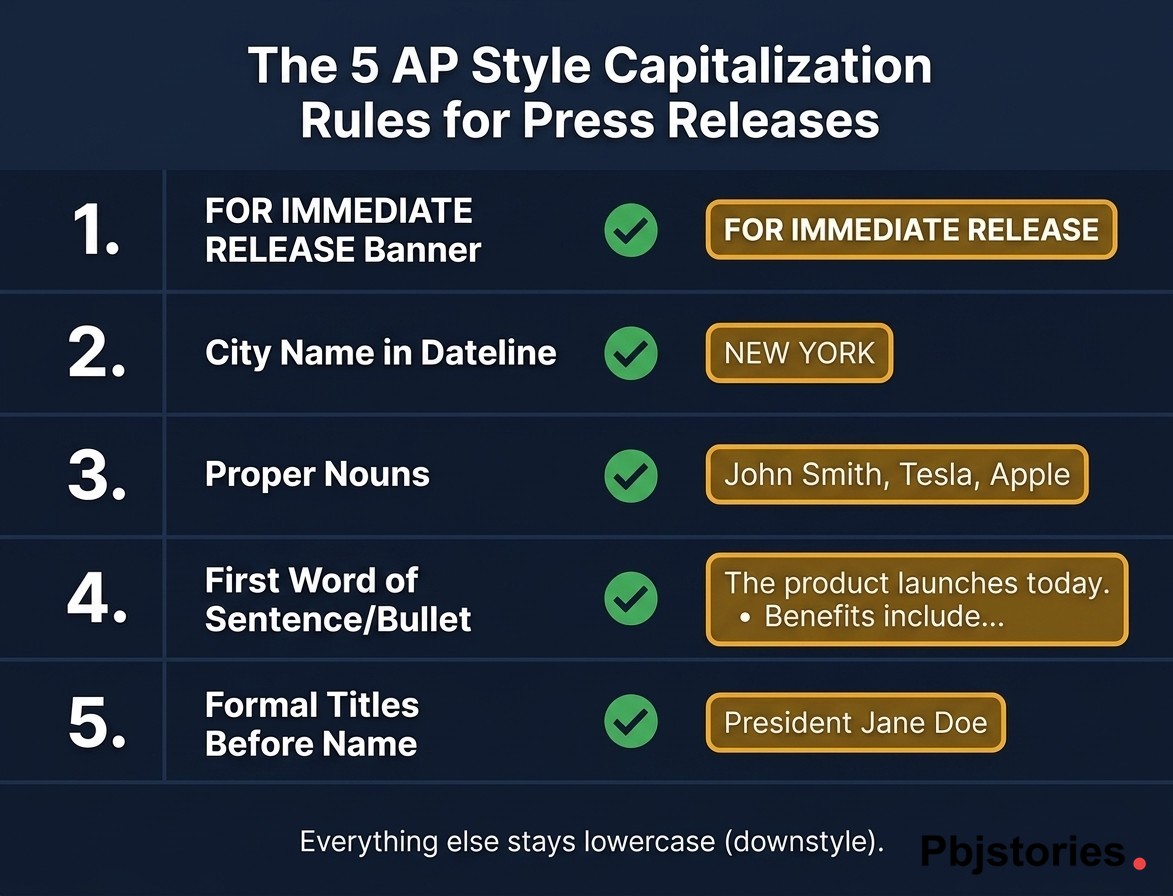
A press release should be capitalized in exactly five places: the "FOR IMMEDIATE RELEASE" banner, the city in the dateline, the headline, proper nouns, and formal titles placed directly before a name. Everything else stays lowercase. That's it.
The reason most releases look amateur isn't that writers don't know the rules — it's that they're getting pulled in two directions. Editors at AP, Bloomberg, and the wires strip extra capitals on sight. Executives and their assistants demand "Chief Executive Officer Jane Smith" mid-sentence because it looks more important on the page. One side wins every time a release crosses into a real newsroom, and it isn't the executive.
Below is what AP Style actually requires, what editors quietly fix before publishing, and how to handle the internal politics when leadership pushes back. You'll see the five-place rule applied to headlines, job titles, datelines, and the mistakes that flag a release as corporate copy pretending to be news. For the underlying format, see our press release dateline guide.
Should a Press Release Be Capitalized? The Short Answer
Yes, but only in five specific places governed by AP Style, not throughout the entire document. Everything else follows downstyle, meaning lowercase by default.
The five elements that always get capitalized in a press release:
-
FOR IMMEDIATE RELEASE banner at the top of the document (all caps)
-
The city name in the dateline (all caps, e.g., AUSTIN, Texas)
-
Proper nouns such as company names, product names, and geographic locations
-
The first word of every sentence and every bulleted item
-
Formal titles placed directly before a name (CEO Jane Smith, Senator Lisa Chen)
The phrase "press release" itself stays lowercase in running text, because it is a generic noun. A sentence like "the company issued a press release today" never takes capital letters on those two words.
AP Style, defined by the Associated Press Stylebook, is the de facto standard journalists, wire services, and PR distribution platforms use. The rules below unpack each case in detail.
AP Style Capitalization Rules for Press Releases
Journalists edit incoming releases against the AP Stylebook before publishing, so submissions already written in AP Style require fewer corrections and move through newsroom queues faster. A release that flouts AP conventions often gets rewritten or discarded, which is why wire services like PR Newswire and Business Wire default to AP rules.
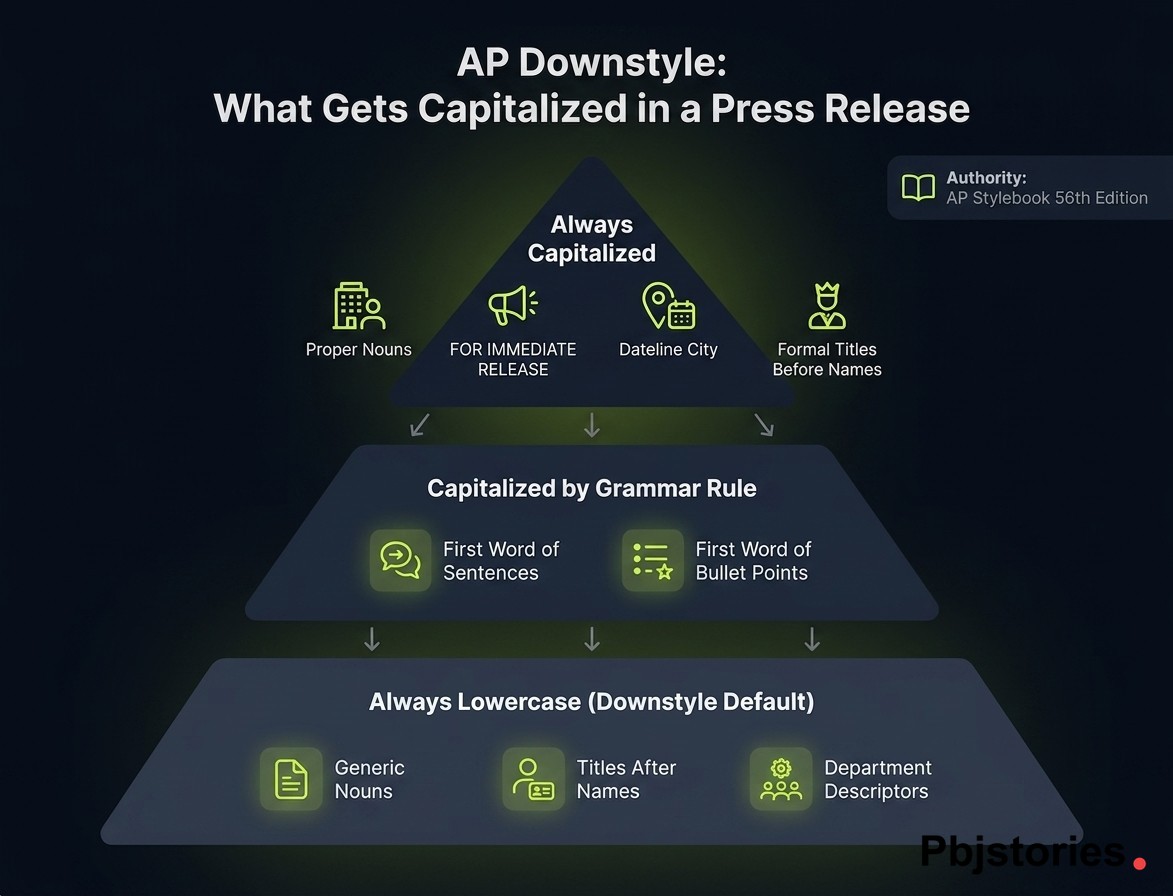
The core capitalization logic is narrow. Capitalize proper nouns (company names, product names, cities, countries), the first word of every sentence, the first word of each bulleted item, and formal titles only when they sit directly before a name. Everything else stays lowercase.
This approach is called downstyle, or AP sentence case. The principle: capitalize only what grammar or proper-noun status demands, and leave the rest alone. Downstyle keeps formal writing clean and avoids the cluttered look of over-capitalized corporate copy.
Department names follow the same logic. "Marketing department" stays lowercase because it is a generic descriptor, but "Department of Defense" is capitalized because the full name is a proper noun tied to a specific institution.
The 56th edition of the AP Stylebook is the current authoritative reference. Press releases lean on downstyle because they function as formal news documents, not casual marketing collateral, and journalists expect that register.
Should the Press Release Headline Be Capitalized? Title Case vs. Downstyle
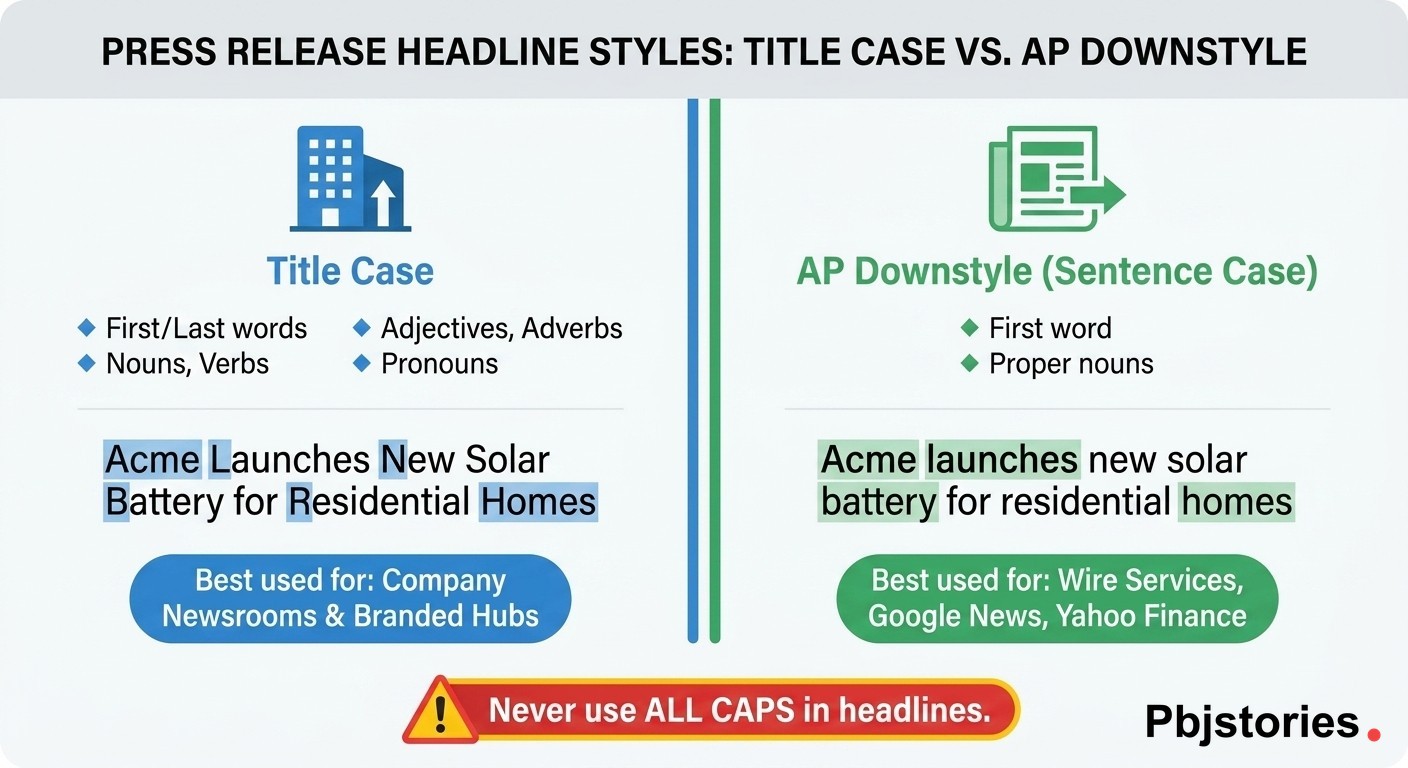
Headlines should never appear in all caps. The two acceptable options are title case and AP downstyle, and the choice depends on where the release will be published and who will read it first.
Title case capitalizes the first and last words, plus all nouns, verbs, adjectives, adverbs, and pronouns. Articles (a, an, the), coordinating conjunctions (and, but, or), and short prepositions under four letters stay lowercase. This is the convention used by most corporate newsrooms and branded content hubs.
AP downstyle, also called sentence case, capitalizes only the first word and any proper nouns. Everything else stays lowercase, because AP treats the headline like a sentence rather than a display title.
The same announcement shows the difference clearly:
-
Title case: Acme Launches New Solar Battery for Residential Homes
-
AP downstyle: Acme launches new solar battery for residential homes
Use AP downstyle when targeting journalists, wire services, or distribution platforms feeding Google News and Yahoo Finance, since editors expect it and will rewrite anything else. Title case is fine for releases hosted on your own company newsroom, where the brand controls the presentation.
Whichever you pick, the subheadline (often called the deck) must match the headline's capitalization style. Mixing title case in the headline with sentence case in the deck looks sloppy and signals to editors that the writer did not follow a consistent style guide.
Should Job Titles Be Capitalized in a Press Release?
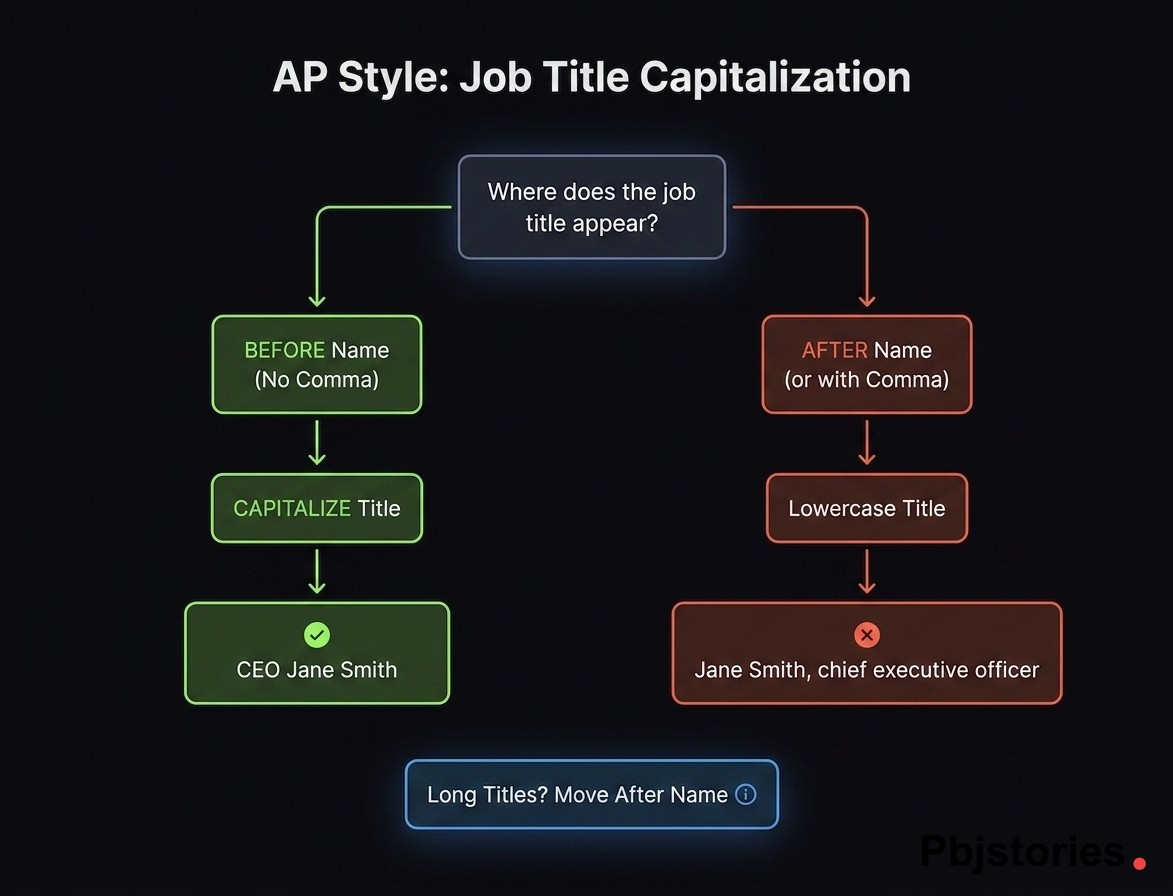
Formal titles are capitalized only when placed directly before a name with no comma between them: CEO Jane Smith, President Mark Johnson, Senator Lisa Chen. The title functions as part of the name in that position, which is why AP Style treats it as a proper noun attachment.
Once the title moves after the name or gets separated by commas, it drops to lowercase. "Jane Smith, chief executive officer of Acme, announced the acquisition" follows AP rules correctly. The same logic applies to "Mark Johnson, president of North American operations."
Long formal titles almost always read better after the name, and AP prefers this placement because stacking five or six capitalized words before a name slows the reader down. "Executive vice president of global marketing Mark Johnson" is technically allowed but clunky, so AP recommends repositioning it.
Here is the practical friction: executives and their assistants frequently demand "Chief Executive Officer Jane Smith" capitalized mid-sentence, even when grammar says otherwise. Journalists receiving that release will quietly de-capitalize it before publication anyway.
A workable compromise: follow AP Style strictly when distributing to newsrooms and wire services, but accept client preferences on corporate-owned newsrooms where the executive signs off on the copy.
One more rule worth remembering. Occupational descriptors are not formal titles and always stay lowercase: "astronaut Scott Kelly," "attorney Sarah Reed," "film director Greta Gerwig."
Capitalizing the Dateline and 'FOR IMMEDIATE RELEASE'
Two elements at the top of every press release sit in all caps by convention: the release banner and the city in the dateline. Both are formatting signals for journalists, not stylistic choices.
FOR IMMEDIATE RELEASE belongs at the top-left of the document in all caps, telling editors the news can run as soon as they receive it. If the announcement is time-locked, replace it with EMBARGOED UNTIL [DATE/TIME], also in all caps, so the embargo is impossible to miss during a quick scan.
The dateline follows a fixed pattern: CITY, State, Month Day, Year, then a dash and the opening sentence. A correct example reads: "AUSTIN, Texas, March 14, 2024 – Acme Corp today announced..."
The city is always all caps. The state uses AP's abbreviation (Texas, Calif., Mass.), not the USPS two-letter code (TX, CA, MA), because AP treats these as words rather than postal codes. Widely recognized datelines like NEW YORK, LOS ANGELES, LONDON, and TOKYO stand alone without a state or country.
Time references surprise new writers: AP Style lowercases a.m. and p.m. with periods, since AP classifies them as abbreviations rather than acronyms. For edge cases involving foreign cities or multi-location releases, see the full press release dateline guide.
Common Press Release Capitalization Mistakes to Avoid
Most capitalization errors come from two habits: shouting for emphasis and promoting generic nouns into proper nouns. Both signal an amateur draft to editors.
All-caps headlines are the most visible mistake. Wrong: "ACME LAUNCHES NEW SOLAR BATTERY." Right: "Acme launches new solar battery" (downstyle) or "Acme Launches New Solar Battery" (title case). All caps is reserved for the FOR IMMEDIATE RELEASE banner and the dateline city.
"Press conference" mid-sentence stays lowercase because it is a generic noun. Wrong: "held a Press Conference Tuesday." Right: "held a press conference Tuesday."
"Company" as a stand-in for the business name should not be capitalized. Wrong: "the Company reported record revenue." Right: "the company reported record revenue" or simply "Acme reported record revenue." Legal contracts capitalize "Company" as a defined term; press releases do not.
Titles after a comma drop to lowercase. Wrong: "Jane Smith, CEO of Acme, said..." with the full phrase capitalized. Right: "Jane Smith, chief executive officer of Acme, said..." The abbreviation CEO stays uppercase because it is an initialism, but the spelled-out title is lowercase once separated from the name.
Seasons are lowercase per AP: "spring 2024," not "Spring 2024," unless part of a proper name like Spring Festival. Product features and internal program names stay lowercase unless trademarked.
Quick cheat sheet:
-
Always capitalize: FOR IMMEDIATE RELEASE, dateline city, proper nouns, first word of a sentence, formal titles before a name
-
Keep lowercase: press release, press conference, titles after a name, seasons, a.m./p.m., generic descriptors
See a correctly formatted press release template for reference.
Frequently Asked Questions
Do you capitalize 'press release'?
Only when it appears as the PRESS RELEASE header banner at the top of the document or at the start of a sentence. In running text such as "the company issued a press release today," the phrase stays lowercase because it functions as a generic noun, not a proper noun or formal title.
Should the headline of a press release be in all caps?
No. All caps are reserved for the FOR IMMEDIATE RELEASE banner and the city name in the dateline, nothing else.
Headlines use either title case or AP downstyle depending on the style guide in play. All-caps headlines read as shouting, trigger spam filters on wire services, and get rewritten by editors before publication.
Should 'press conference' be capitalized?
No. The phrase is a generic noun, so it stays lowercase in running text: "Acme held a press conference Tuesday."
Capitalize it only when it opens a sentence or forms part of a formal event name, such as the Annual Tech Press Conference, where it functions as a proper noun rather than a description.
How do I cite a press release in an article or research paper?
Include four elements: the issuing organization, the headline in quotation marks, the date issued, and the source URL. APA and MLA each prescribe their own punctuation and order, so check the current edition before submitting.
In news writing, AP Style keeps citations inline: "according to an Acme Corp press release dated March 14, 2024." For formatting and writing guidance, see more press release tips.
Getting capitalization right is a small detail that signals professionalism to every editor who opens your release. If you'd rather skip the style-guide checklist entirely, PBJ Stories writes releases in proper AP style by default, then distributes them across 500+ news outlets including Google News and Yahoo Finance.
Starting a release from scratch is easier with a working framework, so grab the template above and let the formatting take care of itself while you focus on the story.
Get PR tips delivered weekly
Join 3,200+ PR professionals getting actionable tips on press release writing, distribution, and media outreach.
No spam. Unsubscribe anytime.