
A good press release rests on three qualities working together: a newsworthy angle, a compelling headline, and concise, fact-focused writing. Miss any one of them and no amount of wire distribution will save the release — reporters will scan it in under two seconds and move on.
Most guides will hand you a fifteen-item checklist covering boilerplate, multimedia, CTA buttons, UTM parameters, and a dozen other "essentials." That list isn't wrong — it's backwards. Boilerplate doesn't earn coverage. A multimedia attachment doesn't earn coverage. The three qualities above decide whether an editor opens the file at all; everything else is supporting structure that only matters once the first three are right.
Below is what each of the three qualities actually looks like in practice, and how to test for them before sending:
-
The four factors that make an angle newsworthy (and the milestones that sound big but fail every one)
-
Five rules for a headline that survives a bulk scan at AP or Bloomberg
-
Inverted pyramid writing that gives an editor a publishable lead even if they cut the rest
-
The supporting elements — quotes, format, boilerplate, multimedia — that separate a polished release from one that looks amateur
For the full drafting process, see how to write a press release.
What Makes a Good Press Release: The Three Core Qualities
A good press release rests on three qualities working together: a newsworthy angle, a compelling headline, and concise, fact-focused writing. Together, they decide whether a release earns media coverage or gets buried in an editor's inbox within seconds.
Journalists at AP, Bloomberg, and Reuters receive hundreds of pitches every day. They scan the headline, read the first line, and move on if nothing grabs them. Releases that nail these three qualities get opened; the rest get deleted.
The same logic applies to algorithmic pickup on Google News, Yahoo Finance, and trade publications, since indexing depends on clear news value and clean writing.
Every other component, quotes, boilerplate, multimedia, and formatting, works as a supporting structural element that reinforces these three core qualities rather than replacing them.
Newsworthy Angle and a Strong Story
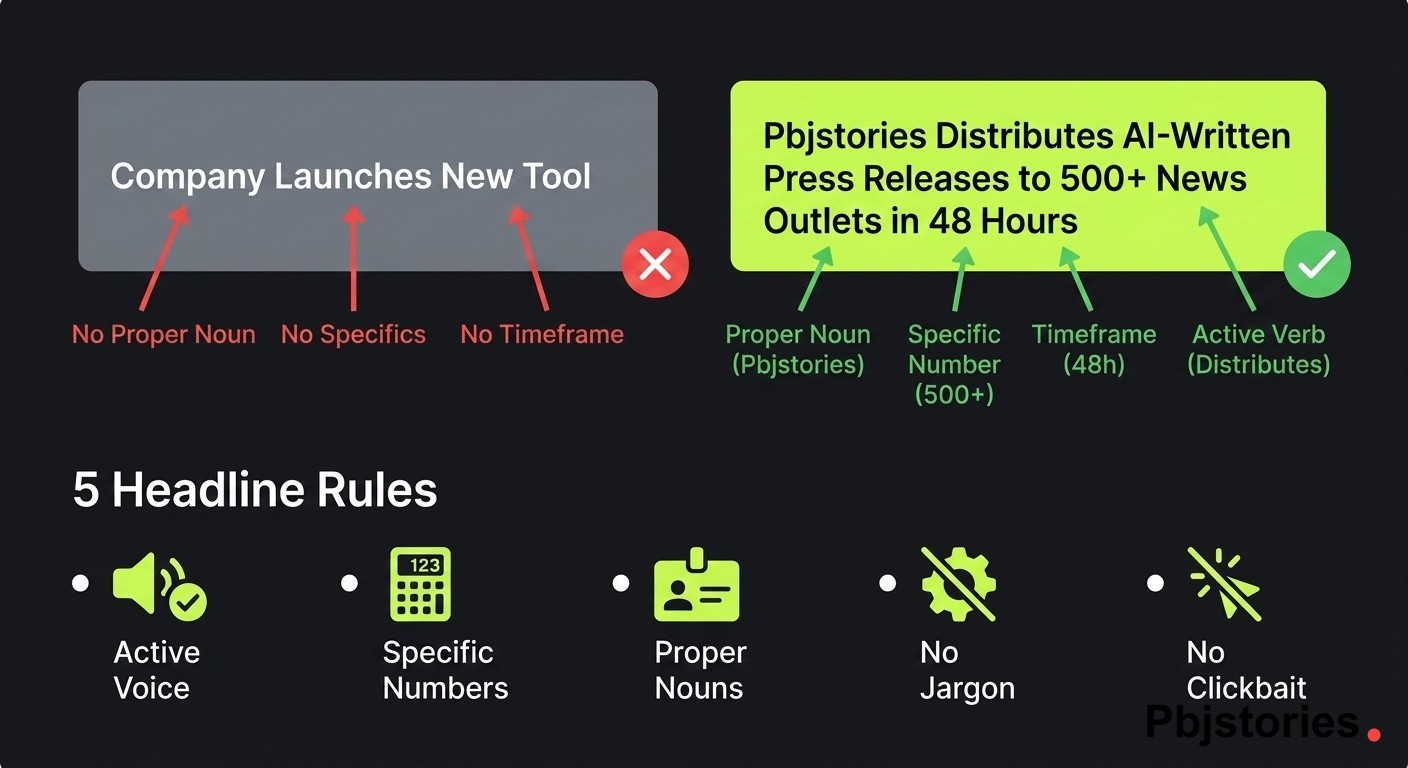
Newsworthiness rests on four factors: timeliness, relevance to a specific audience, novelty, and measurable impact. A release that fails any of these rarely earns coverage, because reporters need stories their readers will actually click, finish, and share.
What qualifies as news is narrower than most founders assume. Product launches with genuinely unique features, funding rounds with specific dollar figures, executive hires with proven track records, proprietary data studies, and partnerships with recognizable brands all clear the bar.
What doesn't: rebrands without a business reason, minor feature updates, or milestones relevant only to the company announcing them.
Major wires reject "vanilla" announcements every day because they offer no hook for their audience. A strong angle ties the announcement to a larger trend, a concrete number, or a named market shift. Before drafting, answer one question honestly: why would a reader outside your company care about this today?
Compelling, Attention-Grabbing Headline
The headline decides whether a reporter opens the release at all, so it must communicate the core news in under 100 characters. Editors scan subject lines in bulk, and anything vague gets deleted before the first paragraph loads.
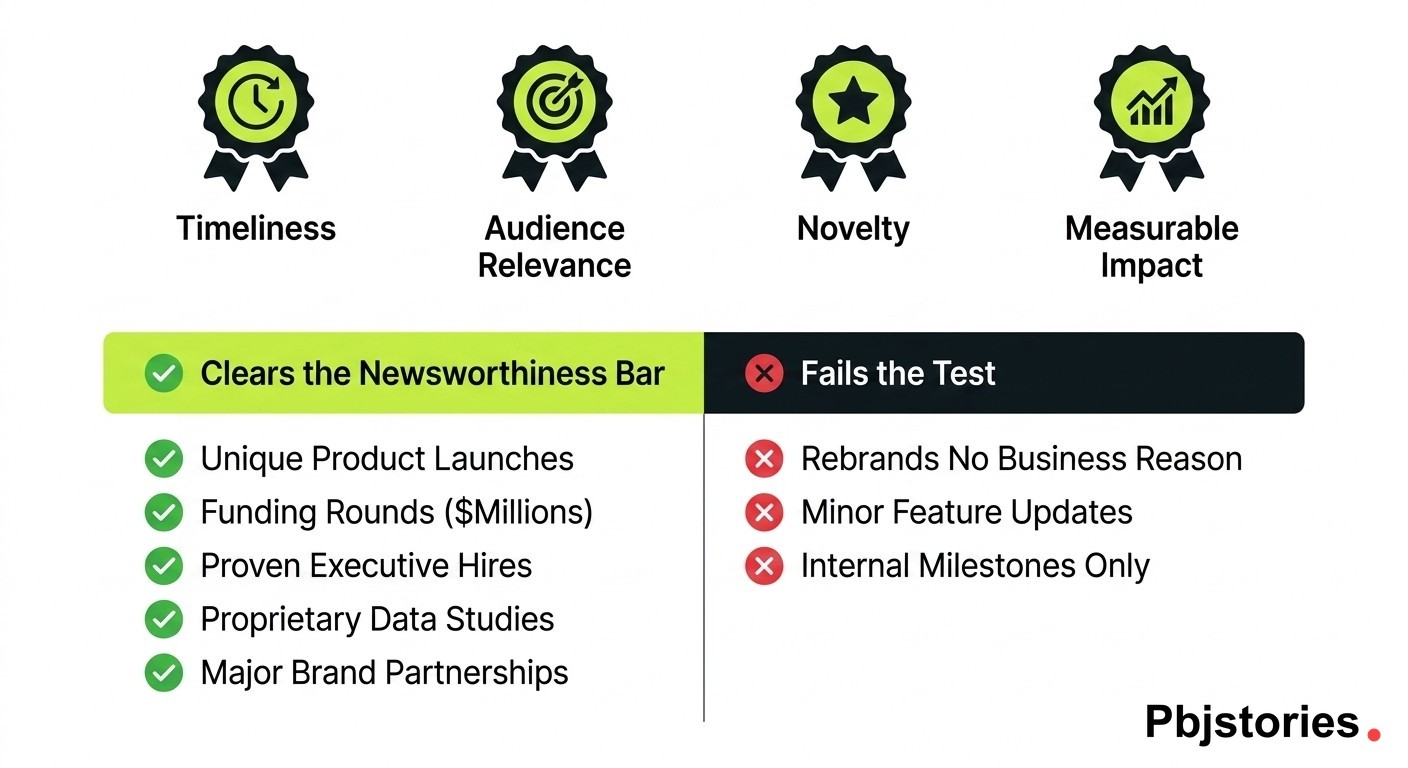
Strong headlines follow five rules:
-
Active voice ("Company launches", not "is launched by")
-
Specific numbers (dollar amounts, user counts, timeframes)
-
Proper nouns naming the company, product, or location
-
No jargon or internal acronyms
-
No clickbait or curiosity gaps
Compare a weak headline like "Company Launches New Tool" with a stronger version: "PBJ Stories Distributes AI-Written Press Releases to 500+ News Outlets in 48 Hours." The second version names the brand, quantifies the scale, and sets a clear timeframe.
That precision pays off twice, because journalists and search engines both index the headline. A well-constructed headline doubles as SEO real estate on Google News, Yahoo Finance, and trade publications.
Concise, Fact-Focused Writing
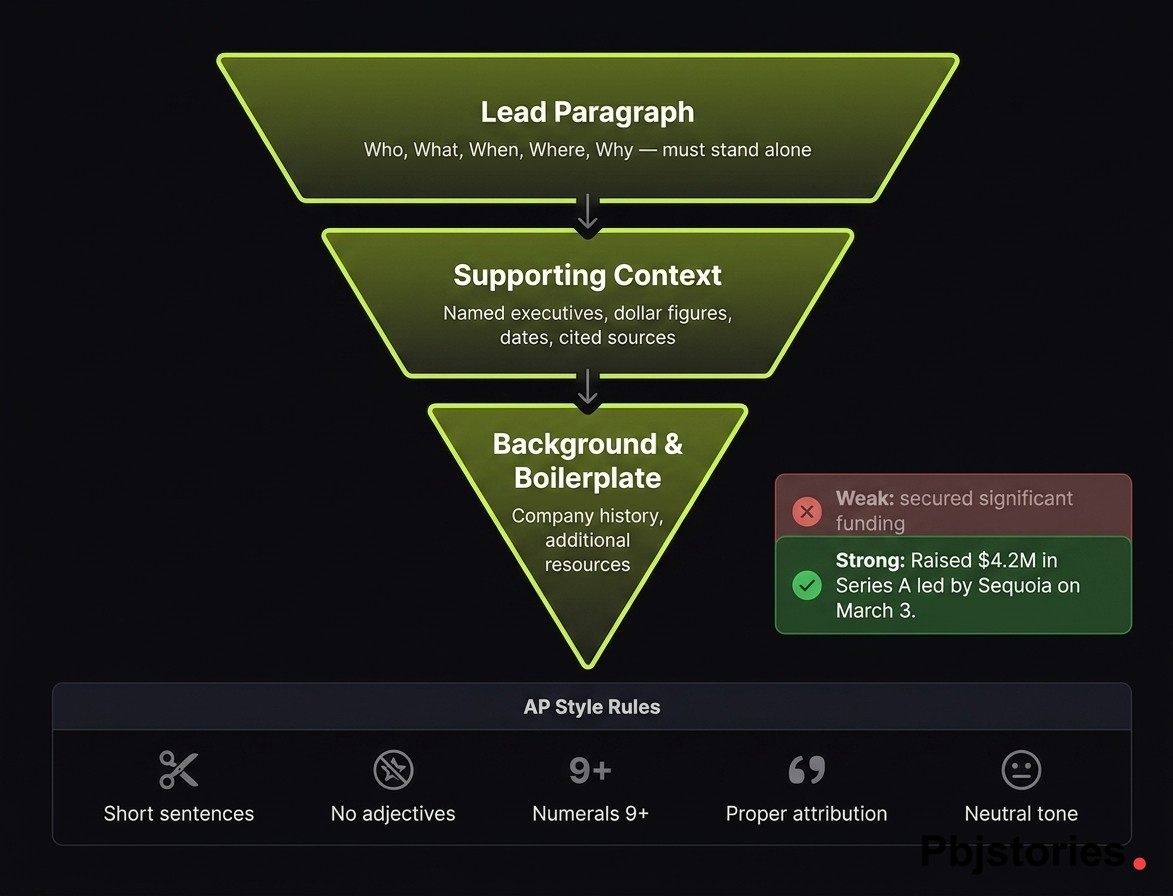
Good press releases follow the inverted pyramid: the first paragraph answers who, what, when, where, and why, and each paragraph after adds supporting context in decreasing order of importance. Editors cut from the bottom, so the lead must stand alone even if nothing else survives.
Most newsrooms expect Associated Press (AP) style: short sentences, neutral tone, no marketing adjectives, numerals for figures above nine, and proper attribution for every claim. Words like "revolutionary," "world-class," or "industry-leading" get stripped on sight because they carry no verifiable meaning.
Every paragraph should deliver one new, useful fact. If a sentence repeats the lead or pads the release with filler, cut it, since reporters equate padding with weak news judgment.
Back claims with specific numbers, dates, named executives, and cited sources rather than vague superlatives. "Raised $4.2M in Series A led by Sequoia on March 3" beats "secured significant funding" every time. For the full writing process, see how to write a press release.
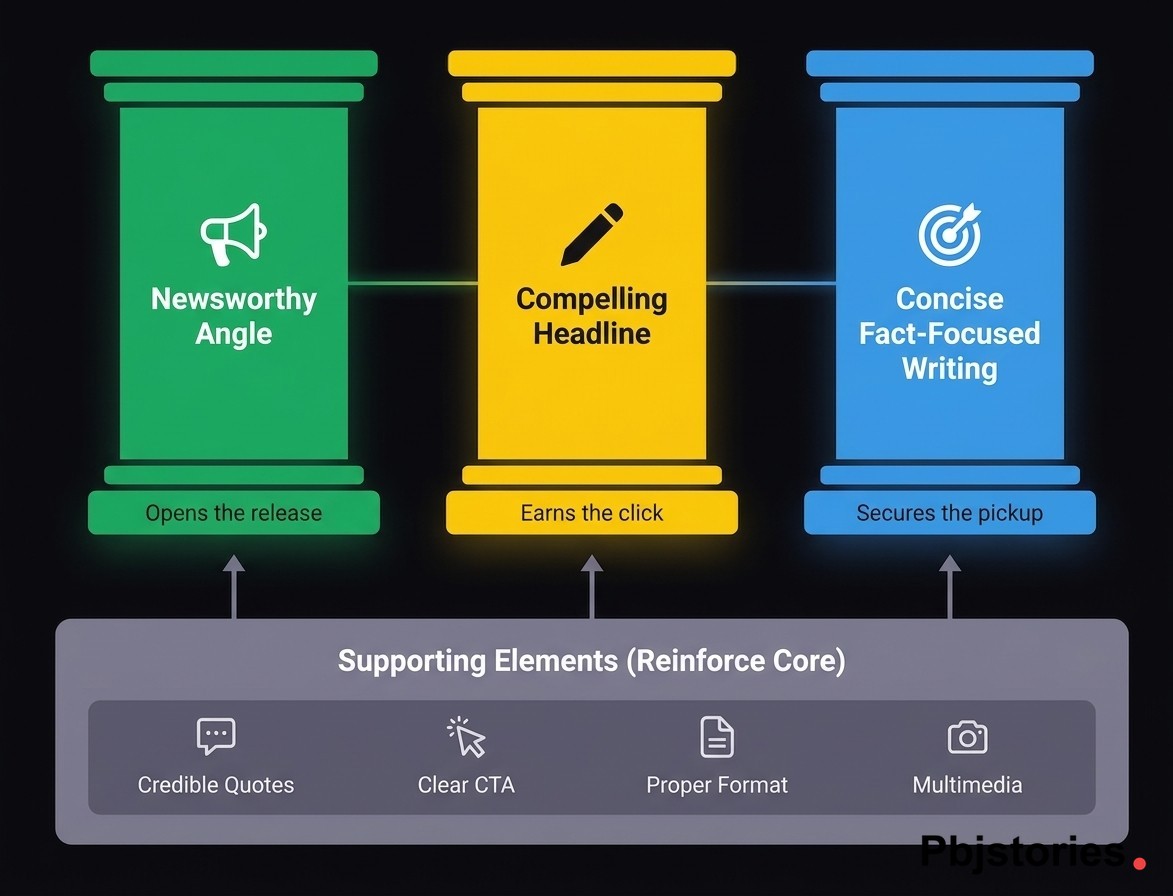
Supporting Qualities Every Good Press Release Should Include
Beyond the three core qualities, five supporting elements separate polished releases from amateur ones and directly influence pickup rates.
Credible quotes add a human voice that pure facts cannot. Include at least one quote from a named executive, customer, or subject-matter expert that delivers insight rather than corporate filler like "we're excited to announce." Review these press release quotes for examples of strong construction.
A clear call to action gives reporters a path forward. Add a contact line with email, phone number, and a media kit link, plus an optional landing page URL for readers who want the full story.
Proper format signals professionalism to editors trained on AP style: dateline (CITY, State, Date), lead paragraph, body, boilerplate, ### end marker, and media contact block. Missing any of these elements makes the release look amateur.
Multimedia assets such as high-resolution images, logos, product shots, or a short video link raise pickup rates on digital outlets because editors prefer ready-to-publish packages.
An accurate boilerplate, a consistent 2-3 sentence company description at the bottom of every release, supports entity stacking across news sites and strengthens brand recognition over time.
The First Three Elements Every Press Release Needs
The first three elements of a press release are the headline, the dateline, and the lead paragraph. These appear in that exact order at the top of the document and carry the weight of the entire announcement.
The headline sits on the first line and summarizes the news in under 100 characters. An optional subhead directly below it adds one line of context, such as a specific metric, geography, or partner name.
The dateline follows, formatted as CITY, State, Month Day, Year. It tells the reporter where and when the news breaks, which matters because local and trade outlets filter stories by region before reading further.
The lead paragraph then delivers the core facts in 25 to 40 words, answering who, what, when, where, and why. If the lead fails, editors rarely scroll to the body.
A quick inline example:
PBJ Stories Expands AI Distribution Network to 500+ News Outlets
AUSTIN, Texas, March 12, 2026. PBJ Stories today announced expanded distribution to 500+ news sites, giving startups direct access to Google News and Yahoo Finance within 48 hours of submission.
For a full reference release, see this press release example.
Ideal Length of a Good Press Release
A good press release runs 400 to 500 words and rarely exceeds one standard page of around 600 words. Journalists skim, so anything longer signals padding rather than substance and gets abandoned before the quote.
The structure breaks down predictably: headline (10-15 words), lead paragraph (25-40 words), body with 2-3 supporting paragraphs (200-300 words), one named quote (40-60 words), boilerplate (50-75 words), and a media contact block (20-30 words). Hitting these ranges keeps the release tight without sacrificing the five Ws.
Longer is acceptable in narrow cases. Technical product announcements, scientific findings, and financial disclosures such as earnings reports often justify 600-700 words because regulators, analysts, and trade reporters need the full context to cover the story accurately.
Everything else should be trimmed. If a sentence does not add a new fact, a new number, or a new named source, it earns its cut. For practical guidance on tightening drafts, see these press release tips.
Good Press Release Qualities: FAQ
What Are the Three Most Important Qualities of a Good Press Release?
A newsworthy angle gives journalists a reason to cover the story, a compelling headline wins the first three seconds of attention, and concise, fact-focused writing earns the trust of editors and readers.
These three qualities matter more than any template, font choice, or formatting detail, since even a perfectly structured release fails without them.
What Does a Good Press Release Include?
A good press release includes every element a reporter needs to file the story without follow-up questions:
-
Headline and optional subhead
-
Dateline (CITY, State, Month Day, Year)
-
Lead paragraph covering who, what, when, where, and why
-
Body with supporting facts and at least one named quote
-
Boilerplate describing the company
-
Media contact with email and phone
-
### end marker
Multimedia assets and a clear call to action further strengthen the release and improve pickup on digital outlets that favor ready-to-publish packages.
How Long Should a Good Press Release Be?
A good press release should run around 400 to 500 words and rarely exceed one page. Journalists skim hundreds of pitches a day, editors prioritize clarity, and shorter releases consistently earn more pickup.
Technical, scientific, or financial announcements may justify 600 to 700 words when the extra context is genuinely necessary for accuracy.
What Are the Key Principles of a Good Press Release?
The key principles are accuracy, newsworthiness, journalistic neutrality, clarity, and audience relevance. Accuracy protects credibility, newsworthiness earns coverage, neutrality satisfies AP-style editors, clarity keeps readers engaged, and audience relevance ensures the right outlets pick it up.
These principles tie directly back to the three core qualities and work together to earn media coverage and ranking on Google News.
Mastering a newsworthy angle, a compelling headline, and concise factual writing takes practice, but the distribution side is where most announcements stall. That is exactly the gap PBJ Stories closes with AI-powered writing in AP style, SERP-driven keyword targeting, and publishing to 500+ high-authority news outlets including Google News and Yahoo Finance.
If you want your next announcement to earn pickup instead of sitting in an editor's trash folder, start with a reference release format to see the structure in action, then let PBJ Stories handle the writing, optimization, and distribution in one workflow.
Get PR tips delivered weekly
Join 3,200+ PR professionals getting actionable tips on press release writing, distribution, and media outreach.
No spam. Unsubscribe anytime.