
Parasite SEO is the practice of publishing keyword-targeted content on an established third-party domain — Forbes, LinkedIn, Yahoo Finance, Reddit — to capture rankings your own site can't reach. A fresh website waits 6–12 months for Google to trust it. A page on a DR 90 host can rank within days because the trust work is already done.
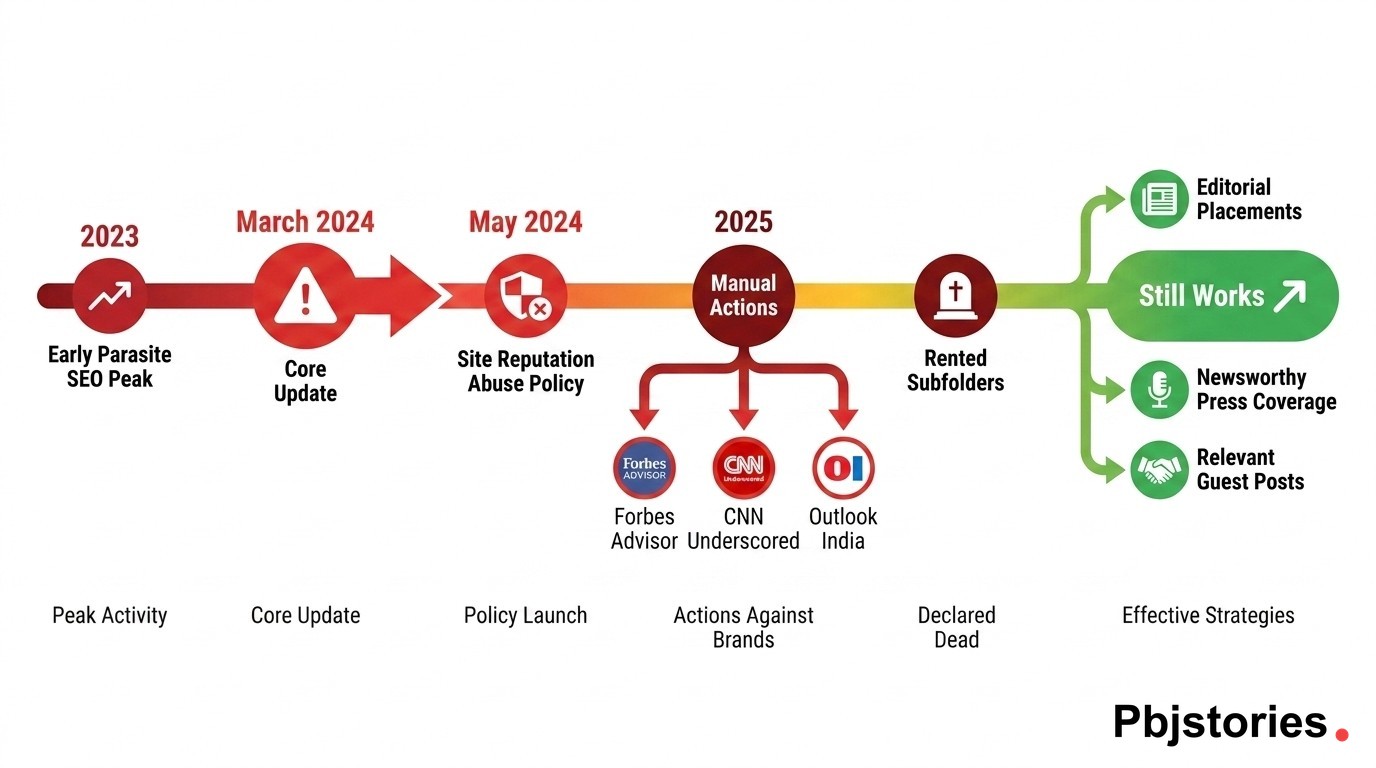
The tactic is older than most "parasite SEO" threads on Twitter, but 2024 and 2025 rewrote the playbook. Google's March 2024 core update, the May 2024 Site Reputation Abuse policy, and the manual actions against Forbes Advisor, CNN Underscored, and Outlook India killed the rented-subfolder era. What still works looks nothing like what worked in 2022 — editorial guest posts, newsworthy press coverage on Google News outlets, and topically relevant contributions now do the work that spammy affiliate injections used to.
Below is what parasite SEO actually is in 2026, and how the tactic breaks down in practice:
-
The difference between parasite SEO, barnacle SEO, and guest posting (used interchangeably, they mean three different things)
-
The black-hat, grey-hat, and white-hat spectrum, with real examples of each
-
Which host platforms still deliver — Medium, LinkedIn, Reddit, Quora, industry publications, newswires — and which are burnt
-
What Google's Site Reputation Abuse enforcement actually targets, and what it leaves alone
What Is Parasite SEO and How Does It Work?
Parasite SEO borrows a host's domain authority, backlink profile, and topical trust to rank a specific page faster than a new or low-authority site ever could. Publishers do this by placing optimized content on platforms like Forbes, Medium, or Reddit and targeting keywords their own domain cannot yet reach.
The mechanism is straightforward. Google evaluates individual pages partly through signals inherited from the host domain: crawl frequency, link equity, and accumulated E-E-A-T. When you publish on a site with Domain Rating above 80, your page enters the index with trust already attached, so it can compete for terms that a fresh site would not touch for months.
This is why practitioners target places like LinkedIn Articles, YouTube, Yahoo Finance, or industry blogs. Each host acts as a shortcut to SERP visibility, because the algorithm weighs the page within the context of the broader domain.
The word "parasite" describes the host-guest relationship, not the ethics. The tactic sits on a spectrum that runs from spammy affiliate injections to legitimate guest contributions and newsworthy press coverage. Execution determines whether it is black hat or white hat, not the format itself.
You will also see the method called piggyback SEO, barnacle SEO, or simply third-party ranking. The terms overlap heavily in practice, though each carries slightly different connotations explored later.
How Parasite SEO Leverages Domain Authority to Rank Faster
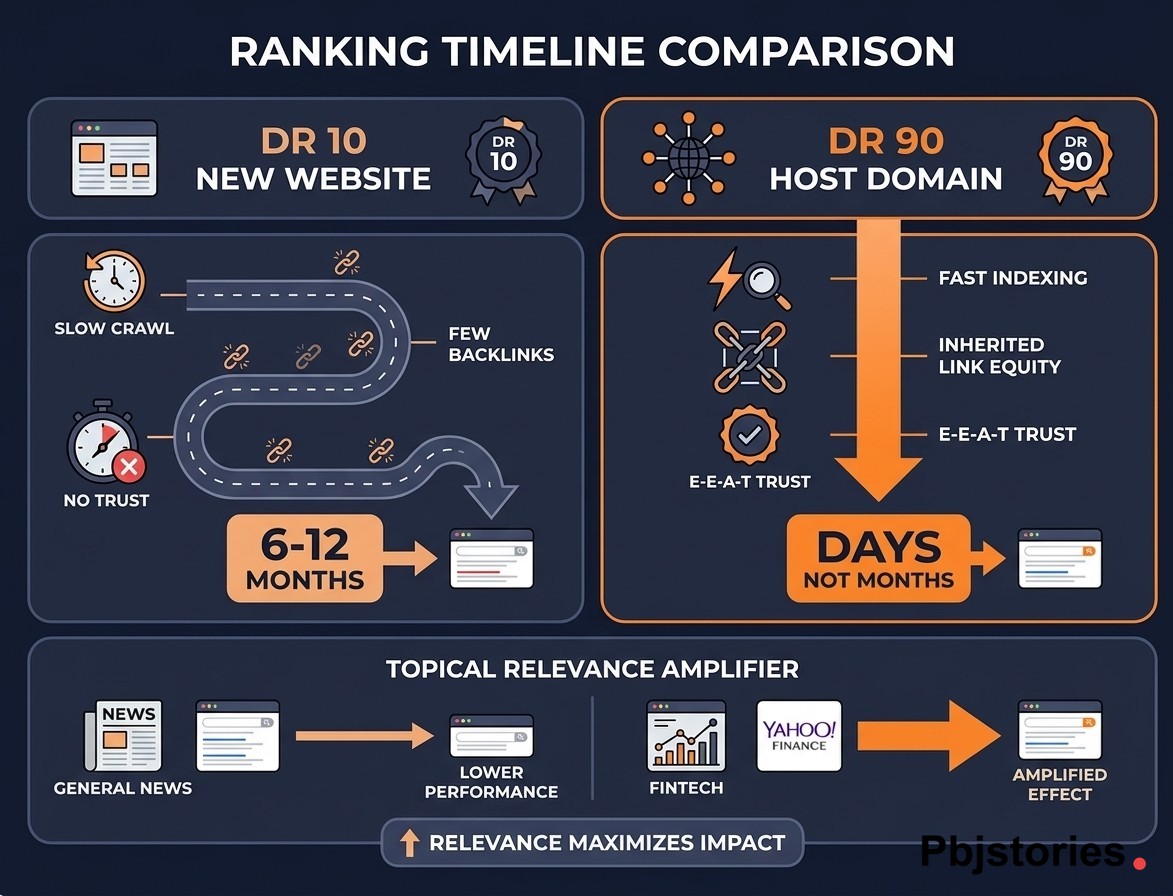
Google ranks pages partly on signals inherited from the host domain: overall backlink profile, historical trust, and topical authority in the niche. A page published on a Domain Rating 90 site starts with a massive head start over the same page on a brand-new domain, because Googlebot crawls established hosts more frequently and treats their content as default-trustworthy.
The causal chain is straightforward. High host authority leads to faster indexing, indexing on a trusted domain leads to inherited link equity, and inherited equity shortens the distance to the first SERP. Content that would struggle for months on a weak site can surface within days on a strong one.
The contrast is stark. A DR 10 website typically waits 6–12 months before ranking for moderately competitive queries, since it must first accumulate backlinks and topical signals. A DR 90 publisher, by comparison, can rank the same content in days because the trust work is already done. Infidigit's parasite SEO analysis puts the speed in concrete terms: pages on platforms like Reddit (DA 92) or Medium (DA 95) can index in under 24 hours and reach top-3 SERP positions within days for long-tail keywords, picking up 1,000–5,000 monthly visits without any on-site authority.
Topical relevance amplifies the effect. A fintech article on Yahoo Finance outperforms the same article on a general-news outlet, because Google rewards hosts with proven expertise in the query's subject area.
Parasite SEO vs. Barnacle SEO vs. Guest Posting: Key Differences
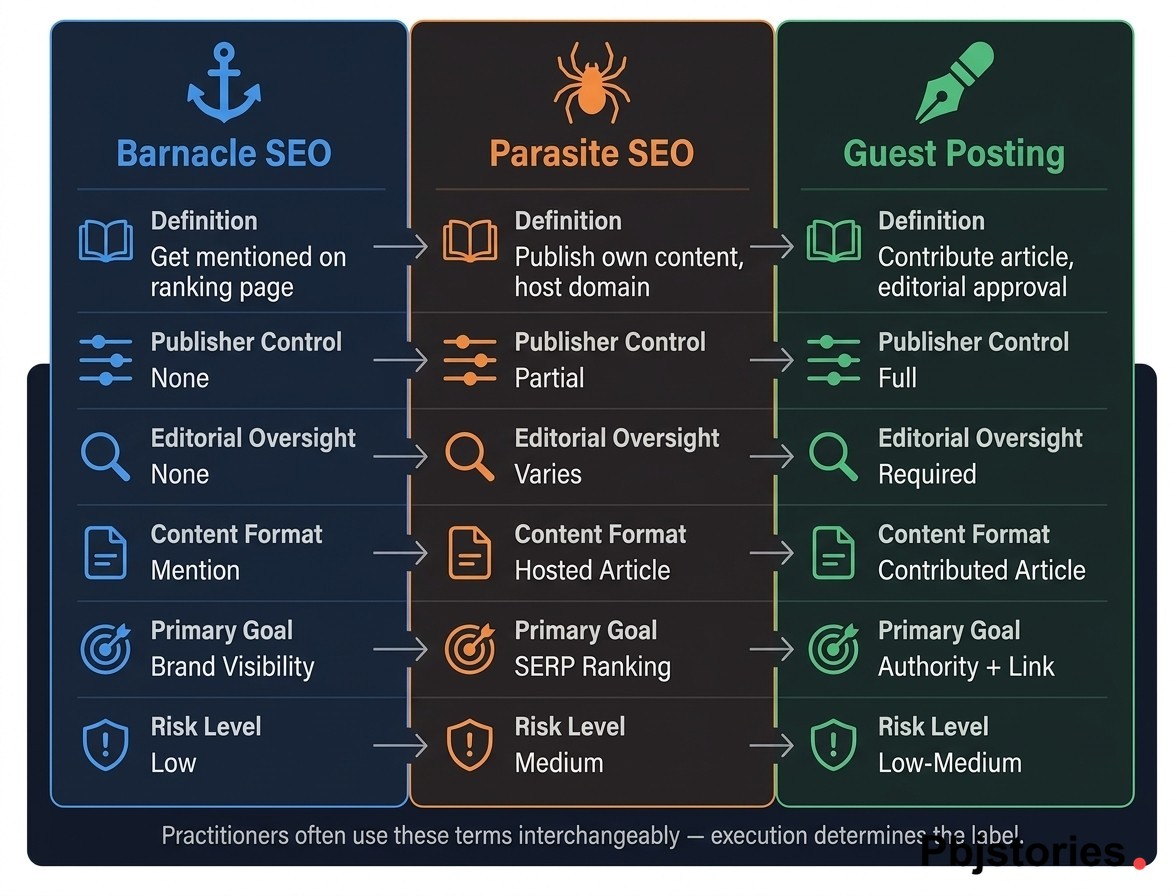
These three tactics share one goal, riding another domain's authority, but differ in execution and editorial control.
-
Barnacle SEO: attaching your brand to a page that already ranks, for example getting listed inside a "top 10 CRM tools" article on a trusted review site. You do not publish; you get mentioned.
-
Parasite SEO: publishing your own optimized content directly on a host domain (Medium, LinkedIn, Forbes, news outlets) to inherit its ranking power.
-
Guest posting: contributing a full article to an industry publication through an editorial approval process, typically with an author bio and contextual link back.
Guest posting is often the white-hat version of parasite SEO, because editorial review filters out thin or purely commercial content. The line blurs further with paid sponsored posts and news distribution, where the host approves the piece but the publisher drives the angle.
Practitioners use these labels inconsistently. One SEO's "barnacle strategy" is another's "parasite play," which causes confusion in job interviews, client pitches, and agency proposals. Before debating tactics, define whether the conversation is about mentions on ranking pages, hosted publishing, or editorial contributions. The mechanics, risks, and KPIs change with each.
Types of Parasite SEO: Black Hat, Grey Hat, and White Hat
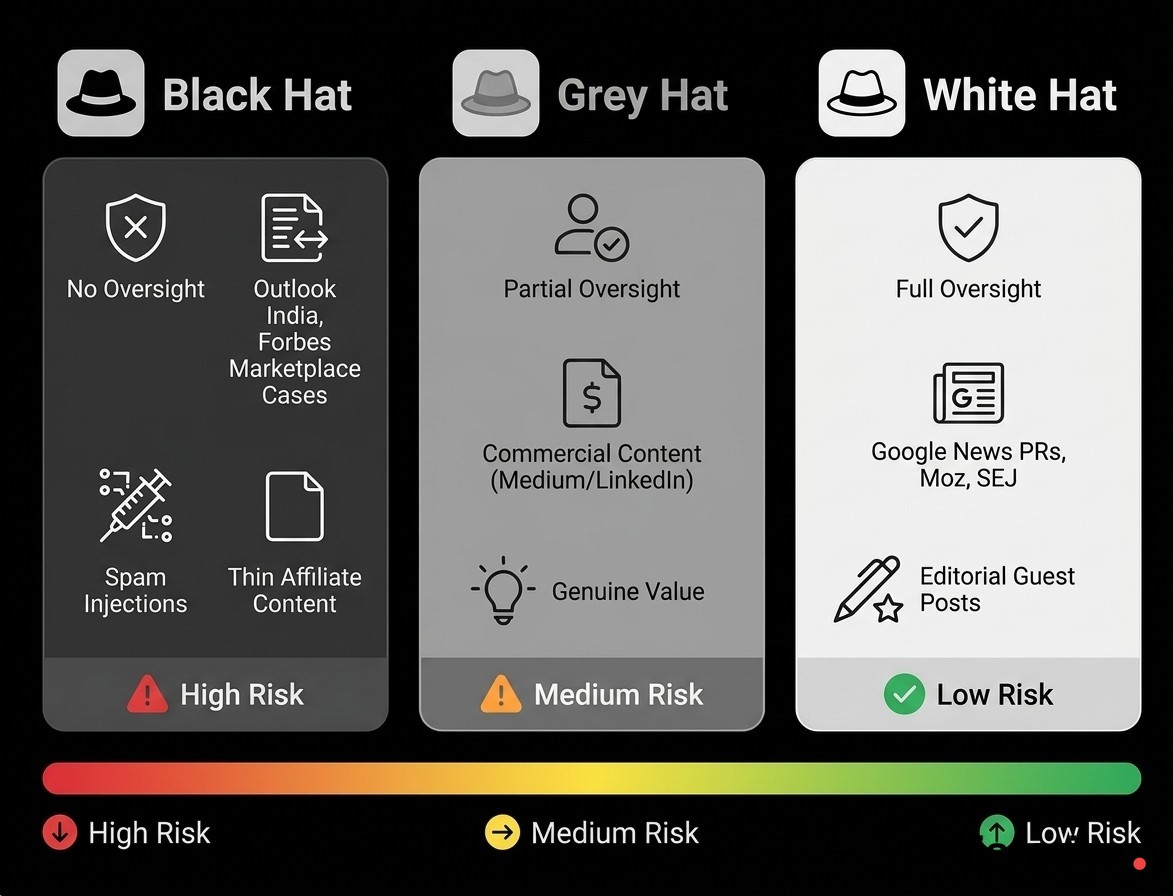
Parasite SEO sits on an ethical spectrum, and the tactic itself is neutral. What determines the hat color is execution: content quality, editorial oversight, and the intent behind the placement.
Black hat campaigns exploit host authority with thin affiliate content, as seen in the Outlook India and Forbes Marketplace cases. Grey hat sits in the middle: commercial content with genuine value on platforms like Medium or LinkedIn.
White hat covers editorial guest posts on publications such as Moz or Search Engine Journal, and newsworthy press releases distributed to Google News outlets. Each approach carries a different risk profile under Google's current policies.
Black Hat Parasite SEO: Spam Content on News Sites
The clearest example is the Outlook India case, where the publication rented out subfolders to affiliate marketers targeting queries like "best free movie streaming sites," "best CBD gummies," and similar high-CPC terms. The content had no editorial relationship to the newsroom; it simply borrowed the outlook.com domain authority to rank. A similar pattern shows up in the essay-writing niche: a Junia breakdown of parasite SEO documents an agency ranking for "top essay writing service" (KD 87) by placing a sponsored post on washingtoncitypaper.com, a DR 80 host.
Forbes Marketplace, CNN Underscored, and USA Today Reviews came under scrutiny for comparable arrangements, where third-party teams operated coupon, review, or affiliate sections under the publisher's masthead. Wall Street Journal reporting on Forbes Marketplace accelerated public awareness of the practice.
The pattern is consistent: a trusted news domain licenses a subfolder or subdomain, an affiliate operator fills it with commercial content aimed at transactional SERPs, and both sides split revenue. Quality and editorial oversight collapse because ranking power, not journalism, is the product.
Google's March 2024 Site Reputation Abuse policy targeted exactly this setup. Rented subfolder schemes became the riskiest form of parasite SEO, with manual actions wiping entire sections from search visibility. According to BrandWell's summary of the update, SEMrush data tied to the rollout showed roughly 65% of identified low-value parasite pages were deindexed or dropped by more than 50 positions, with UGC platforms hit hardest.
Grey Hat and White Hat Parasite SEO
Grey hat parasite SEO sits in the middle: content with commercial intent, but written to actually help the reader. A typical case is a keyword-targeted review or comparison article on Medium or LinkedIn, optimized for a transactional query, with affiliate links embedded naturally. The content has value, yet the primary motive is ranking and revenue, which is why platforms occasionally suspend accounts that push this line too far.
White hat parasite SEO is editorially gated. Contributing a researched guest post to Moz, Search Engine Journal, or Ahrefs means passing a human editor who enforces originality, citation standards, and topical fit. The link back to your site is earned, not rented.
Press releases distributed to Google News outlets and Yahoo Finance fit the white hat category when the announcement is genuinely newsworthy: a funding round, product launch, data study, or hire. Newsrooms and syndication partners reject boilerplate promotional copy, so editorial oversight filters out the spam. Austin Heaton makes a parallel case that PR and earned media drive SEO value more reliably than rented links, because LLM citation patterns now favor coverage from credible publishers over manipulated link profiles.
White hat parasite SEO remains safe because it aligns with Google's quality guidelines on two fronts: real value for readers and independent editorial judgment on the host side. Site reputation abuse enforcement rarely touches these placements.
Best Platforms for Parasite SEO: Sites List with Pros and Cons
Host relevance often beats raw domain authority. A Domain Rating 70 industry publication covering your exact topic will usually outrank a piece on a generic DR 95 site, because Google weighs topical fit alongside trust signals.
The Reddit SEO community consensus reflects this hierarchy: trusted relevant niche site > Medium > LinkedIn for ranking effectiveness.
Below is a breakdown of the main platforms practitioners use, with indexing speed, content control, and commercial tolerance for each.
-
Medium indexes within days, offers full content control, and has moderate commercial tolerance. Best for informational keywords and review-style content. Accounts pushing affiliate links aggressively get suspended.
-
LinkedIn Articles index inconsistently but give full control, with low commercial tolerance. Works for B2B thought leadership and personal-brand queries, less reliable for transactional terms.
-
Reddit indexes fast with no content control (mods and users vote) and very low tolerance for promotion. Useful for brand mentions and long-tail queries where a thread naturally ranks.
-
Quora has moderate indexing speed, answer-level control, and low promotional tolerance. Fits question-based keywords and brand visibility.
-
YouTube indexes fast inside Google's video pack with full control and high commercial tolerance. Ideal for "how to," "review," and "vs." queries.
-
Google News partners and Yahoo Finance index in hours to days for trending topics, with no post-publish control and editorial gatekeeping. Best for announcements, product launches, and newsworthy angles.
-
Industry publications (Moz, Search Engine Journal, Ahrefs blog, niche trade sites) have slow approval, editorial oversight, and allow contextual backlinks. Highest ranking durability because topical relevance is maximized.
-
Press release distribution networks publish across 250-500+ news outlets in 24-72 hours, preserve editorial gatekeeping, and permit contextual links when news is genuine.
Press release distribution deserves its own category because it stacks news-domain authority across hundreds of hosts simultaneously. PW Skills' parasite SEO overview reports that AP-style releases distributed to relevant news sites can deliver 3–5× higher ROI for traffic from niche-relevant hosts, particularly on commercial-intent keywords. For a technical breakdown of how this builds link equity, see press release backlinks.
Does Parasite SEO Still Work in 2026?
Yes, parasite SEO still works in 2026, but the risk-reward balance has shifted sharply toward white hat and newsworthy approaches. Rented subfolder schemes are effectively dead, while editorial guest posts, legitimate news coverage, and press releases on trusted outlets continue to rank reliably.
The turning point was Google's Site Reputation Abuse policy, announced in March 2024 alongside the March 2024 Core Update. The policy directly targeted arrangements where third-party content exploits a host's reputation without editorial involvement, and manual actions began rolling out in May 2024.
Forbes Advisor, CNN Underscored, and USA Today's affiliate-coupon sections lost significant rankings during the 2024-2025 enforcement waves, because those sections met the classic definition of reputation abuse: commercial content bolted onto a newsroom's authority with minimal oversight.
Editorial placements behave differently. A guest post on Search Engine Journal, a press release published through Google News partners, or a genuine industry contribution still inherits host trust, because the content passes editorial review and serves readers.
The practical read: treat parasite SEO as a publishing strategy, not a loophole. Content that would survive on its own merits still ranks; content designed purely to exploit a domain no longer does.
Timeline of Google's Crackdown on Parasite SEO (2023-2026)
The enforcement pattern moved from algorithmic signals to explicit policy, then to manual actions, and finally to AI-focused expansion.
2023, Helpful Content Update: Google targeted thin, unhelpful content written primarily for search engines. Third-party affiliate pages published on news domains lost visibility because the system started evaluating content usefulness at the page level, not just host authority.
March 2024, Site Reputation Abuse policy: Google formally named the tactic of publishing low-value third-party content to exploit a host's reputation. The policy gave manual reviewers a clear rule to act on rented subfolders and coupon sections.
May 2024, manual actions: Major publishers running affiliate subfolders saw rankings collapse after human reviewers applied penalties. Forbes Advisor, CNN Underscored, and USA Today Reviews were widely reported casualties.
2025-2026, algorithmic enforcement: Google extended the policy algorithmically and began flagging AI-generated parasite content at scale. Surviving winners are editorial guest posts, genuine news coverage, and press releases tied to real announcements.
When Parasite SEO Makes Sense (And When It Doesn't)
Parasite SEO fits best when your own domain cannot compete on trust signals. New brands with zero Domain Rating, product launches that need visibility within days, and local businesses chasing transactional queries all benefit, because the host absorbs the waiting period a fresh site would otherwise spend earning crawl frequency and backlinks.
It also works well for keyword validation. Publishing on Medium or a news outlet reveals whether a term converts before you commit months of budget to your own content hub.
A common allocation, recommended in Digital Loop's parasite SEO guide, is 70% of effort on building core website authority and 30% on parasite campaigns for immediate traffic and channel diversification. The split treats parasite SEO as a speed and visibility play, not a substitute for the slower work to improve your own domain authority.
The tactic fits poorly in the opposite conditions. Established sites with strong authority risk cannibalization, and documented Medium experiments have shown that LinkedIn content sometimes outranks the author's own domain for the same query, splitting traffic instead of multiplying it.
YMYL niches such as health, legal, and finance are another poor fit, because trust in those topics compounds on the publisher over time and cannot be rented reliably. Topics that need frequent updates also suffer, since you lose editorial control the moment the host changes policy or deindexes the page.
How to Do Parasite SEO: A Practical Process
Effective parasite SEO follows four stages: keyword and SERP research, host platform selection, publishing optimized content, and ongoing monitoring. Each stage feeds the next, because a poorly chosen host wastes even the best content, and unmeasured results leave you guessing.
Finding High-Authority Sites and Evaluating Opportunities
Start with a SERP analysis for every target keyword. Search the query in Google and list the third-party domains that already rank on page one, because Google is openly telling you which hosts it trusts for that topic. Sites that appear repeatedly across related queries are the strongest candidates.
Next, pull each candidate into Ahrefs, Semrush, or a similar tool and check three metrics: Domain Rating, topical relevance (do they rank for semantically related keywords?), and organic traffic trend over the past 12 months. A declining traffic curve often signals the host is under algorithmic pressure, which means any content you publish there inherits that weakness.
Then evaluate editorial policy. Medium and LinkedIn allow self-publishing with minimal friction, while Moz, Search Engine Journal, and most news outlets require editorial approval and brand-fit review. Free publishing scales faster; editorial gatekeeping gives stronger ranking durability because Google treats vetted content as higher quality.
Finally, sanity-check the host's current Google standing by searching site:domain.com and reviewing whether cached pages still rank. For scaling to news domains without pitching editors individually, press release distribution handles placement across 250–500+ outlets while keeping journalistic review intact. The PBJ Stories workflow uses SERP-driven keyword targeting to match each release to outlets that already rank for related queries.
Publishing, Optimizing, and Monitoring Your Parasite Content
Optimization starts with entity stacking: mention the core topic alongside related entities, tools, and proper nouns that Google associates with the query. Place the target keyword in the H1, the URL slug where the platform allows it, the first 100 words, and one H2. Add two or three internal links to your money site with descriptive anchors, since those contextual backlinks are the main SEO asset you extract from the placement.
On news outlets, follow AP style and reinforce E-E-A-T: include a real author bio with credentials, cite primary sources, and add original data or quotes. Thin rewrites get flagged fast, whereas cited, newsworthy content survives algorithmic sweeps. For distributed releases, the mechanics of headline structure, boilerplate, and anchor selection are covered in this guide on optimizing a press release for SEO.
Monitoring is the hard part. You cannot access Google Search Console for a domain you do not own, so performance has to be reconstructed from proxies. Use a rank tracker like Ahrefs or Semrush to follow the parasite URL for its target keywords, and watch referral traffic in your own GA4 to measure downstream impact.
Track every contextual backlink the placement generates, then monitor your Domain Rating monthly. Rising DR alongside stable referral traffic confirms the placement is compounding. Flat metrics after 60 days usually mean the host lost trust for that topic.
For local campaigns the proxies shift. Per Brandon Leuangpaseuth's local parasite SEO guide, parasite placements on platforms like Reddit can capture 70% more impressions for "near me" searches, and branded citations from press release distribution can strengthen Google Business Profile and Knowledge Panel visibility, with some platforms tracking 3× backlink growth in the first 90 days.
Risks and Downsides of Parasite SEO
The biggest structural risk is loss of content control. The host platform can deindex, edit, or delete your article without notice, because you are a guest on their domain and their terms of service override your SEO roadmap.
Google penalties sit close behind. Site Reputation Abuse enforcement can wipe rankings overnight if the host gets flagged, and your placement disappears along with everything else in the affected section.
There is also a permanent analytics gap. You cannot connect Search Console to a third-party domain, so performance tracking relies on rank trackers, referral traffic in GA4, and backlink tools rather than direct query data.
Keyword cannibalization is a subtler threat. Parasite content can outrank pages on your own site for the same query, splitting traffic and diluting the authority you are trying to build on your money domain.
Account suspension risk applies on Medium, LinkedIn, Quora, and similar platforms when commercial intent becomes too aggressive. Affiliate-heavy posts, repeated outbound links, and thin content trigger automated and manual reviews.
Finally, reputation risk. Being publicly associated with spammy parasite tactics can damage trust with peers, partners, and prospects in your industry, which is why editorial guest posts and genuine press releases remain the safer long-term play.
Parasite SEO FAQ
Common questions about parasite SEO cover definitions, real examples, ranking timelines, and ethical boundaries. The answers below address what practitioners ask most often before committing to the tactic.
What Is a Real-World Example of Parasite SEO?
Three cases show the full ethical spectrum. Outlook India represents black hat: rented subfolders pushed affiliate content for queries like "best free movie streaming sites," exploiting a news domain with zero editorial oversight.
Medium affiliate reviews illustrate grey hat. Writers publish keyword-targeted comparison posts with affiliate links; the content helps readers, yet the primary motive is commercial ranking on a borrowed domain.
White hat appears in editorial guest posts on Moz or Search Engine Journal, and in genuine press releases distributed to Google News outlets, where newsworthiness and author vetting remain intact. The tactic is identical across all three cases. Execution, content quality, and editorial control determine the ethics.
Is Parasite SEO the Same as Guest Posting?
No. Guest posting is a subset of white hat parasite SEO, specifically the editorially approved contribution model on industry blogs like Moz, Ahrefs, or Search Engine Journal.
Parasite SEO covers a wider surface: free publishing platforms like Medium and LinkedIn, forums such as Reddit and Quora, video hosts like YouTube, and paid sponsored placements on news outlets. Some practitioners use "barnacle SEO" to describe the more ethical end of this spectrum, where the content genuinely helps readers and respects host guidelines. Every guest post is parasite SEO, but not every parasite placement qualifies as a guest post.
Can Parasite SEO Help a Brand-New Website?
Yes, and it is one of the strongest use cases. A brand-new site typically waits 6–12 months to rank for competitive queries because Google needs time to build crawl frequency, trust, and backlink signals. Parasite SEO shortcuts that delay by borrowing an established host's authority for immediate visibility.
The practical play is a hybrid approach. Use parasite placements for speed while your own domain accumulates long-term authority through original content and earned links.
Press releases on Google News outlets and editorial guest posts on industry blogs are the safer entry points, because both carry editorial oversight and produce contextual backlinks that feed your money site.
How Long Does It Take for Parasite SEO Content to Rank?
Timelines vary by host, but parasite content generally ranks far faster than new-domain content.
Medium and Reddit posts typically surface within days to a few weeks, because both platforms are crawled aggressively and carry strong topical trust. LinkedIn is inconsistent: some articles index within hours, others never appear in Google at all, due to the platform's uneven crawl signals.
News outlets distributed through Google News can rank in hours for trending or newsworthy topics, especially when the release follows AP style and targets low-competition queries. Durability is the harder question. Rankings hold as long as the host keeps its authority and Google does not target the domain in a later update.
Is Parasite SEO Considered Black Hat?
No, parasite SEO is not inherently black hat. It is a tactic that lives on an ethical spectrum, and execution decides where a specific campaign lands.
It becomes black hat when low-value spam content piggybacks on a host purely to exploit its authority, as with rented subfolders and thin affiliate pages. It stays white hat when the content creates genuine value on a relevant platform, such as an editorial guest post or a newsworthy announcement.
Google's stated concern is site reputation abuse, not all third-party publishing. Editorial guest contributions, legitimate news coverage, and press release SEO on trusted outlets remain compliant because the host applies oversight and the content serves readers, not just rankings.
Parasite SEO works best when the host outlet carries real editorial weight and the content is engineered for ranking, not just publication. Pair strong keyword research with contextual backlinks and entity stacking inside each release, start with a single optimized announcement, measure the lift, and scale from there.
Get PR tips delivered weekly
Join 3,200+ PR professionals getting actionable tips on press release writing, distribution, and media outreach.
No spam. Unsubscribe anytime.